









The country’s wood industries have been suffering from a shortage of raw materials for many years now. This has been caused mainly by decades of indiscriminate logging which have systematically reduced the areas of our natural growth forests.
To help beef up the country’s wood supply, the Department of Science and Technology’s Forest Products Research and Development Institute (DOST-FPRDI) started a research program for studying different kinds of tree plantation species (TPS).

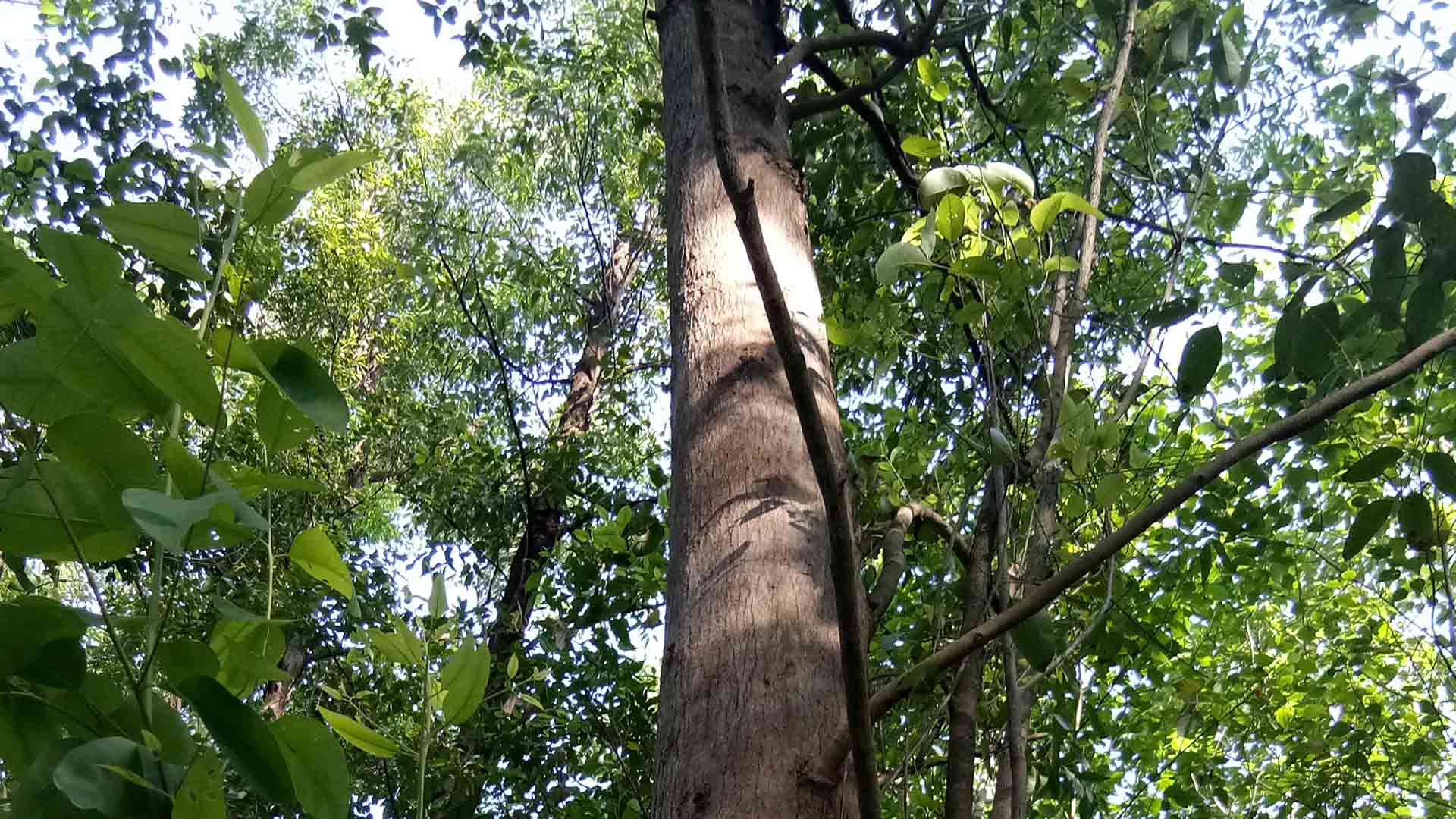
Large-fruited red mahogany (top) and river red gum (bottom) are two of the most common ITPS planted in the country.
According to the Institute’s Dr. Dwight A. Eusebio, “TPS are fast-growing trees that are either native or introduced to a particular place, and grown in tree farms at least half a hectare in size.” Tree farms or plantations became popular in the Philippines starting in the 1980s, and especially in the last 10 years after the government finally imposed a logging moratorium on all natural growth forests.
TPS are grown mainly as substitutes to traditional species, and the ones commonly found in local tree farms include yemane (Gmelina arborea Roxb.); malapapaya [Polyscias nodosa (Blume) Seeman]; mangium (Acacia mangium Willd.); river red gum (Eucalyptus camaldulensis Dehnh); falcata [Falcataria moluccana(Miq.) Barneby & J.W. Grimes]; large-fruited red mahogany (Eucalyptus pellita F.v. Muell); large-leaf mahogany (Sweitenia macrophylla King) and bagras (Eucalyptus deglupta Blume).
“DOST-FPRDI studies TPS not only because they make good construction and housing materials, but also because they have a host of other industrial uses,” says Eusebio.
They can be used for pulp and paper, veneer and plywood, composite boards (particleboard, fiberboard, etc.), power and telecommunication poles, and packaging materials (pallets, fruit boxes, crates, etc.).
They can also be tapped for builders woodworks (doors, windows, door and window jambs, moldings, balusters, stairs and railings, shingles and shakes, parquets, etc.), fancy woodwork, wooden shoes, pencil slats, ice cream spoons, chopsticks, matchsticks, toothpicks and many more.
Explains Eusebio, “The uses of wood, of course, are dependent on its inherent qualities. For example – Is the wood light or heavy? Durable or not? Easy or difficult to dry, machine or finish? These are some things we need to know to determine its applications.
“Thus, for three decades now, DOST-FPRDI researchers from diverse fields have been looking into the properties of 15 TPS (mostly eucalypts and acacias) – their anatomical, chemical, physical and mechanical, sawmilling, machining, finishing, drying characteristics, natural durability and treatability.”
All the information generated has consequently been published in handbooks and bulletins. “In the coming years, we are committed to conduct research and development studies on other TPS that have not yet been tapped by our client-industries,” adds Eusebio.
According to the Forest Management Bureau (FMB), the wood sector needs about 6 million cubic meters of raw materials a year. This is way beyond the 1 million cubic meters produced, 75% of which is supplied by tree plantations.


