



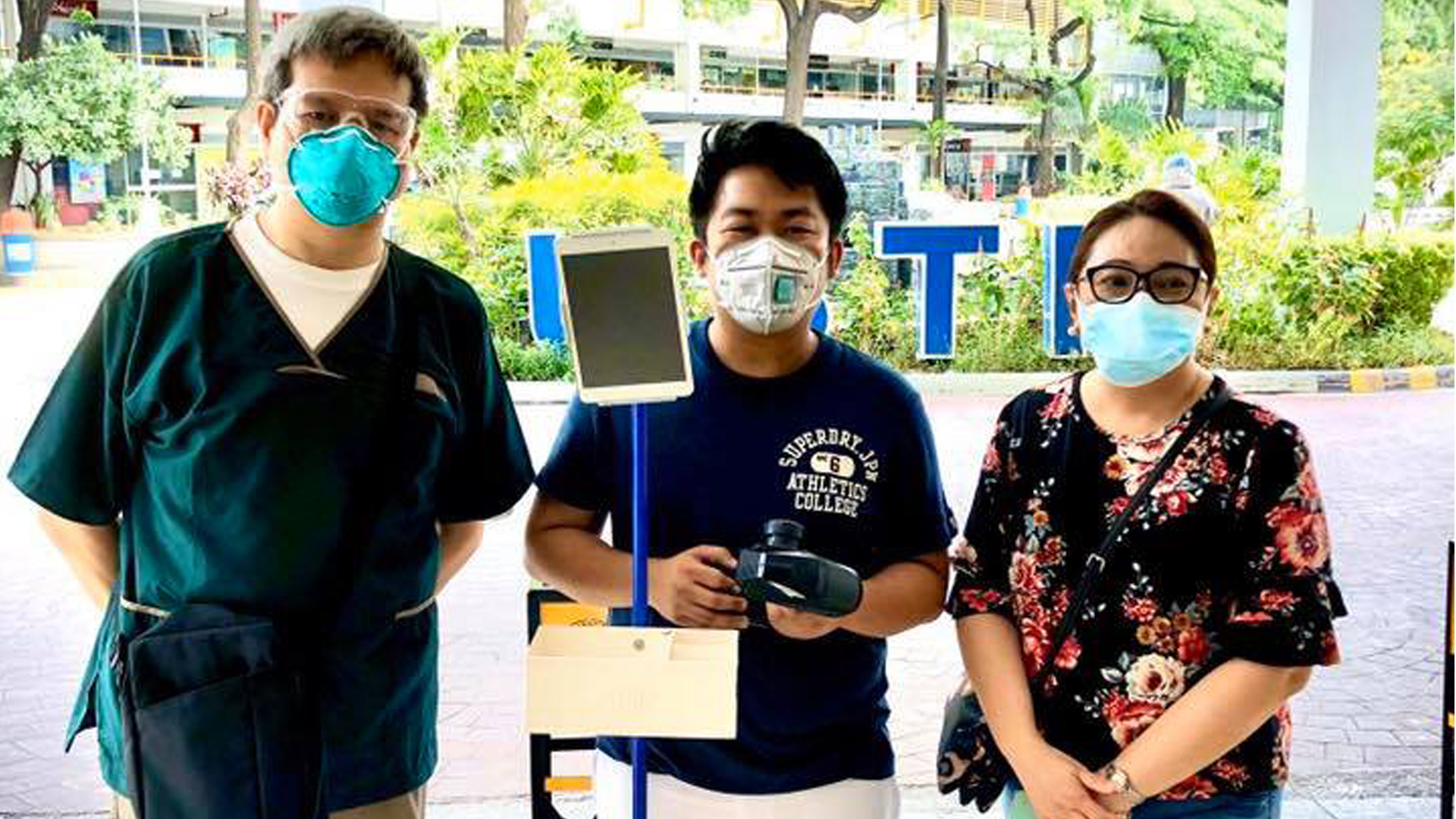






An engineer from the University of Santo Tomas (UST) invented a service assistant robot designed to significantly reduce medical workers’ exposure to the novel coronavirus.
Spearheaded by UST Assistant Professor and Engineer Anthony James Bautista, a remote-controlled, wheeled robot named as Logistic Indoor Service Assistant (LISA) was designed to allow communication between a healthcare staff and a COVID-19 patient through internet-based communication platforms (Zoom, Viber and Facetime). The tablet is covered with plastic and is disinfected afterwards since it will be directly used by patients.
In addition, the telepresence robot has a compartment box that allows delivery of medication needed by the patient. Operated by medical frontliners with the use of a remote control, the robot is also capable of moving in different directions.
“Doctors will no longer have to have contact. Siguro mga two to five meters away dun sa patients,” the engineer said in an interview. Since physical contact has been minimized, the use of protective personal equipment (PPE) may also be conserved.
Bautista noted that his team was able to develop LISA in only 5 days. The challenge for them, however, was the lack of available components due to the Luzon-wide lockdown, thus leaving them to make use of what was readily available in his laboratory.
“During these challenging times ng lockdown, level one automation lang muna ang ma-de-deliver namin which is remote controlled. Pero in the future, once everything stabilizes, magpapasok kami ng two levels of advanced automation,” Bautista said.
In a statement, the UST Hospital’s Department of Medical Education and Research said they had deployed the LISA for a pilot run last April 9 at the UST Hospital. But despite receiving positive feedback from doctors, Bautista eyes to modify the robot to improve its performance. For instance, making the base of the robot four-wheeled for smoother navigation.
Currently, the Department of Science and Technology Philippine Council for Industry, Energy and Emerging Technology Research and Development (DOST – PCIEERD) expressed their support on the project and has requested for 4 units of LISA robots. With this, Bautista is looking forward to working on the new robots starting April 20. A unit costs around P12,000.
Bautista is also working with Thomasian Cardiologist Dr. Rodrigo Santos of the Pasig Doctor’s Medical Center, who serves as a consultant of the project.
“We are thinking of this to be a long-term project not only in this situation but also in the future,” he ended.

