



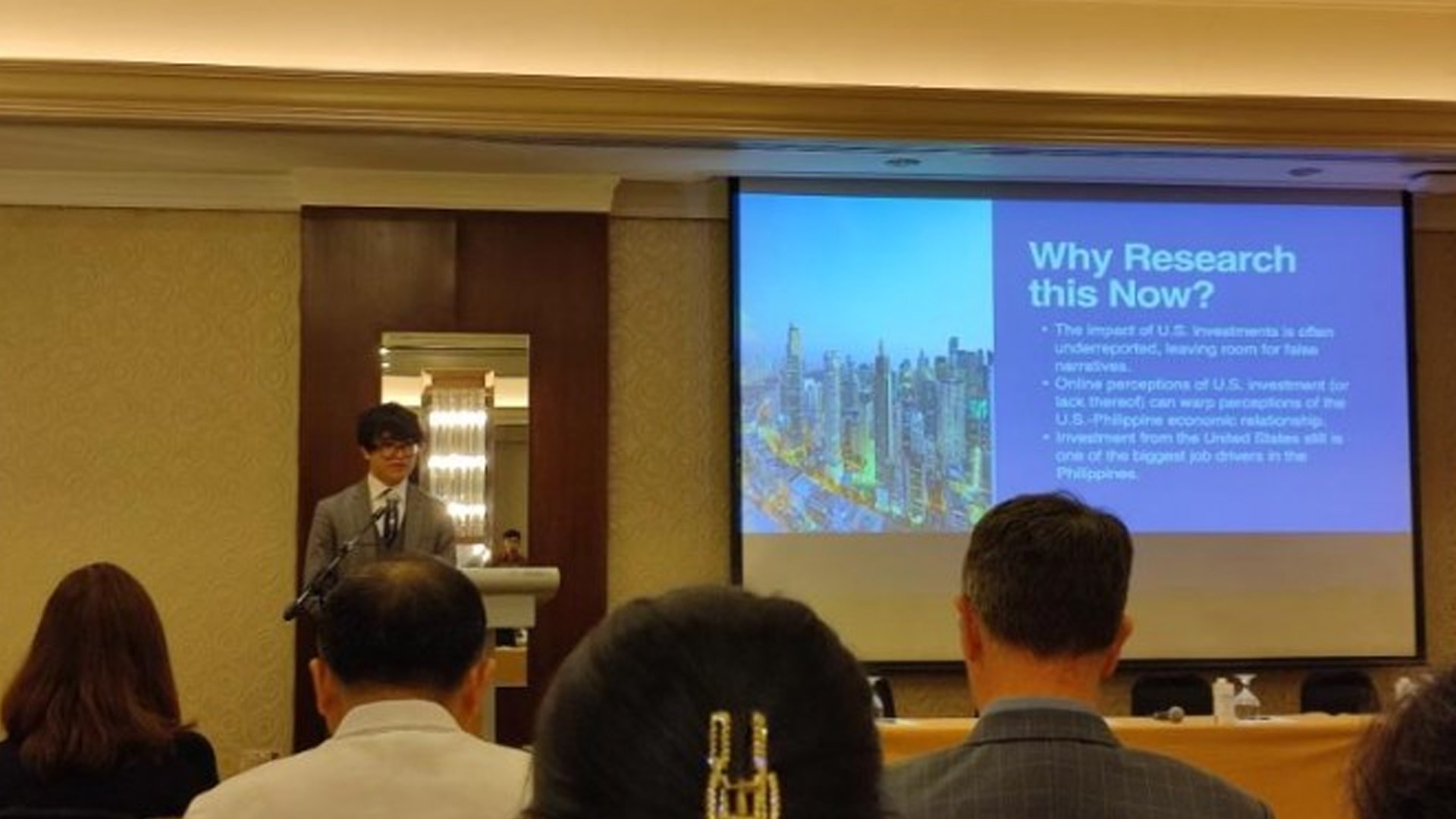







The Center for Strategic and International Studies (CSIS) on Monday cited various strategies to further boost economic ties between the Philippines and the United States.
In a presentation at the Edsa Shangri-La Hotel in Mandaluyong City, the American think tank underscored the need to address current challenges in transparency, consistency of US-Philippines foreign investments data, lack of or limited assessment on the impacts of US investments, minimal visits from US business leaders, investment concentration or oversaturation in Luzon, and bureaucratic red tape, among others.
CSIS Southeast Asia Program research associate Japhet Quitzon said there is a need to develop a comprehensive database on the US investments resulting in employment advantages in the country.
“The actual impact on Filipinos on the ground here in the Philippines is underreported. And that leaves online false narratives proliferating,” he said.
Based on the study, the quantitative and qualitative effects of the Philippines-US economic ties are not “well-documented,” making the long-standing partnership susceptible to disinformation or mischaracterization of the US to stir public opinion.
“Without any intervention in this phase, the United States can be portrayed as uninterested or unable to fulfill its economic responsibilities and partnerships with the Philippines,” Quitzon said.
Among the competitive areas of investments in the Philippines include agriculture, renewable energy, Information Technology- Business Process Management (IT-BPM), and semiconductors and electronics, the study showed.
Besides the creation of a comprehensive database, the CSIS also recommended the collation of both US and Philippine data in a single platform with a common unit of measure; the Philippine Economic Zone Authority (PEZA) and the Philippine Statistics Authority (PSA)’s data aggregation of incoming investments; as well as the expansion of online presence to counter fake news.
Likewise, the CSIS recommended boosting and sustaining person-to-person exchanges regardless of the administration in the US government, and further expanding investments in areas outside Metro Manila, including Cebu and Davao.
To date, the key economic developments between the Philippines and the US include the Indo-Pacific Framework, the Luzon Economic Corridor, the 123 Agreement, the Development Finance Corporation, the Presidential Trade and Investment Mission, and the Enhanced Defense Cooperation Agreement (EDCA).
The US has invested around USD3.6 billion in the Philippines from 2013 to 2024, ranking fifth among the country’s foreign direct investments (FDI).
In terms of trade, the PH-US exchange of goods and services was pegged at USD36.1 billion in 2022 alone, with USD12.8 billion worth of exports to the Philippines and USD23.3 billion in imports to the US. (PNA)


