



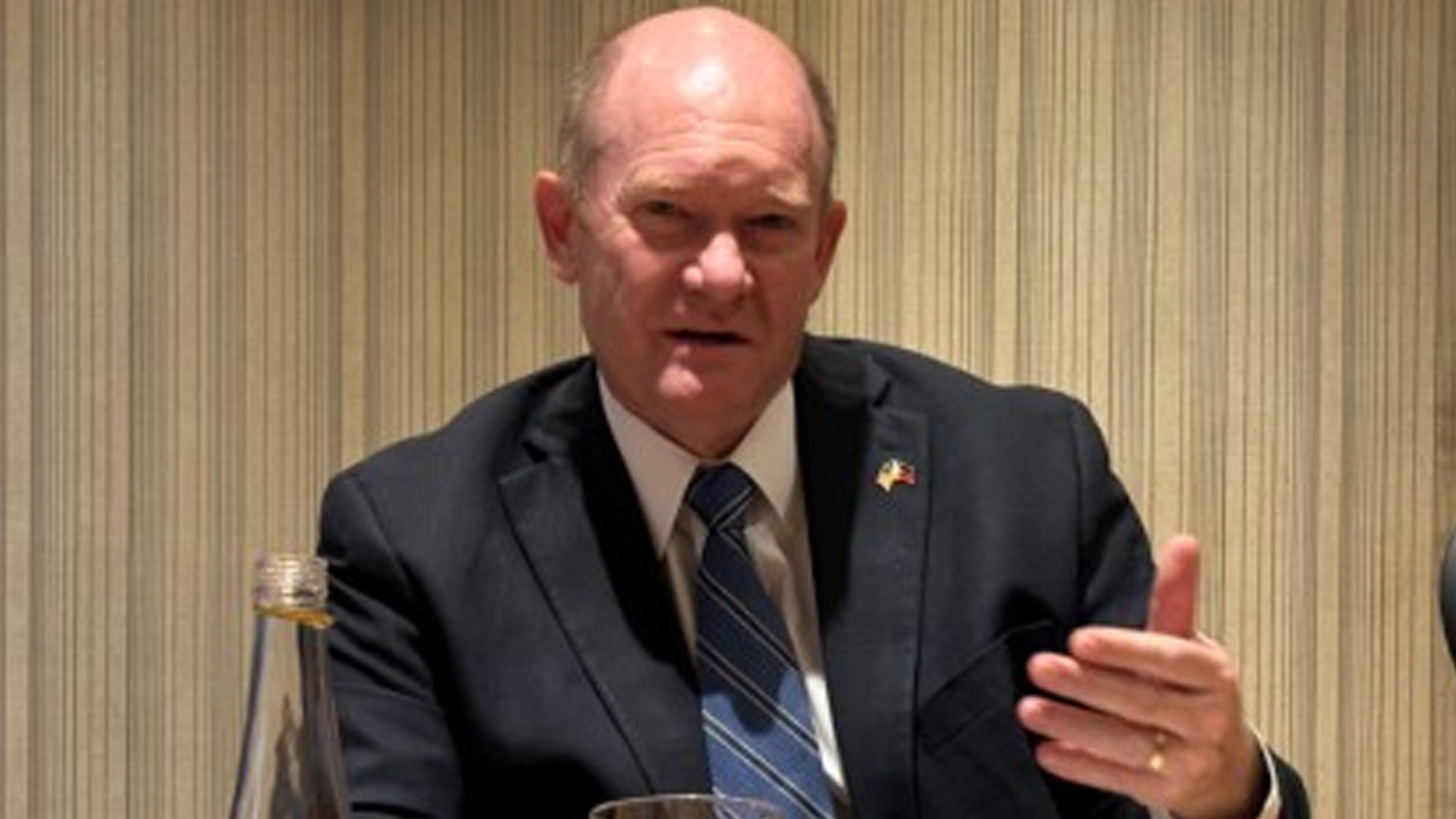






A United States senator on Friday said he wants a “significant” portion of the new USD2 billion Indo-Pacific foreign military financing (FMF) to be given to the Philippines, labeling the country as the “second core priority” next to Taiwan in the supplemental aid package approved last month.
Senator Christopher Coons, a member of the Foreign Relations and Appropriations Committees, shared the development, following a trip to Taiwan also this week as part of a US congressional delegation.
“Given that we just passed a very large supplemental appropriations bill, one of the key questions that will face me and others is exactly how we allocate the USD2 billion in FMF, much of which may go to Taiwan, but the Philippines would be the second core priority, ally or partner nation in the region,” he told the Philippine News Agency in an interview at Fairmont Makati.
He said there is no identified amount as of yet for the allotment but his judgment is that “a significant portion” must go to the Philippines.
The future allocation is expected to augment the USD40 million in annual FMF that the Philippines will receive from the US.
FMF is provided to a partner nation on either a grant or direct loan basis to fund the purchase of American weapons, equipment and defense training.
Coons acknowledged the “significant challenges to Filipino sovereignty in the West Philippine Sea” and Manila’s “shift in priorities” from ongoing land-based counterterrorism to maritime situational awareness.
The US legislator said talks are also underway between the two nations’ defense and national security agencies “just to make sure that there’s an understanding of what sorts of systems, on what timeline” and how the financing would contribute to the Armed Forces of the Philippines’ modernization.
“We have some challenges in terms of actually delivering in a timely way new systems because there’s so many other challenges or conflicts around the world,” he said.
“I think there is a conversation about how can we both appropriate but actually deliver on a meaningful timeframe solutions to challenges that the Philippine leadership is identifying,” he added.
The US, a treaty ally of the Philippines, has been vocal in its opposition to China’s aggressive actions in the West Philippine Sea, including its repeated use of water cannons against Filipino civilian vessels that deliver provisions to Filipino troops manning the grounded BRP Sierra Madre in the Ayungin Shoal or Second Thomas Shoal.
“You may have picked up that our politics are somewhat divided, we have difficulty agreeing on many things in the current environment in the US Senate, but this is something that is broadly agreed on a bipartisan basis in the Senate and the House — that there is widespread concern about the increased level of aggressiveness by the PRC (People’s Republic of China) in how they have responded to fisherfolk just simply trying to continue to access historic locations that are within the Philippine exclusive economic zone,” Coons said.
“And there’s a whole series of incidents that have impacted the sovereignty and the rights of Vietnamese, Filipino, Malaysian, and Indonesian and other partners. So, I think this is something that senators, broadly, are quite concerned about,” he added.
Strongest bipartisan support
Coons was among the legislators who voted for the passage of a USD95 billion US aid package for Ukraine, Israel, Taiwan and other Indo-Pacific partners.
The measure, which combined four bills approved by the US House of Representative on April 20, was signed into law by President Joe Biden on April 24.
It allots more than USD60 billion for Ukraine, USD26 billion for Israel and humanitarian aid for Gaza and other populations in conflict zones, and about USD8 billion for Taiwan and the Indo-Pacific.
A significant line of the USD8 billion allocation is for a USD2 billion in FMF to be made available until Sept. 30, 2025, “for assistance for the Indo-Pacific region and for related expenses.”
Coon said out of the four bills, the Indo-Pacific appropriation received the “strongest bipartisan support.” (PNA)


