










Robots have been around for years, working alongside human in ways never imagined before. Robots makes human lives easier as they serve as tools that compliment how humans live, work and play. They are the perfect “assistants” to people because they help in simple everyday tasks.
In modern workplaces, there is this term called RPA technology, a term that is gaining popularity. For IT professionals RPA doesn’t need any further explanations. But to others there is still a bit of a question on what it is.
Robotic Process Automation (RPA) technology is a “robot” that emulates and integrates the actions of a human interacting within digital systems to execute a business process. RPA works just like a “virtual assistant”. Using this technology can help businesses configure software or “robots” to capture and interpret applications for processing a transaction, manipulating data, triggering response, and communicating with other digital systems to imitate the way people work, without disrupting business.
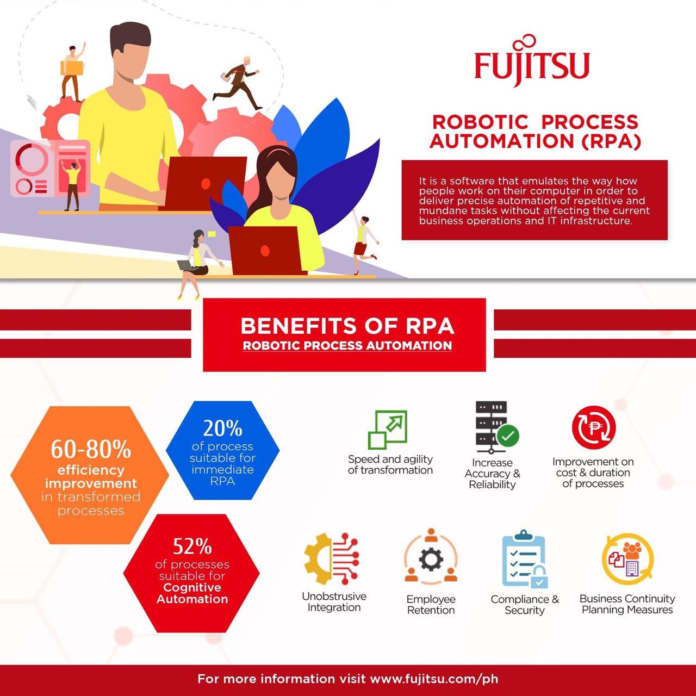
RPA is not yet a “deep learning” robot like the Artificial Intelligence (AI), that solves global problems with automated algorithms, but you can use it to automate processes. RPA is helpful in increasing efficiency, cutting cost, accelerating speed, and achieving compliance within a workplace.
But other than those helpful benefits that RPA can bring to an office, here are the other features of RPA’s application, as listed by Fujitsu Philippines, Inc., one of the country’s leading Information and Communications Technology (ICT) system integrators.
Fujitsu’s RPA offers a faster and error free order processing. This means that with RPA, the manual processing of orders that leaves businesses open to errors and delays can be avoided. RPA can help streamline the process as it automatically checks prices, verify it against sales orders, and post them directly to the company’s enterprise resource planning (ERP) or any back-office applications.
RPA can also provide a stress-free financial closing and a remote workflow automation. RPA can help reduce error risks when it comes to opening hundreds of excel files and manually gathering data for financial closing. Fujitsu’s RPA can also be commanded to execute tasks, anytime and anywhere with just an email or a portal. It also reduces the need for laptops with higher specs and reduces the consumption of electricity in a workplace.
Fujitsu Philippines, with its local knowledge that comes from its nearly five decades of operations in the country and with its rich experiences and best practices in executing pilot projects has been helping local organizations across various industries in automating their business processes through the RPA technology.


