



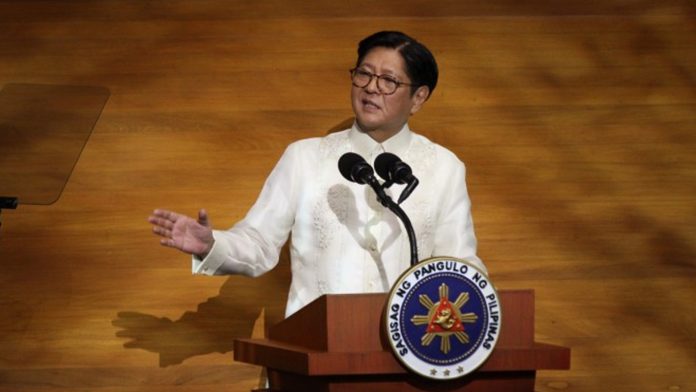






President Ferdinand R. Marcos Jr. has acknowledged that much work remains to be done to turn his administration’s commitments and aspirations into reality.
In his latest vlog released on Saturday, Marcos said his fifth State of the Nation Address (SONA) on July 27 was more than just a speech, with the government needing to carry out the programs and initiatives for Filipinos.
“Alam ko na ang SONA ay higit pa sa isang talumpati. Marami pang trabaho ang kailangang gawin para maisabuhay ang lahat ng ating tinatalakay at minimithi bilang isang bayan (I know that the SONA is more than a speech. There is still much work that needs to be done to bring to life everything we discussed and aspire for as a nation),” Marcos said.
Marcos shared details about the lengthy process of preparing his speech, saying the work started several weeks before the address.
He noted that his team conducted research on various subject matters, including statistics, developments and government initiatives that would be continued.
He added that they also worked on the flow of the speech, determining which topics should be discussed first, which should follow and what should be placed in the middle.
Marcos said he personally worked on the language and made changes to make the speech more appropriate for oral delivery.
“We fine-tuned it so that alam niyo po iba ang ang pagsulat para sa mga babasahin. Iba ‘yung pagsulat para sa pagsasalita (so you’d know that writing for people to read is different from writing for people to hear),” he said, explaining that his penultimate SONA had to be crafted “for rhetoric rather than for reading.”
He revealed that he continued making revisions until the last minute and even made some adjustments while delivering the speech.
“Kaya ‘pag basta’t may naisip ako na mas maganda ang pwedeng pagkasabi, eh ‘yun ang aking ginagawa (If I thought of a better way to say something, that’s what I did),” Marcos said.
Marcos said the speech went through several stages of drafting and editing before it was finalized. His team worked on different portions before reviewing the entire address.
The draft had to be shortened because it was initially too long.
“Marami kaming nailagay na kailangan na hindi namin na maisama dahil masyado ng mahaba (There were many things we included in the draft that we ultimately had to leave out because it was already too long),” Marcos said, adding that some of the issues excluded could be discussed in his last SONA.
On the eve of the SONA, a Sunday, Marcos practiced the speech, timing its delivery and rehearsing on a podium with a microphone.
On SONA day, he devoted his time for the final rehearsal and familiarized himself with its contents without exhausting his voice.
Beyond the preparation, Marcos emphasized the importance of following through on the issues raised by Filipinos.
The President said the government has programs aimed at addressing hunger, including assistance to local government units to distribute rice to families in need, as well as feeding programs for children in schools.
He also cited the government’s Yaman ng Kalusugan Program (YAKAP) health program, which provides medical consultations and medicines to students, parents and teachers.
He noted that for dialysis patients, the Philippine Health Insurance Corp.’s (PhilHealth) support and assistance for medicines had been increased, while government interventions for cancer, human immunodeficiency virus/acquired immunodeficiency syndrome (HIV/AIDS), and mental health concerns have also been expanded.
Marcos highlighted the government’s Zero Balance Billing policy in Department of Health-run hospitals and the removal of value-added tax on certain medicines.
“Lahat iyan ay pinarami natin at ito’y tulong para naman mas maging maginhawa ang buhay ng ating mga kababayan at makatulong tayo sa kanilang kalusugan (These are all efforts to make life more comfortable for our fellow Filipinos and to help with their health),” he said.
Marcos said the government would continue to listen to citizens and determine what more could be done to address their concerns.
“Dito sa maraming iba’t ibang sulat na natanggap natin, lahat nang sumulat po sa akin ay asahan ninyo bata man o matanda ay babasahin ko lahat ito (To everyone who has written to me, whether you are young or old, rest assured that I will read all of them),” he said.
“Titiyakin natin na kung meron pa tayong maaring gawin matugunan ang mga inyong binabanggit na problema ay asahan ninyo gagawin naman ng inyong pamahalaan ito (We will make sure that if there is anything more we can do to address the problems you have raised, your government will do so).” (PNA)


