



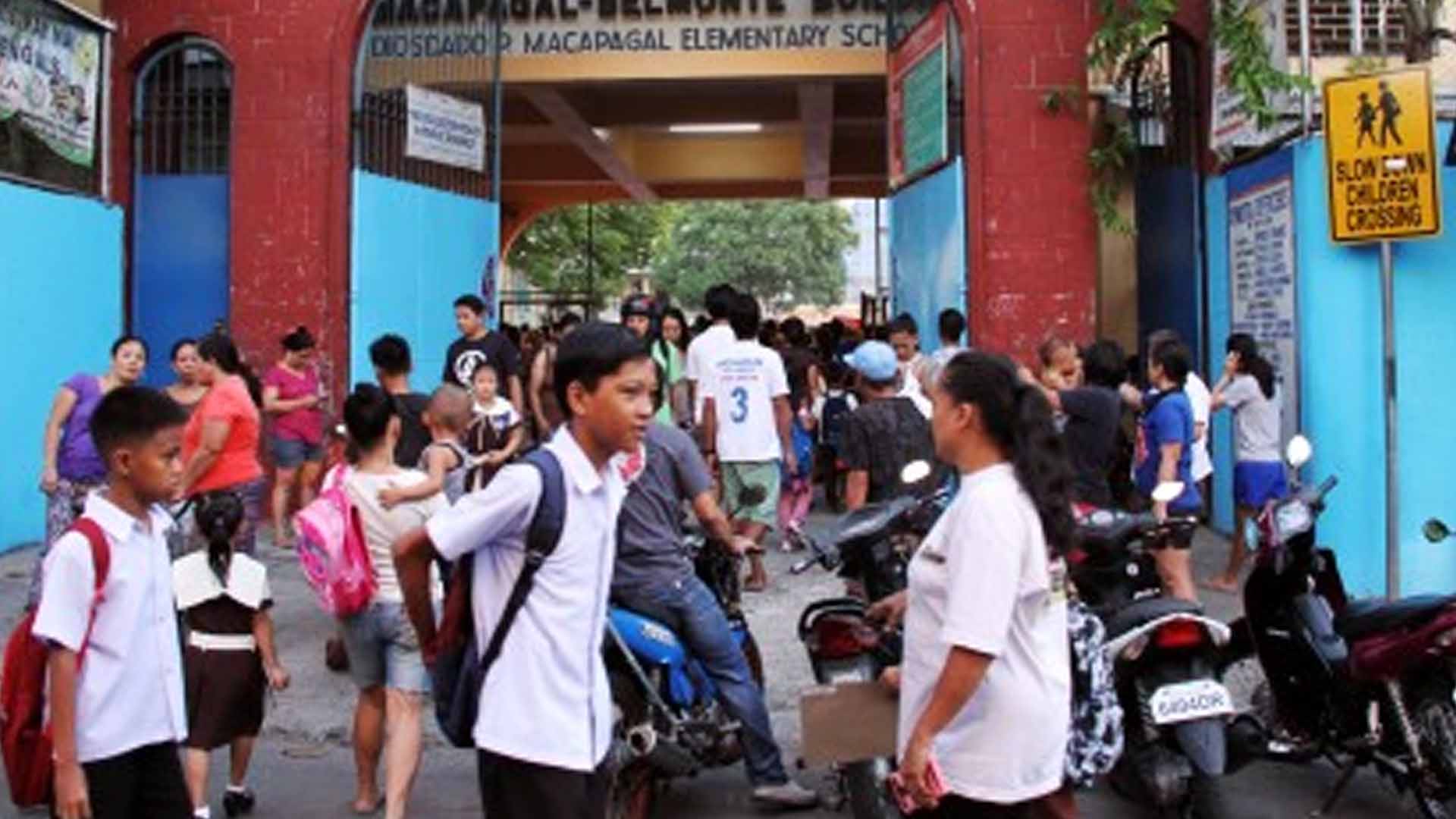






Classes for grade school students will not begin in June due to the prevailing coronavirus disease (Covid-19) health crisis in the country, Malacañang said on Wednesday.
Presidential Spokesperson Harry Roque made this clarification amid the intention of some private schools to start classes in June by implementing a “multi-modal approach” which allows combination of both face-to-face and online classes.
Roque reiterated that only Higher Education Institutions (HEIs) may resume operations on a skeletal workforce in areas not under the enhanced community quarantine (ECQ) on May 4.
“I can announce that there will be no classes this June for grade school, but for higher education institutes, they can have skeletal forces but only to finish the academic year and only to consider alternative learning,” Roque said in a television interview.
The Inter-Agency Task Force for the Management of Emerging Infectious Diseases (IATF-EID) earlier recommended moving the next school opening to September, subject to the approval of the Department of Education (DepEd).
DepEd, which is eyeing the opening of classes in late August, is set to present its recommendations to the IATF-EID in May.
“I don’t think there’s much of a difference between the recommendation of the IATF and the law because we’re only talking of one week. I think that can be threshed out,” he said.
Although continuity of learning is important, Roque said “the primary consideration now is the health of the nation.”
Citing a study by the University of the Philippines, Roque said the youth “have the most contact with vulnerable populations including the elderly.”
“As far as epidemiology is concerned, the worst ‘carriers’ are actually young people,” he said.
Last April 23, President Rodrigo Duterte approved the IATF-EID’s recommendation to place Metro Manila, Central Luzon, Calabarzon, Pangasinan, Benguet, Albay, Catanduanes, Davao del Norte, Davao City, Oriental Mindoro, Occidental Mindoro, Antique, Iloilo, Cebu, and Cebu City under ECQ until May 15 since these are considered as high-risk areas.
The EITF-EID, however, recommended to revise the list of areas to be placed under ECQ, Roque announced on Tuesday.
The revised list includes Metro Manila; Central Luzon, except Aurora; Calabarzon; Pangasinan; Benguet; Baguio City; Iloilo; Cebu; Cebu City; and Davao City.
Roque said other areas will be placed under a less-stringent general community quarantine from May 1 to 15.
GCQ in low-risk areas may be lifted after May 15, in case there is no deterioration in their risk level.
The Philippines currently has 7, 958 confirmed cases of Covid-19, 530 deaths, and 975 recoveries. (PNA)


