



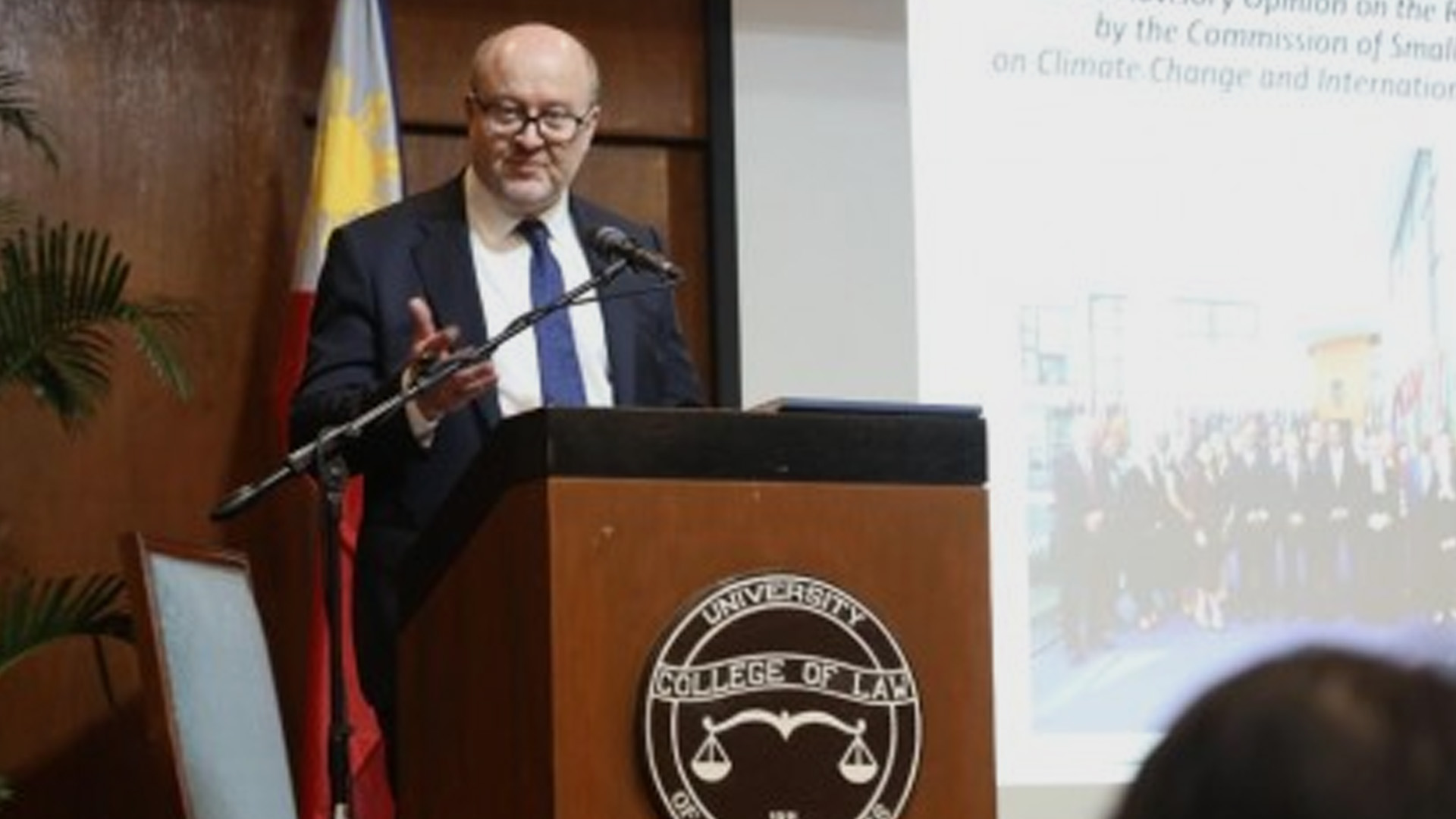







International Tribunal for the Law of the Sea (ITLOS) president Tomas Haukur Heidar has emphasized the importance of legal frameworks in driving climate action and ocean protection.
“Hopefully, this particular Advisory Opinion will improve cooperation between states—it’s a key in climate change because you will not deal with climate change unilaterally. You need to do it together,” Heidar said as quoted in a news release of the Commission on Climate Change (CCC) on Friday.
The ITLOS issued its Advisory Opinion on May 21, 2024, upon the request of the Commission of Small Island States on Climate Change and International Law in December 2022.
The CCC said Heidar, the first ITLOS president to visit the Philippines, delivered a series of high-level lectures at the University of the Philippines (UP), the Asian Institute of Management for the Office of the Solicitor General, and the Department of Foreign Affairs (DFA) during his recent visit to the country.
At the University of the Philippines, Heidar delivered a lecture titled “Intersections between the Law of the Sea and International Environmental Law: The Role of ITLOS in Climate Action.”
The CCC said Heidar’s lecture was an important step in the Philippines’ ongoing commitment to address climate change through international discussions on marine protection and climate governance.
It said the ITLOS president’s historic visit highlighted the need for multistakeholder support for a rules-based ocean regime to resolve disputes, clarify sovereign commitments under international frameworks, and identify areas for cooperation towards a just, peaceful, climate-resilient future for all.
“This opinion emphasized the need for States to protect the oceans from climate-related threats such as sea level rise and ocean acidification. For the Philippines, with one of the world’s longest coastlines and thriving coral ecosystems within the Coral Triangle, these threats pose significant risks to marine biodiversity, fisheries, and coastal economies,” it added.
The CCC is committed to ensuring that the Philippines remains a key player in shaping global climate policy, particularly in advocating for the rights of vulnerable island states and coastal communities that are disproportionately impacted by climate change.
“The ITLOS opinion aligns with the Philippines’ National Adaptation Plan and defines our State’s promises under UNCLOS, the UNFCCC and its Paris Agreement, and other relevant international legal instruments,” said CCC Vice Chairperson and Executive Director, Secretary Robert E.A. Borje.
“As a responsible member of the international community, the Philippines relies on international law to clarify responsibilities and commitments to advance climate action, including on greenhouse gas emissions and marine pollution. This lecture is crucial for a better understanding of the nexus between UNCLOS and UNFCCC,” he added.
Heidar’s visit also serves as a reminder of the global responsibility to protect the planet’s oceans and ensure that international law supports climate resilience.
“The Philippines will continue to work with other states in contributing to the ongoing work premised on the interconnectedness of a healthy ocean, climate change, and the human rights of all. Guided by, among others, the landmark ITLOS Advisory Opinion, climate change is the greatest global governance challenge of our generation,” Department of Environment and Natural Resources Secretary Maria Antonia Yulo Loyzaga, for her part, said.
The CCC said it will continue to work closely with academic institutions, international bodies, and stakeholders to ensure the Philippines remains at the forefront of climate and ocean governance. (PNA)


