



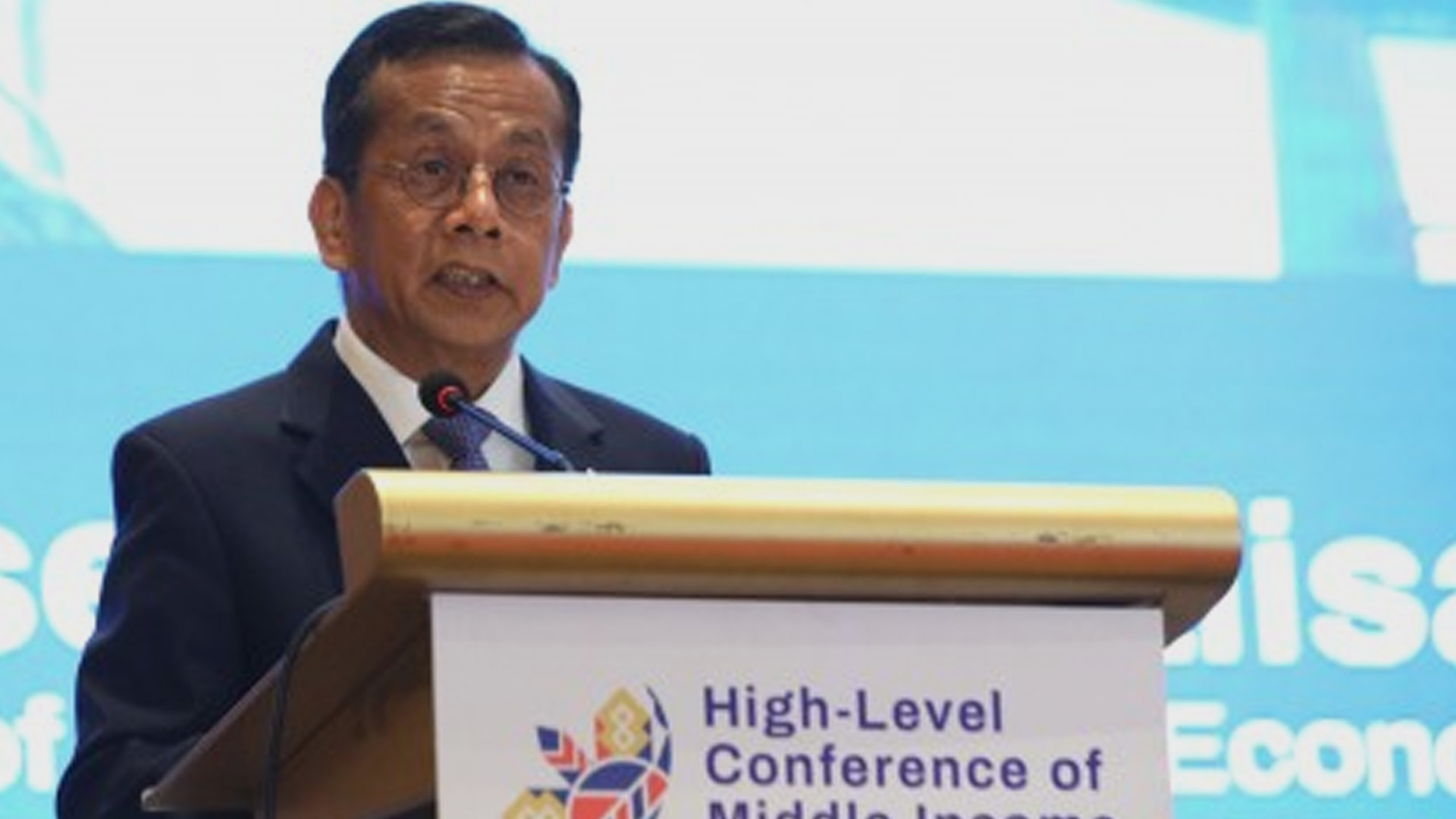







Addressing risks and reinforcing economic resilience remain the government’s top priorities to ensure that the country is on the path to sustainable development, Department of Economy, Planning, and Development Secretary Arsenio Balisacan said.
In his speech at the High-Level Conference of Middle-Income Countries in Makati City on Monday, Balisacan said that while the Philippines is one of the fastest-growing among emerging and middle-income economies, the government is aware of the uncertainties in the global economy.
“Barring major external shocks, and assuming a favorable global trade environment, we are well-positioned to achieve upper-middle-income status by 2026,” Balisacan said.
“Nonetheless, we remain acutely aware of the uncertainties that confront the global economy—ranging from systemic risks in economic institutions and technological disruption to environmental challenges,” he added.
To sustain and accelerate the country’s progress, Balisacan said the country must mainstream efficient green transitions, foster resilience, and harness innovation as new frontiers for growth.
“In the Philippines, we aim to realize these goals through targeted investments, strengthened national institutions, workforce upskilling and reskilling, climate and biodiversity resilience integration, and the revitalization of partnerships, particularly through South-South and technical cooperation,” he said.
Balisacan said the government must also ensure that development benefits reach all segments of society.
Last year, the Philippine economy grew by 5.7 percent.
The Development Budget Coordination Committee (DBCC) earlier set a 6 percent to 8 percent economic growth target for 2025 and 2026.
In a separate interview on Monday, DBCC Chair and Budget Secretary Amenah Pangandaman said that so far, there are no major revisions to the growth outlook this year despite the potential impact of higher US tariffs.
Pangandaman said that based on data, the impact of higher US tariffs on the Philippine economy is less than one percentx.
She is also hopeful that the first quarter of Philippine economic growth data, which will be released next week, will be better than expected. (PNA)


