



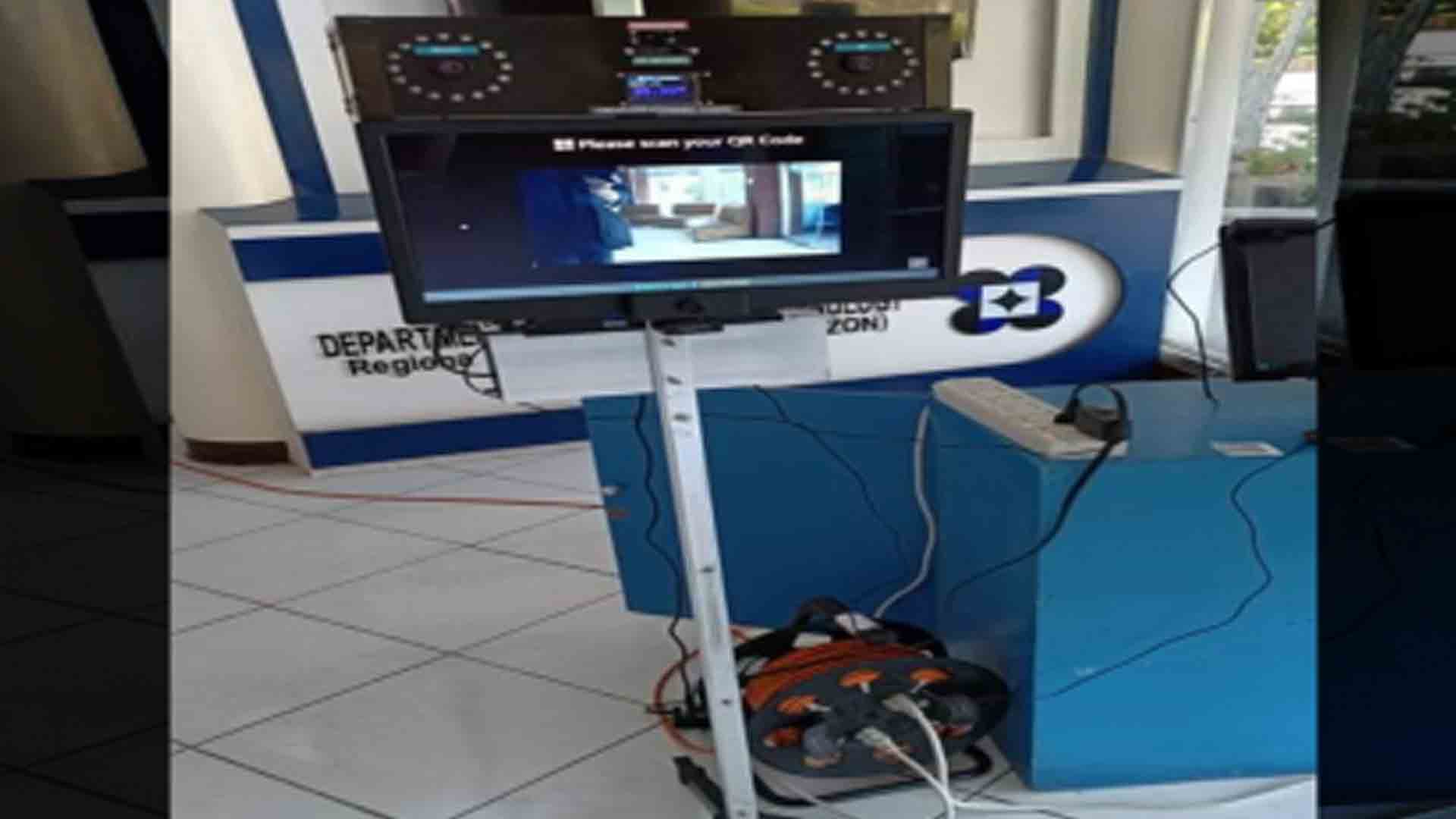







As minimizing contact has become a common practice during the pandemic, the staff of the Department of Science and Technology (DOST) 4A (Calabarzon) have developed and are pilot-testing a contactless attendance system (CAS) device.
In an interview with the Philippine News Agency (PNA) on Friday, DOST Secretary Fortunato de la Peña said they developed the CAS during their free time in the fourth quarter of last year to veer away from manual temperature screening and enable the employees to answer health screening questions without them touching a computer or any other device.
The device, excluding the monitor and CPU, only cost the office PHP7,000, de la Peña said.
Employees using the sensors-equipped CAS would only need to place a hand near the left sensor to select options displayed on the screen. The right sensor is used to confirm the selected option.
“The device uses an Arduino microcontroller and infrared and thermal sensors to get the employees’ temperature,” he said.
After getting the temperature and answering health check questions, employees would have to scan a quick response (QR) code on their mobile phones for them to time in.
The employees’ log in and log out are integrated into their in-house Human Resource Management Information System (MIS).
Those who conceptualized and developed the CAS were also from the MIS, de la Peña said. They are Glenn John Geronimo, Francisco Barquilla III, Ralph Anthony Magbiray, and John Julius Calibo.
The DOST-4A has been using the device since January 4.
“The regional office plans to deploy this technology (to) provincial science and technology centers in Calabarzon after the pilot-testing,” he said. (PNA)


