



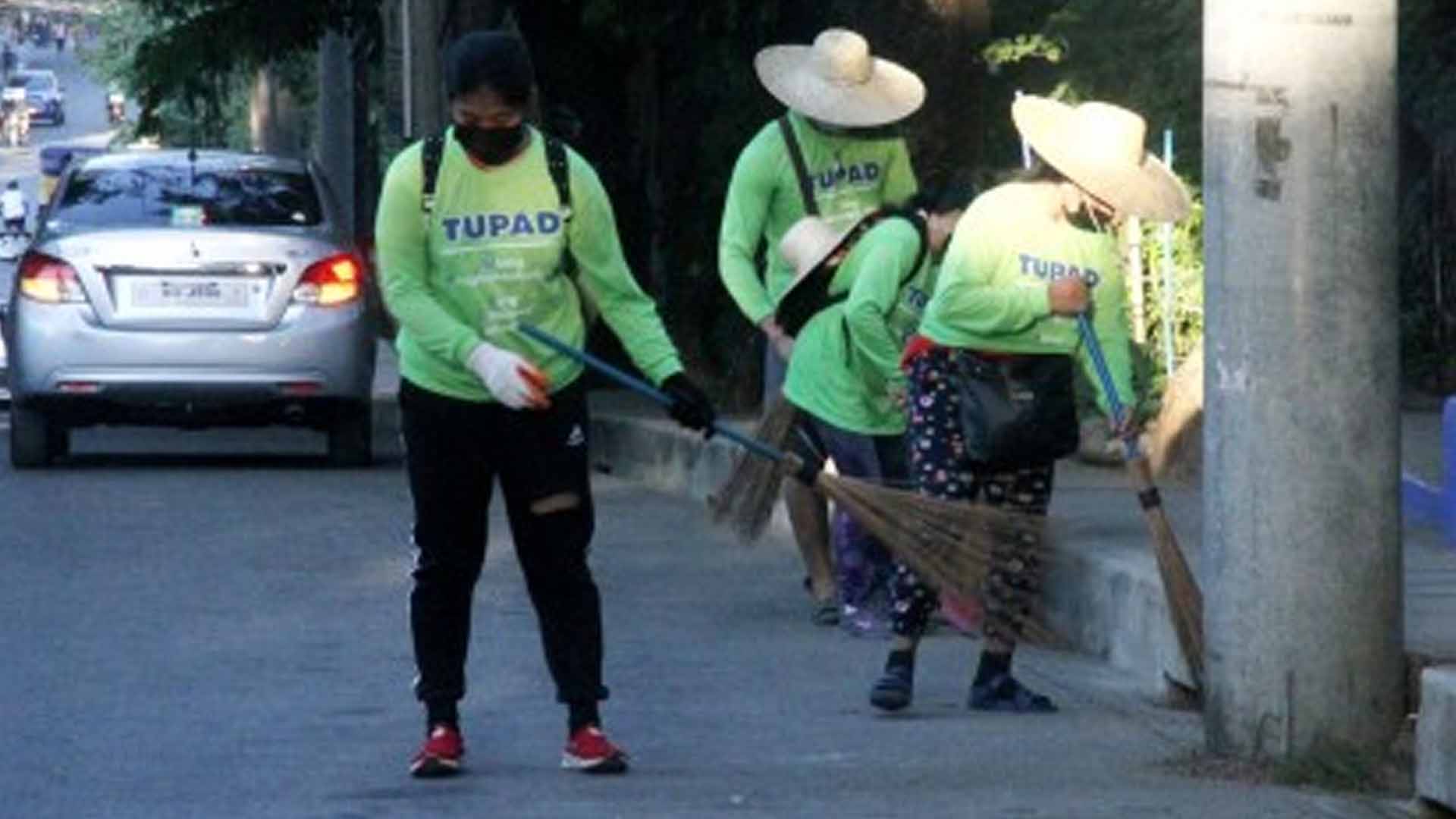






The Department of Labor and Employment (DOLE) has expanded its emergency employment program, Tulong Panghanapbuhay sa Ating Disadvantaged/Displaced Workers (TUPAD) to still help the beneficiaries work up to a maximum of 90 days.
Bureau of Workers with Special Concerns (BWSC) Director Ma. Karen Trayvilla said the expansion of the program’s coverage is one of the DOLE’s contributions to fortify the economy.
“One of the contributions of DOLE to revitalize the economy through the DOLE integrated livelihood employment program as part of BWSC contribution to the national employment recovery strategy (NERS),” she said in a virtual forum.
The expanded TUPAD program has been classified in four categories: Emergency Response Method, Labor-Intensive Method, Labor-Based Method, and Labor-Based Equipment Supported Method.
Under Emergency Response Method, employees will be hired for 15 days to perform light work such as street sweeping and cleaning of public facilities; agro-forestry projects such as tree planting, seeding preparation, and reforestation, including planting or mangroves and bamboo in coastal communities; and other projects such as crop growing and vegetable farming that require preparation.
The workers under this method can also provide assistance to the local government units (LGUs) through the delivery of essential goods, and services, such as food and non-food items, packing/re-packing of relief goods, preparation, design, dissemination, posting of information and educational materials especially in rural areas, and other related tasks as may be assigned by the LGU; transport services for setting up of mobile markets and community disinfection/sanitation activities.
For the Labor-Intensive Method, beneficiaries will be hired for 45 days for social community projects such as de-clogging of canals, debris, segregation, and materials recovery, stockpiling, and clearing during the aftermath of a calamity/disaster, and waste management.
Workers will be hired for 60 days under the Labor-Based Method where they will work on social community projects such as minor repair of common public facilities such as minor repair of common public facilities such as schools, health centers, bridges, construction of footpaths, bridge repairs; construction of water catchment, terracing and planting for soil protection; and tide-embankments, pedestrian lane infrastructure, bike lanes/facilities, and support facilities.
Under the Labor-Based Equipment, those who will be hired to work for three months in government projects that require the use of equipment for the improvement of government facilities and infrastructures such as health centers, irrigation canals and facilities, roads, flyovers, underpass, evacuation centers, school buildings, drought-proofing facilities, flood mitigation structures, erosion reduction projects, major highway and bridge construction, and dredging activities.
They will also work in the economic community projects such as maintenance and/or rehabilitation of farm to market roads, bridges, post-harvest facilities, public markets, and common public facilities such as production and display centers, fish ports, among others to support the food system.
The TUPAD expanded coverage was included in Administrative Order No. 117 signed by Labor Secretary Silvestre Bello III on May 31, 2021.
“Based on the AO signed by the Secretary. He saw that TUPAD was very relevant particularly in the NERS and he instructed us to look into it as a public employment program,” Trayvilla said.
Trayvilla said initially, those who were hired for 90 days have worked as the contact tracers in National Capital Region, Ilocos Region, and Central Luzon. (PNA)


