



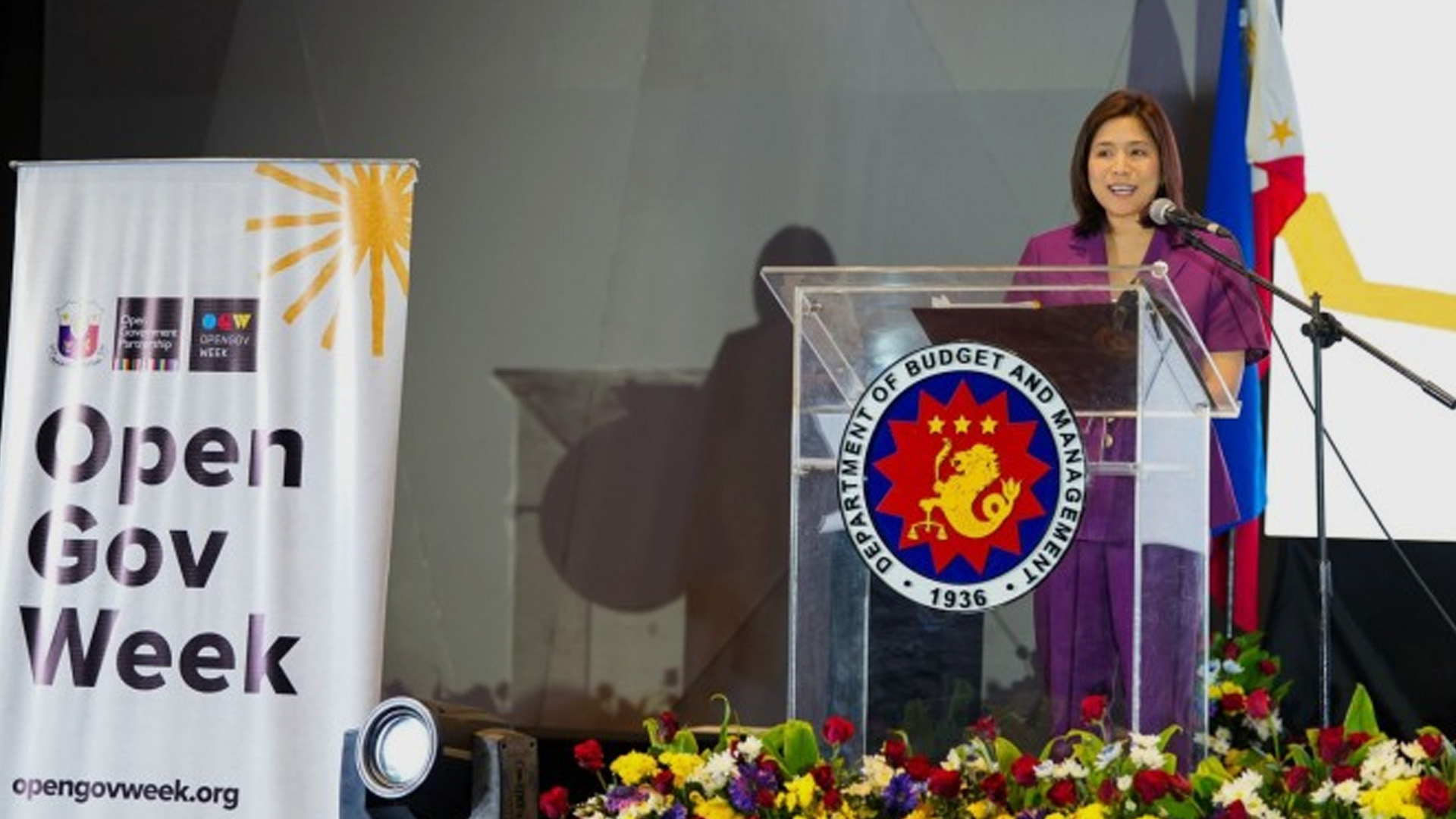






Budget Secretary Amenah Pangandaman has renewed her call for lawmakers to pass the long-delayed Freedom of Information (FOI) bill, emphasizing its importance in fostering transparency and public participation in government.
Speaking at the closing ceremony of the Open Government Week, Pangandaman urged the 20th Congress to prioritize the passage of the measure, which would grant citizens broader access to public information.
Access to information, she said, is crucial in attaining the open government agenda.
“We are proud that the Philippines has not only cemented its position as the most fiscally transparent country in Asia, based on latest Open Budget Survey, but has also drastically improved its standing in the World Press Freedom Index 2025,” Pangandaman said.
“However, the fact remains that we have yet to pass an enabling law that will truly uphold people’s constitutional right to information. That is why I am calling on everyone present here tonight to make our clamor for the passage of a law on right of access to information in the 20th Congress even louder and clearer.”
While Congress has yet to pass a national FOI law, she acknowledged that 88 local government units have already enacted ordinances to provide their constituents with access to government data, an initiative she hopes more LGUs would follow.
“We need more champions of transparency at the local level,” she added.
The Department of Budget and Management (DBM) earlier held a series of roundtable discussions with various stakeholders to get their insights and incorporate them in the draft FOI bill.
The DBM is working with the Presidential Communications Office (PCO) in tweaking the salient provisions of the measure, which will be presented at the Legislative-Executive Development Advisory Council (LEDAC) meeting on May 26.
Pangandaman said the DBM has taken deliberate steps to promote transparency, accountability, and citizen participation.
She also mentioned that the New Government Procurement Act and the Public Financial Management Reforms Roadmap 2024-2028 are among the government’s game-changing reforms in governance.
She said the Open Gov Week enables the Philippine economic team to consult civil society organizations to help the Marcos administration achieve “a more responsive macroeconomic and fiscal targets.”
“As we mark the end of this year’s Open Gov Week, we come together, not only to check on our progress but to honor the partnerships that continue to shape our collective journey toward a truly open government,” Pangandaman said.
“Since the inception and institutionalization of the Philippine Open Government Partnership under the leadership of no less than President Ferdinand R. Marcos Jr., we have moved steadily from commitment to action. We’ve demonstrated that open government is not just a passing trend, it is a working principle embedded in how we plan, spend, consult, and reform.” (PNA)


