



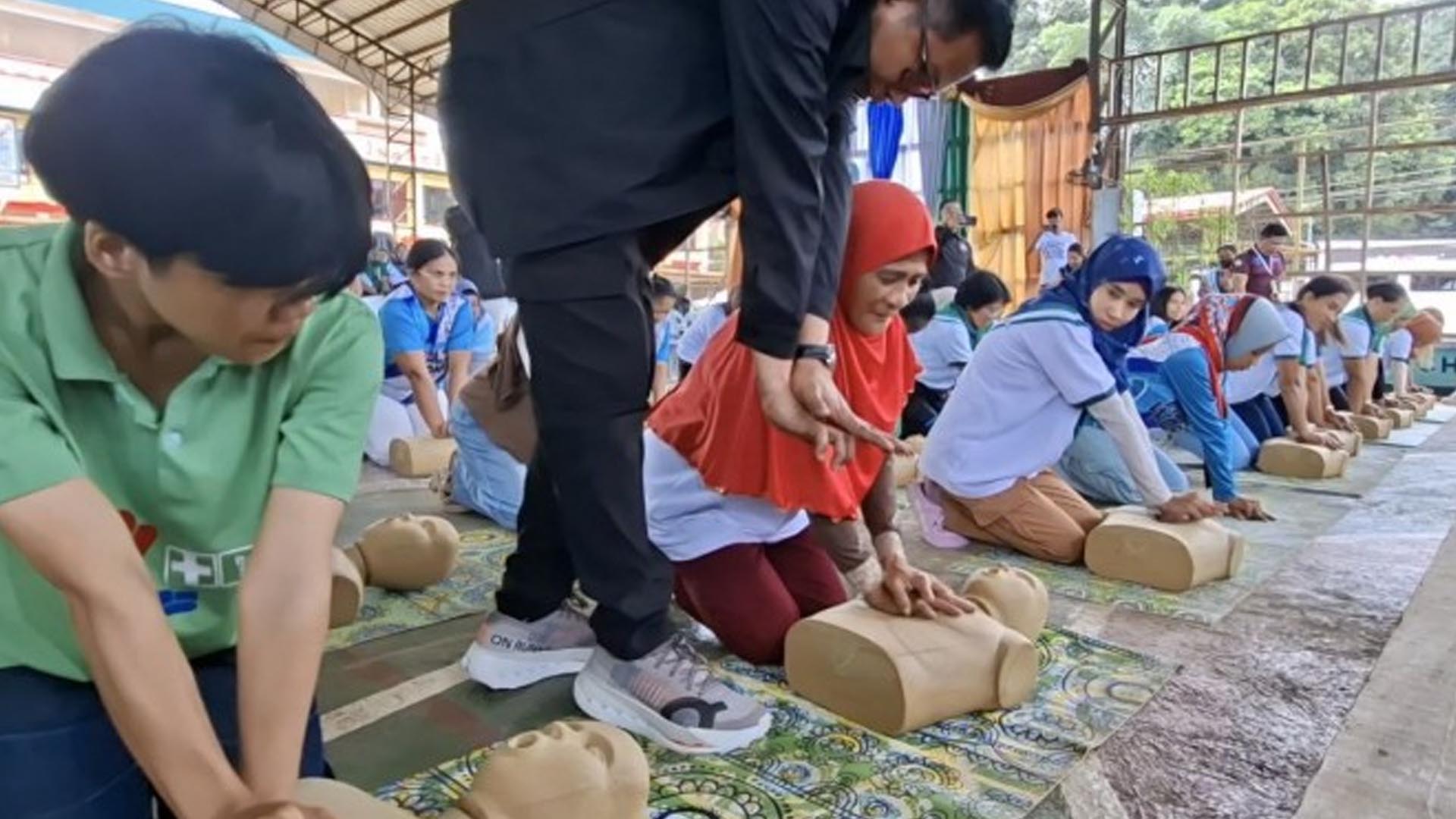






Basic cardiopulmonary resuscitation (CPR) training is crucial in geographically isolated and disadvantaged areas where access to specialists and advanced facilities remains limited, a provincial health official said on Wednesday.
Rural health physician and Basilan Board Member for District 2 Dr. Nur Khar Istarul said cardiac emergencies in the province are often “a race against time,” citing distance, geography, and resource constraints that delay access to definitive care.
“In Basilan, if you have a heart emergency, it is not just a medical condition, it is a race against time. The most critical period, the first few minutes after cardiac arrest, usually happens far from an [intensive care unit], far from advanced equipment, and far from a specialist,” he said.
Istarul underscored that CPR knowledge can spell the difference between life and death, particularly in communities that serve as first responders by necessity.
“If the moment comes when CPR is needed, we must be ready to act, and to act correctly, because a life depends on it,” he added.
He also addressed public criticism faced by first responders after a CPR video circulated on social media platforms, emphasizing that in emergencies, inaction is the greater mistake.
“Ang pinakamalaking mali ay ang walang gawin (The biggest mistake is to do nothing). CPR is not about being perfect, it is about being prepared and compassionate,” he said.
The official encouraged more people to undergo formal training instead of criticizing responders and advised them “not to let perfect be the enemy of good.”
Making communities “CPR-ready” bridges the gap between cardiac arrest and definitive care, transforming bystanders into first responders.
“As a newbie policymaker, we also have a responsibility to act,” he said.
Training in schools
In connection to this, he proposed the institutionalization of basic CPR or Basic Life Support (BLS) training for all senior high school students, which would allow every household to have a responder during a cardiac emergency.
He described the proposal as a practical and sustainable approach, especially in provinces with long emergency response times.
He noted that it could be studied, piloted and eventually legislated in coordination with the Department of Education, health institutions and professional groups like the PHA.
Beyond emergency response, Istarul stressed the importance of prevention through healthy lifestyles and early management of risk factors.
Promoting heart-healthy lifestyles — proper nutrition, regular physical activity, tobacco cessation, and early control of blood pressure, blood sugar, and cholesterol — can prevent cardiac emergencies.
He also called for continued investments in a robust public health system that prioritizes prevention, early detection, a supported health workforce, effective referral networks, and accessible, well-equipped hospitals, particularly in isolated provinces.
In response to this need, the Philippine Heart Association (PHA), with its ZamBaSulTa (Zamboanga, Basilan, Sulu, Tawi-Tawi) Chapter, conducted the First Mass Hands-Only CPR at the Claret College of Isabela in Basilan, Zamboanga.
About 600 barangay healthcare workers, teachers, senior high school students, police officers, and firefighters participated in the training.
PHA ZamBaSulTa member and past president Dr. Kristine Bantala Supnet taught the participants the right way to perform the lifesaving skill.
Supnet emphasized that it must be done right to keep blood circulating and minimize interruptions for rescue breaths, helping ensure consistent blood flow to the brain and other vital organs.
The activity aims to equip communities with hands-only CPR by targeting frontline sectors and individuals beyond the medical community, as they are most likely to witness a sudden cardiac arrest as responders.
Reynaldo Reyes, a second-year college student, participated in the CPR training, which he found significant in daily living.
“Kahit naglalakad tayo o nasa bahay lang tayo, magagamit natin ‘yung knowledge sa CPR (Whether we are walking around or just staying at home, we can use our knowledge of CPR),” Reyes told Philippine News Agency in an interview.
“Importante na kaming mga students marunong nito kasi kami ‘yung mas gala eh, kung saan man lugar kami makapunta, pwede namin maituro ‘yung skill na ‘yun sa ibang kabataan (It is important for us students to know this because we are the ones who go out more; wherever we go, we can teach that skill to other young people),” he said.
To the young people who are fearful to perform CPR or to learn it, Reyes advised that they must keep in mind that the skill gives a person who may need it a second chance at life.
Istarul noted that PHA’s activity will be more than a training to the people in their community.
“It is a shared commitment to preparedness, to equity in healthcare, and to the belief that where a person lives should never determine their chance of surviving a heart emergency,” he said.
The PHA is keen on reviving CPR on Wheels on Wings (CWW), which is a joint undertaking between the association and the Department of Tourism (DOT) launched in 2016.
It was grounded by the pandemic after serving 26 tourist destinations around the country and stopped in Pilar, Bataan, in February 2020.
Designed to transform tourist destinations into CPR- and Automated External Defibrillator-Ready communities, the majority of the CWW trainers were hotel and resort staff, ambulant vendors, drivers, boatmen, barangay health workers, and DOT key officers and employees.
From 2016 to 2020, the CPR-ReadyPH campaign trained 1.5 million Filipinos (lay, health professionals, and health workers combined) for hands-only CPR, BLS, and Advanced Cardiac Life Support (ACLS).
From 2020 to Oct. 12, 2025, the PHA has successfully trained 111,415 participants in BLS and Advanced ACLS. Of these, 50,121 were trained exclusively in BLS, while 61,294 completed both BLS and ACLS courses. (PNA)


