



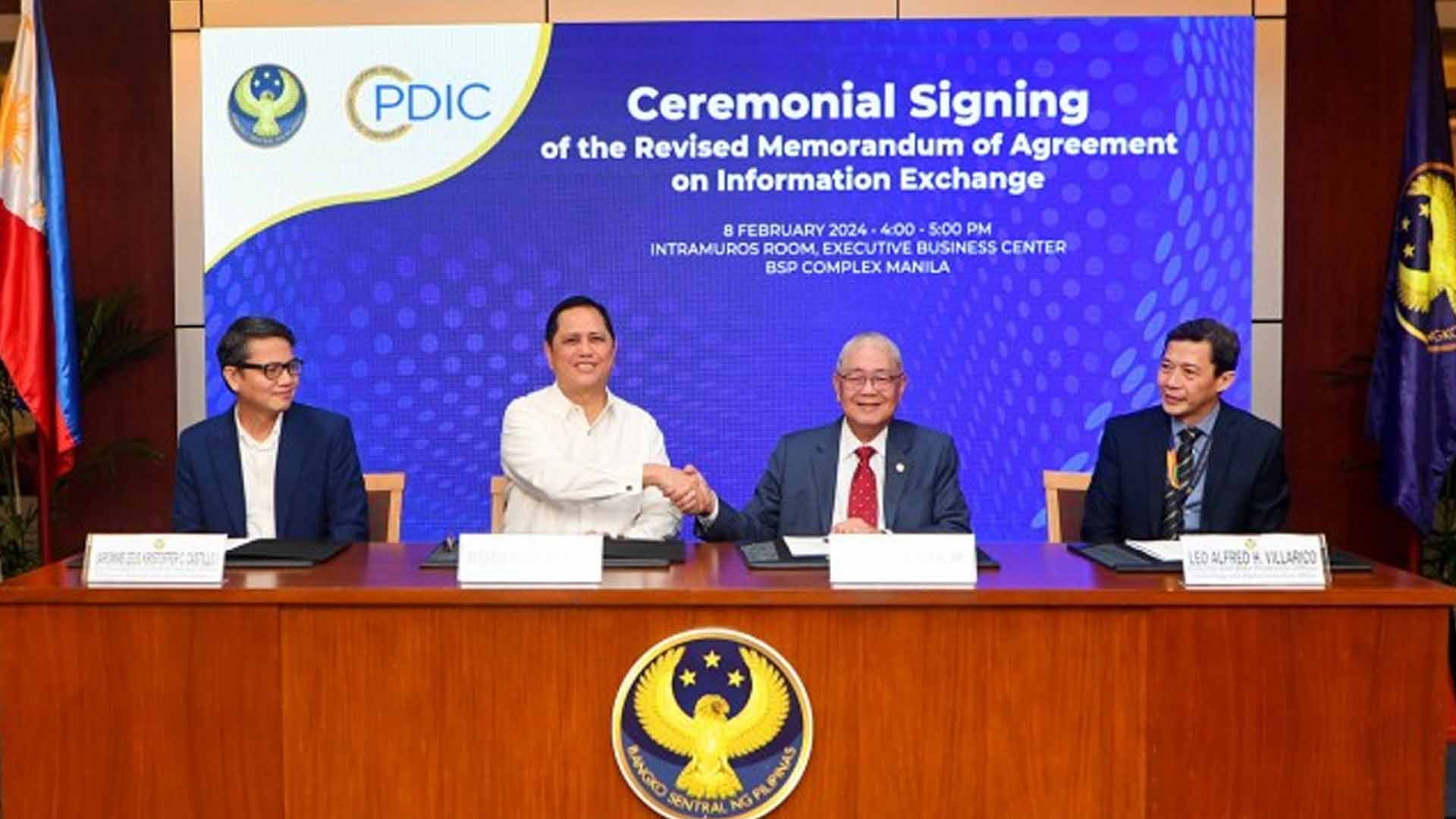







The Bangko Sentral ng Pilipinas (BSP) and the Philippine Deposit Insurance Corporation (PDIC) have signed a revised memorandum of agreement (MOA) on information exchange.
In a statement on Wednesday, the BSP said the revised MOA, signed on Feb. 8 by BSP Governor Eli Remolona Jr. and PDIC president and chief executive officer Roberto Tan, amends the agreement dated Nov. 12, 2002 and the supplemental MOA executed in 2004.
It updates the list of documents shared between the BSP and the PDIC and will be operationalized as an Omnibus Agreement covering all information, data and reports shared between the two agencies in pursuit of their respective mandates.
The central bank said other salient points of the revised MOA include seamless information sharing through digital platforms and rationalized processes; leveraging the BSP Electronic Information System for the timely, secure, and efficient sharing of reports, data and information between the two agencies; and the periodic review and update of the MOA to consider evolving supervisory requirements.
Prudential reporting requirements of banks will also be streamlined, thus they are no longer required to submit some prudential reports separately to the PDIC.
Remolona said the revised MOA is timely as the regulatory framework and supervisory culture for both the BSP and the PDIC have changed over the years.
“We have moved from a very prescriptive examination and supervision style to a risk-based, more principles-based supervision. We do not tell banks specifically what to do. We tell banks to take risks seriously, and that is the reason for all these regulatory standards,” he said.
“I enjoin everyone, as stewards of this Revised MOA, to follow through on your commitments to keep the Revised MOA updated, relevant, and operational in pursuit of our primary objective of promoting financial system stability,” he added.
Tan, meanwhile, said transparent communication between the BSP and the PDIC provides opportunities for a comprehensive understanding of potential risks, enabling them to draw up preemptive measures, detect challenges early, and promptly intervene to immediately address problems among banks.
“The collaboration between our institutions becomes even more paramount and imperative to protect the depositing public, especially from frauds and scams that have become even more elaborate and complex,” he said. (PNA)


