



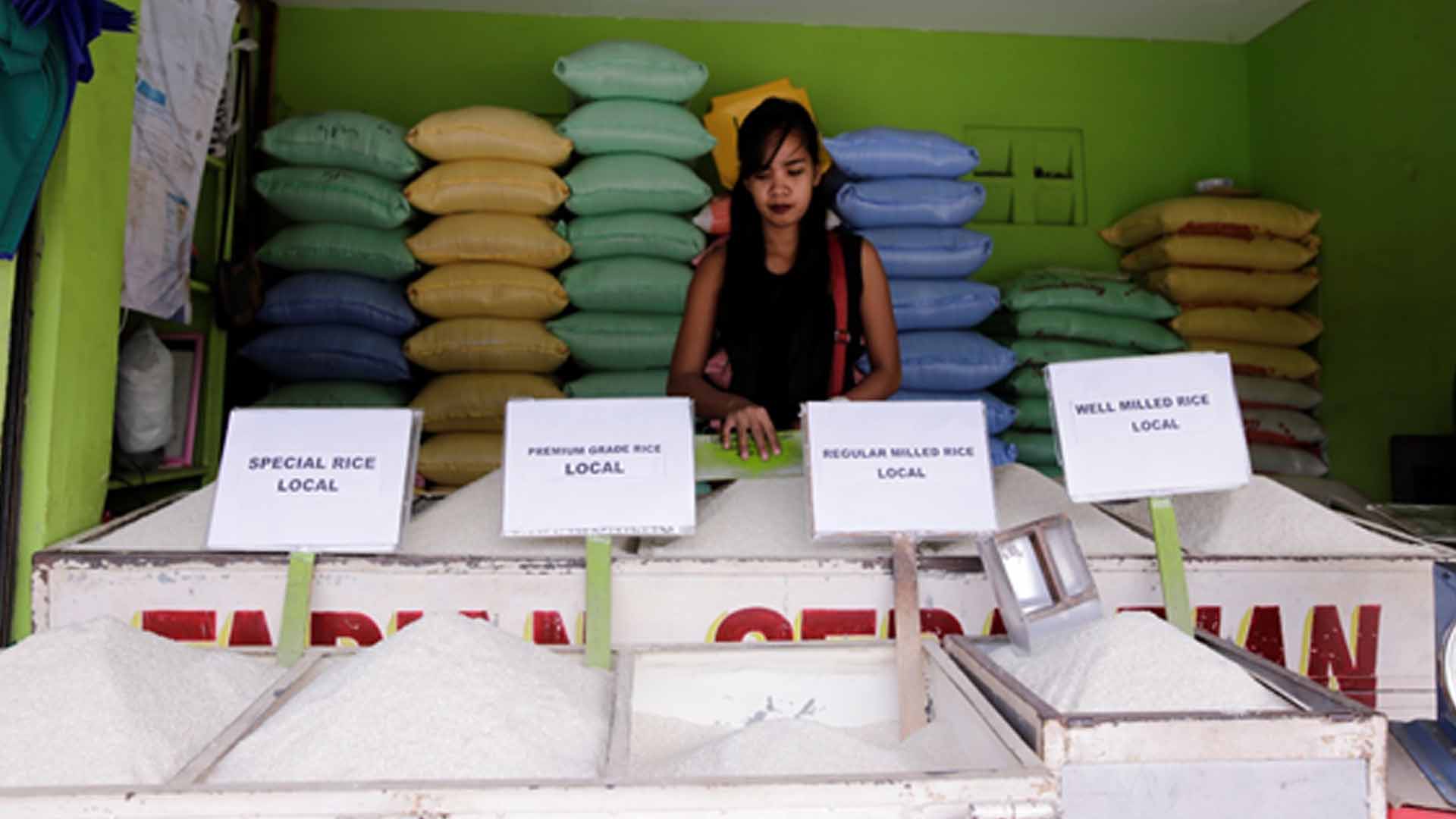






The local government of Nueva Ecija is the first province in the country to enact an ordinance on the truthful labeling of rice based on the recommendations of the Department of Agriculture-Philippine Rice Research Institute (DA-PhilRice) Policy Research and Advocacy team.
The ordinance requires rice retailers to indicate valid, reliable, and complete information about the prescribed milling classification, price, and source of rice (local or imported) on rice sacks, box labels, and price tags.
Truthful labeling aims to empower consumers to choose between imported and locally produced rice and to ensure food safety.
“Specifying rice source in rice packages, box labels, and price tags will aid consumers who want safe and quality local rice to make easy choices,” Alice B. Mataia, Policy Research and Advocacy team co-lead, said.
Mataia, also an agricultural economist in DA-PhilRice, explained that demand for local rice may spur when more consumers are able to spot local rice and buy it over imported ones.
“This will encourage rice traders to source their supply from local farmers,” she said.
The ordinance indicates that labels should follow the guidelines in the Philippine National Standard on Grains – grading and classification – paddy and milled rice.
It also states that price tags should be used in labeling retailed unpacked rice. Under the guidelines, the tag’s size should be 21.5cm x 16.5cm (length by width), while the tag’s color should be light yellow for premium grade rice, and white for well-milled and regular-milled rice.
The price tag should also be printed with information on price per kilogram, classification, and grade in black bold letters and figures except for the unit symbol “kg”. The prescribed color-coded price tags should also be conspicuously displayed on the grains’ box.
The ordinance detailed that unpacked milled rice for retail must be displayed in wooden rice boxes painted with food grade or non-toxic white paint, and free of posters and advertisements. The boxes should be covered to prevent rice from being exposed to pests and other contaminants.
It also specified that “rice sacks should only be labeled as regular-milled, well-milled, premium, and special. The prescribed colors of rice sacks are white for ordinary rice varieties, light yellow for premium varieties, and sky blue for special varieties.”
Premium grade rice is the highest grade based on the prescribed national standards. Meanwhile, well-milled rice are rice kernels from which the hull, germ, outer bran layers, and the greater part of the inner bran layers have been removed but parts of the lengthwise streaks of the bran layers remain in less than 20% of the kernels. Regular-milled rice are almost similar with well-milled rice but parts of the lengthwise streaks of the bran layers remain in 20-40% of the kernels.
According to Mataia, the National Food Authority (NFA) issued guidelines on the prescribed labeling of rice boxes and price tags in 2018; however, the Rice Tariffication Law repealed NFA’s regulatory functions including its role to enforce the national grains standard. The Bureau of Agriculture and Fisheries Standards (BAFS) then developed the Philippine National Standards on Grains – grading and classification – paddy and milled rice in 2019.
She added that the Bureau of Plant Industry took charge of NFA’s functions through inspections and issuance of sanitary and phytosanitary import clearances, but it does not cover the implementation of labeling guidelines in rice.
This lack of compliance due to the absence of an authority that enforces truthful labelling is one of Nueva Ecija’s reasons for enacting the ordinance.
As recommended by the team, a local task force (LTF) headed by the governor will be formed.
The LTF will set the general implementation guidelines and will ensure that the task force of all the cities and municipalities are doing their functions.
City and municipal LTFs, which are to be created and convened by the mayor of each city or municipality, are mandated to promote, regularly monitor, and regulate rice box labeling and price tag practices of rice retailers; and inspect rice sold by rice retailers to validate their claims in rice box labels and/or price tags.
They are also tasked to penalize, record, and maintain documentary evidence against violators; endorse compliant rice retailers to the provincial LTF for awarding of an Honesty Seal; and issue clearances to rice retailers for issuance of business permits.
An Honesty Seal entitles a rice retailer, who has been consistently following the labeling guidelines for not less than six months, to a discount on fees.
Meanwhile, violators will be penalized with a payment of P1,500 or suspension of business permit until fine is paid for the first offense, P3,000 and suspension of business permit until fine is paid for second offense, and P5,000 and revocation of business operations until compliance with the prescribed labeling for the third offense.
The LTFs will be trained by NFA and DA-PhilRice.
The ordinance was approved by Nueva Ecija Governor Aurelio M. Umali on Oct. 26.


