



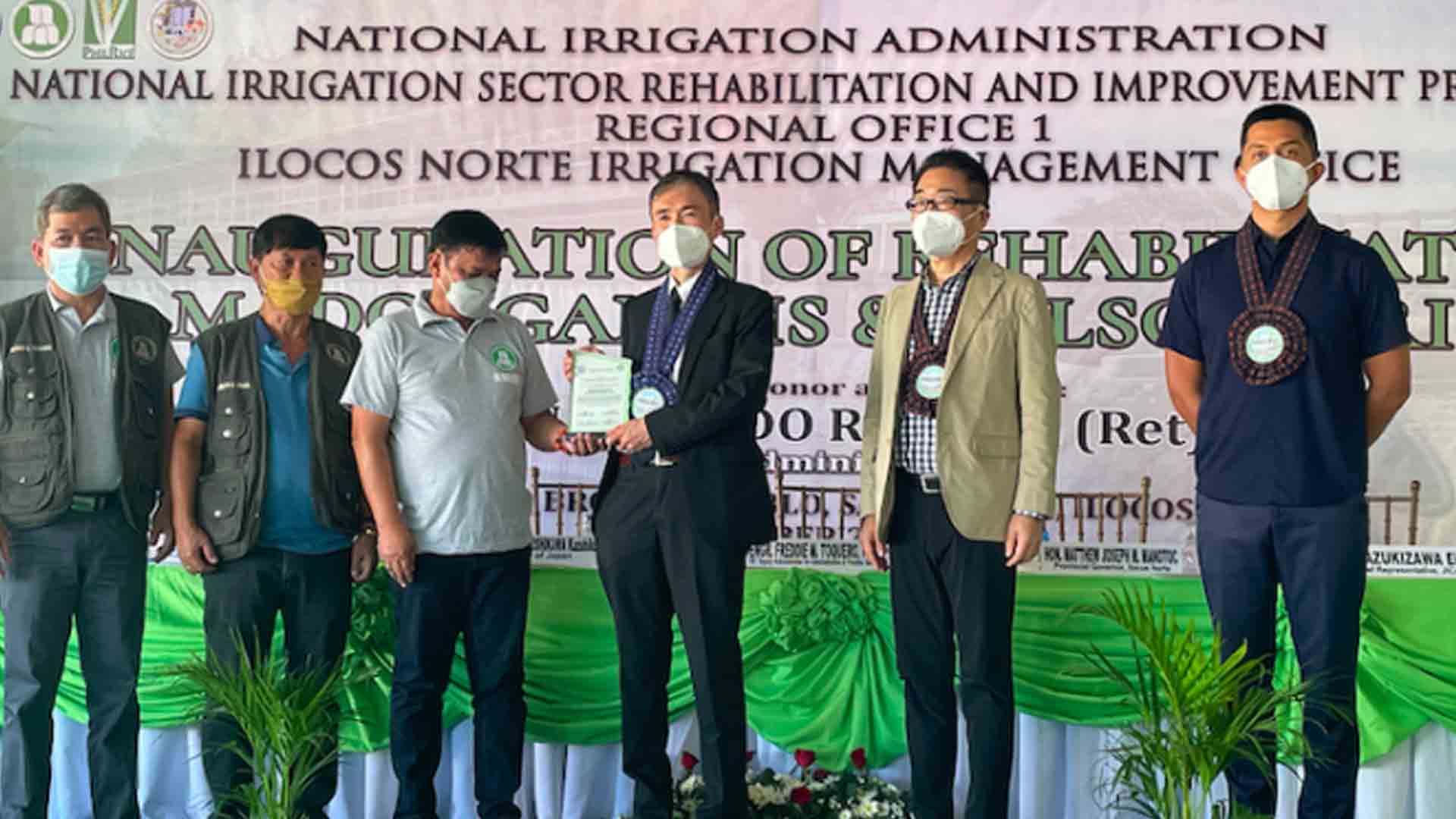






Around 8,000 farmers covering the towns of Solsona, Dingras and Marcos in Ilocos Norte province look forward to a bountiful palay harvest and other high-value commercial crops as the repair and rehabilitation of the Madongan and Solsona River Irrigation Systems (RIS) have finally been completed.
The PHP318-million rehabilitation and improvement projects under the National Irrigation Sector Rehabilitation and Improvement Project are among the big-ticket infrastructure development projects of the national government under the administration of President Rodrigo Roa Duterte which was funded through the support of the Japan International Cooperation Agency (JICA).
“From a total of 1,000 hectares of well-irrigated rice fields, we are now able to irrigate 2,020 hectares because of these high-impact projects,” said Sherwin V. Rico, Federation president of the Madongan RIS in the rice granary town of Dingras.
He said they are so blessed and thankful for the government support which paved the way for the construction of concrete canal linings where they can access water to irrigate their farms.
Aside from the repair of the old dilapidated dams and repair of damaged intake tunnels, resulting in inadequate water supply during the dry season and affecting the villages’ rice and corn production, the farmers’ irrigators associations also underwent a series of seminars and training to improve their economic welfare.
“They did not only repair our old irrigation systems, we now have our own warehouse, farm machinery, and a solar dryer, among others, to augment our income,” said Jovencio Pascua, Federated president of the Solsona RIS, in a simple program after the blessing and unveiling of markers of the completed projects on Wednesday.
In his short speech, Azukizawa Eigo, chief representative of the JICA, told farmer-beneficiaries to make the most out of these projects and help maintain them for the future generation.
For his part, Japanese Ambassador Koshikawa Kazuhiko, who likewise attended the unveiling of the markers, expressed his gladness that the multi-million infrastructure development projects for the Ilocos farmers have materialized and completed.
“I hope that the more than 3,000 hectares of farmlands covering the projects will be revitalized as it will likewise bring smiles to local faces and a lasting impact to future generations,” he said in his speech.
In a separate interview, Engr. Silvino C. Navarro, project manager of the National Irrigation Sector Rehabilitation and Improvement Project, recalled that the project started in 2008 when a feasibility study was conducted to rehabilitate old irrigation systems with at least 15 percent rate of return in terms of viability.
“With free access to irrigation, the National Irrigation Administration aims to increase their harvest to five tons per hectare from an average of three tons per hectare,” said Navarro as he noted the JICA-funded projects has a 20-year repayment period with a grace period of 10 years at a minimal interest rate. (PNA)


