



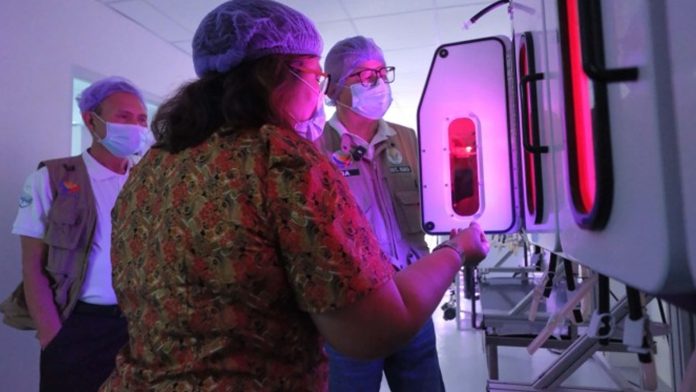






As one of the leading global producers of carrageenan-bearing seaweeds, the Philippines further advanced its export capacity through the country’s first-ever seaweed bioreactor.
This comes as the Department of Agriculture (DA) unveiled the facility at the Bureau of Fisheries and Aquatic Resources’ (BFAR) National Seaweed Technology Development Center.
In a statement on Wednesday, DA Secretary Francisco Tiu Laurel Jr. said this serves as a “turning point” for the seaweed industry.
“This is the first facility of its kind in the Philippines. We can now produce seaweed propagules on demand instead of waiting for seasonal growth,” he said.
The first automated 1250L bioreactor, which cost PHP10 million, will replace decade-old laboratory methods.
This means replacing old methods, such as improvised bottles, manual aeration, and less precise propagation techniques.
The facility also includes PHP12 million worth of two modular seaweed bioreactors.
With its operation, the BFAR is expected to produce healthier, high-quality seaweed propagules faster at higher volumes.
Through this, scientists can regulate the conditions for optimal seaweed growth, such as light, nutrients, and temperature.
Tiu Laurel cited how these bioreactors can boost the country’s productivity.
“Our goal is simple. We want to provide clean, disease-free planting materials from Luzon, Visayas, and Mindanao and help regain the Philippines’ position as the world’s leading Kappaphycus seaweed producer,” he said.
To date, the Philippines ranks as the world’s fourth largest source of the commodity.
The country supplies raw materials used globally in food processing, pharmaceuticals, cosmetics, and a wide range of industrial products.
Nationwide distribution
The BFAR, meanwhile, said planting materials will be distributed to benefit seaweed farmers nationwide.
The move is expected to boost harvest and reduce post-harvest losses due to poor-quality or disease-prone seedlings.
The first batches of propagules will be sent to major seaweed-producing areas, considering the high demand for quality planting materials.
These include Zamboanga, Palawan, and the Bangsamoro Autonomous Region in Muslim Mindanao (BARMM).
Cebu, Iloilo, Camarines Sur, Camarines Norte, and Masbate will also receive free planting materials.
To ensure survival rates and higher yields, the BFAR will also train farmers before the distribution of the propagules.
Meanwhile, BFAR Chief Aquaculturist Ida Capacio said the procurement and use of the country’s first seaweed bioreactor is a dream come true.
“This is something we have waited for decades. Before, we relied on improvised systems,” she said. “Now we can produce quality propagules much faster because of the SBRs. The dreams we have for the Philippine seaweed industry are finally becoming reality.”
The DA, meanwhile, is looking into the procurement of additional bioreactor facilities in Palawan and Mindanao to expand production.
Research on new seaweed varieties for food, pharmaceuticals, industrial applications, and organic fertilizer is also underway. (PNA)


