



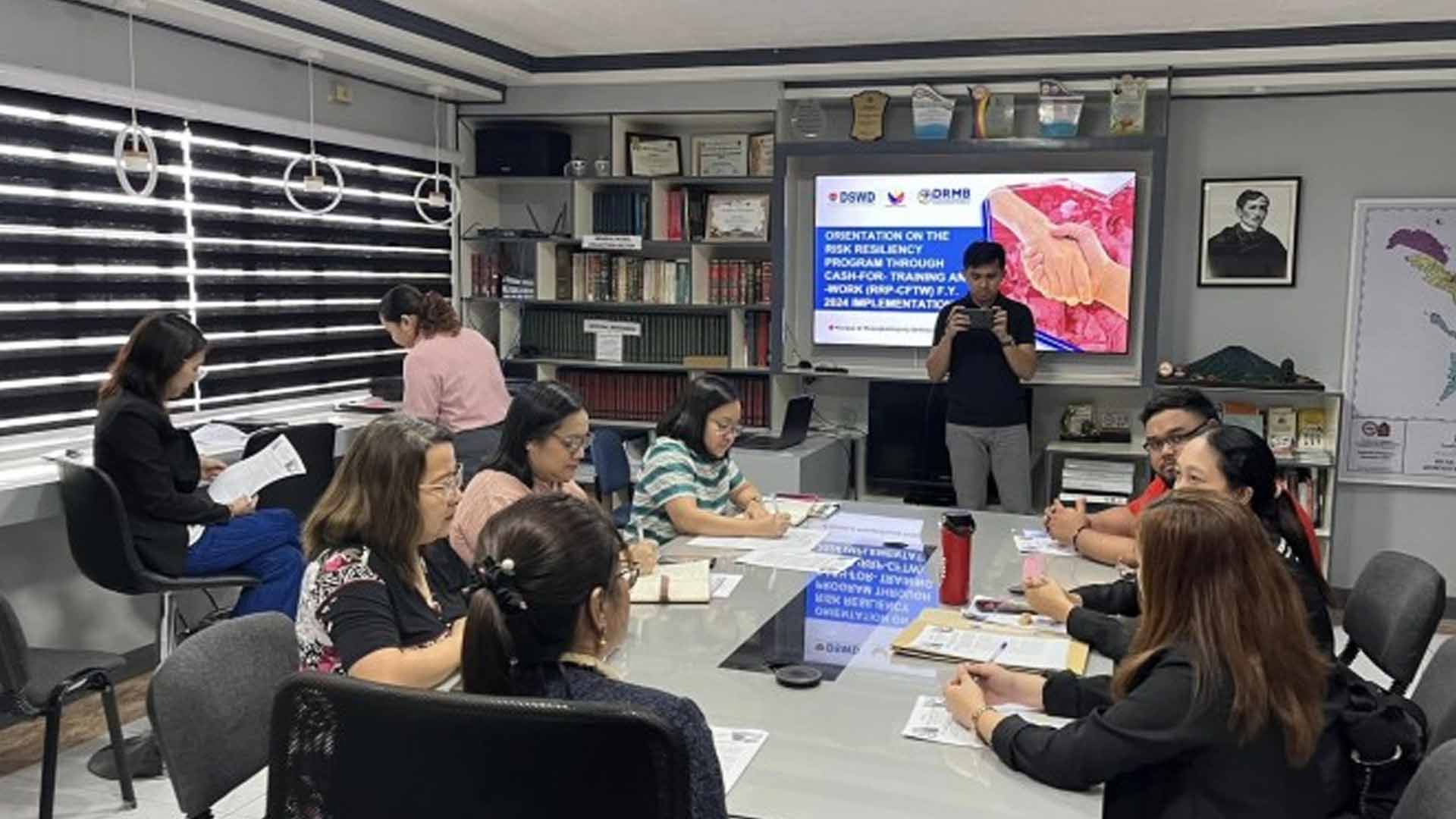






The Department of Social Welfare and Development 5 (DSWD-Bicol) on Thursday said at least 15 towns in the region will benefit from the Project LAWA at BINHI or Local Adaptation to Water Access and Breaking Insufficiency through Nutritious Harvest.
In an interview, Claudio Villareal Jr., DSWD-Bicol disaster response and management division chief, said the Project LAWA at BINHI is a cash-for-training and cash-for-work endeavor that will teach the beneficiaries the basics of Risk Resilience and Climate Change Adaptation.
“The Project LAWA at BINHI aims to strengthen the adaptive capacities of vulnerable families during droughts, addressing food insecurity and water scarcity brought by the El Niño phenomenon. The beneficiaries will be receiving cash for attending training for 20 days with a payment of PHP395 per day. After the training, they are expected to be working on activities that will answer the need for water and address food insecurity in their areas,” Villareal said.
He said the project that will be implemented by mid-April in 15 towns will have at least 4,773 beneficiaries and some PHP41.6 million allocated funds.
Villareal said some activities related to ensuring water sufficiency and expected to be the output of the beneficiaries were the construction of small farm reservoirs, repair, and rehabilitation of water-impounding facilities, repair of multipurpose water infrastructures, diversification of water supplies and other activities related to water sufficiency.
To address food insecurity, there will also be activities like urban gardening, school-based gardening, community-based gardening, and planting of disaster-resilient crops, fruit-bearing trees, and mangroves and hydroponics, aquaponics and vermicomposting.
“Currently, we have ongoing consultation and dialogues with line agencies like the Department of (the) Interior and Local Government, Department of Agriculture, National Irrigation Administration and Mines and Geosciences Bureau. They will help us with the program’s specifics, discussing processes, modalities, and the counterpart of partner agencies in ensuring successful project execution and maintaining sustainability,” Villareal said.
He said the towns were selected for the project based on the Department of Science and Technology-Philippine Atmospheric, Geophysical and Astronomical Services Administration Climate Outlook, which indicates that they are likely to be affected by El Niño.
“They are also included in the Listahanan 3 with the highest poverty incidence in the region. The 15 towns are from Catanduanes, Masbate, and Sorsogon,” Villareal added.
On Jan. 19, President Ferdinand R. Marcos Jr. signed Executive Order No. 53 to streamline, reactivate, and reconstitute the old El Niño task forces under EO No. 16 (s. 2001) and Memorandum Order No. 38 (s. 2019).
Under EO 53, President Marcos directed the task force to develop a comprehensive disaster preparedness and rehabilitation plan for El Niño and La Niña to provide “systematic, holistic, and results-driven interventions” to help the public cope and minimize their devastating effects. (PNA)


