



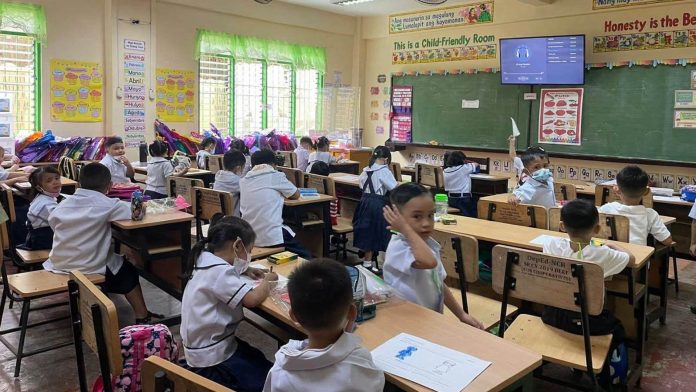






The 2nd Congressional Commission on Education (EDCOM II) is targeting 90 percent preschool participation by 2035 while strengthening early childhood instruction, parental involvement, and foundational literacy.
In a news release on Friday, EDCOM II said its 10-year roadmap prioritizes nutrition during the first 1,000 days, early childhood education, and reading proficiency by Grade 3, following a policy discussion with Harvard Graduate School of Education Dean Dr. Nonie Lesaux.
“One of the early findings of EDCOM is that without these three things – nutrition in the first 1,000 days, improved access to early childhood education, whether it is in a center, at home, in a community, and third, mastery of foundational skills by Grade 3 – no reader should move beyond Grade 3 without reading and without having basic literacy,” EDCOM II Executive Director Dr. Karol Mark Yee said.
Only about 30 percent of Filipino children aged three to four currently access early childhood care and development (ECCD) services, based on figures presented during the discussion.
EDCOM II aims to increase participation to at least 50 percent within two years and 90 percent by 2035.
During the discussion, Lesaux emphasized that children should receive quality learning experiences during their first five years to develop literacy, numeracy, and social-emotional skills, even outside formal classrooms.
“The trick is you need a few hours a day, and you need everybody doing this in order to get there,” she said.
She also recommended community-based programs involving parents, including home visits and activities that strengthen children’s early development.
“We can’t have thriving kids without thriving adults,” Lesaux said.
Meanwhile, EDCOM II Co-Chairperson Rep. Roman Romulo emphasized the importance of tracking newborns and children with special needs through structured data collection under Republic Act 12199, or the Early Childhood Care and Development System Act.
“So, when we passed that, when we were deliberating on the ECCD law (RA 12199), the first thing we did was to find a way to ensure that data is gathered,” Romulo said.
Lesaux also stressed that reliable data and continuous monitoring would help sustain education reforms despite changes in political leadership.
The discussion, organized under the Philippine Education Reform Movement, forms part of efforts to coordinate lawmakers, researchers, civil society organizations, and local governments in improving education outcomes.
EDCOM II’s earlier findings identified more than 4,600 barangays without child development centers, while about 10 percent of more than 5.1 million Grade 1 to Grade 3 learners assessed at the end of School Year 2025-2026 remained struggling readers. (PNA)