



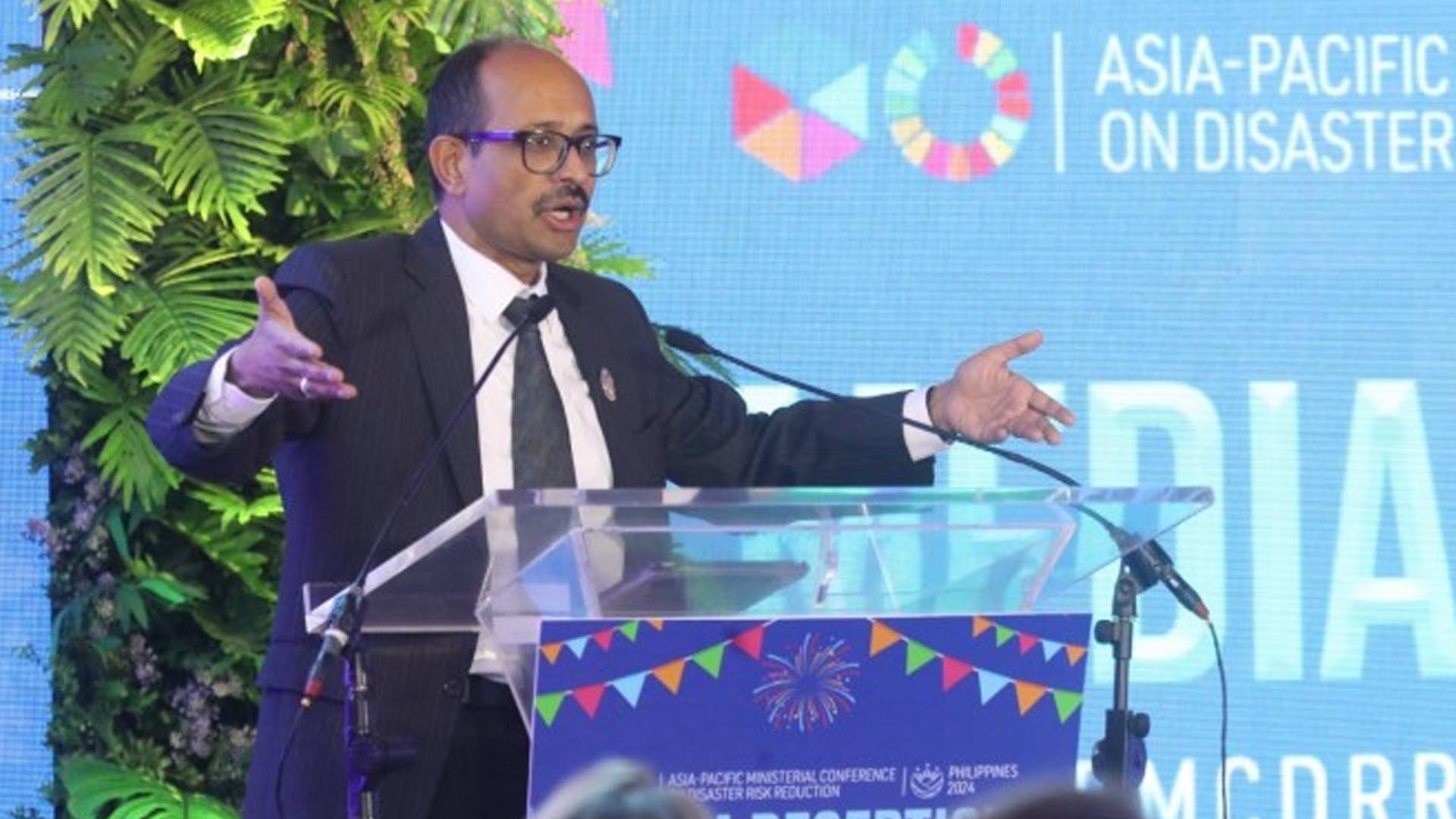






The head of the United Nations Office for Disaster Risk Reduction (UNDRR) on Monday praised the Philippines’ people-centered approach in disaster risk reduction.
At the 2024 Asia-Pacific Ministerial Conference on Disaster Risk Reduction (APMCDRR), UNDRR chief Kamal Kishore said the Philippines is already “way ahead” of the DRR curve as focus on communities, which are often the most affected during calamities, is an essential component of reducing and managing disaster risks.
“The work that is being done in Philippines can be a lighthouse to the rest of the region, and, indeed the world,” he said at a media reception.
On top of making sure that policies and projects come together at the local level, Kishore said the close collaboration between government agencies in the Philippines is a policy that other states should also replicate.
“Also very unique is how you bring together different parts of the government —there are two secretaries in the media event and there are other departments involved throughout the conference— it is not something that you see very often in many countries,” he said.
Joining Kishore at the forum were Defense Secretary Gilberto Teodoro Jr. and Environment Secretary Maria Antonia Yulo-Loyzaga.
In an interview, Yulo-Loyzaga said fostering closer collaboration between different sectors in the country “has not been easy” for the Philippines as well, but the key is making the academe an integral part of the conversation.
“The key seems to be is in how you institutionalize this disaster risk reduction agenda and how that can be based in the state colleges and universities that are localized also in their focus,” she said.
“(This is) so that when political administrations change, the knowledge continues to develop and is somewhere in the local government.”
One of the outcome documents expected after the week-long APMCDRR is a co-chairs’ statement issued by the Philippine government and the UNDRR.
The APMCDRR is held every two years and brings together UN member states, international organizations, and other stakeholder groups to accelerate the implementation of the Sendai Framework 2015-2030 at the regional level.
The framework is the outcome of the UN-supported negotiations held from 2014 to 2015 that aims to prevent new and reduce existing disaster risk.
All states and stakeholders involved in the agreement are currently working towards achieving seven global targets by 2030, including reducing mortality and direct economic loss from disasters; and increasing access to multi-hazard early warning systems and the number of countries with national and local DRR strategies, among others. (PNA)


