



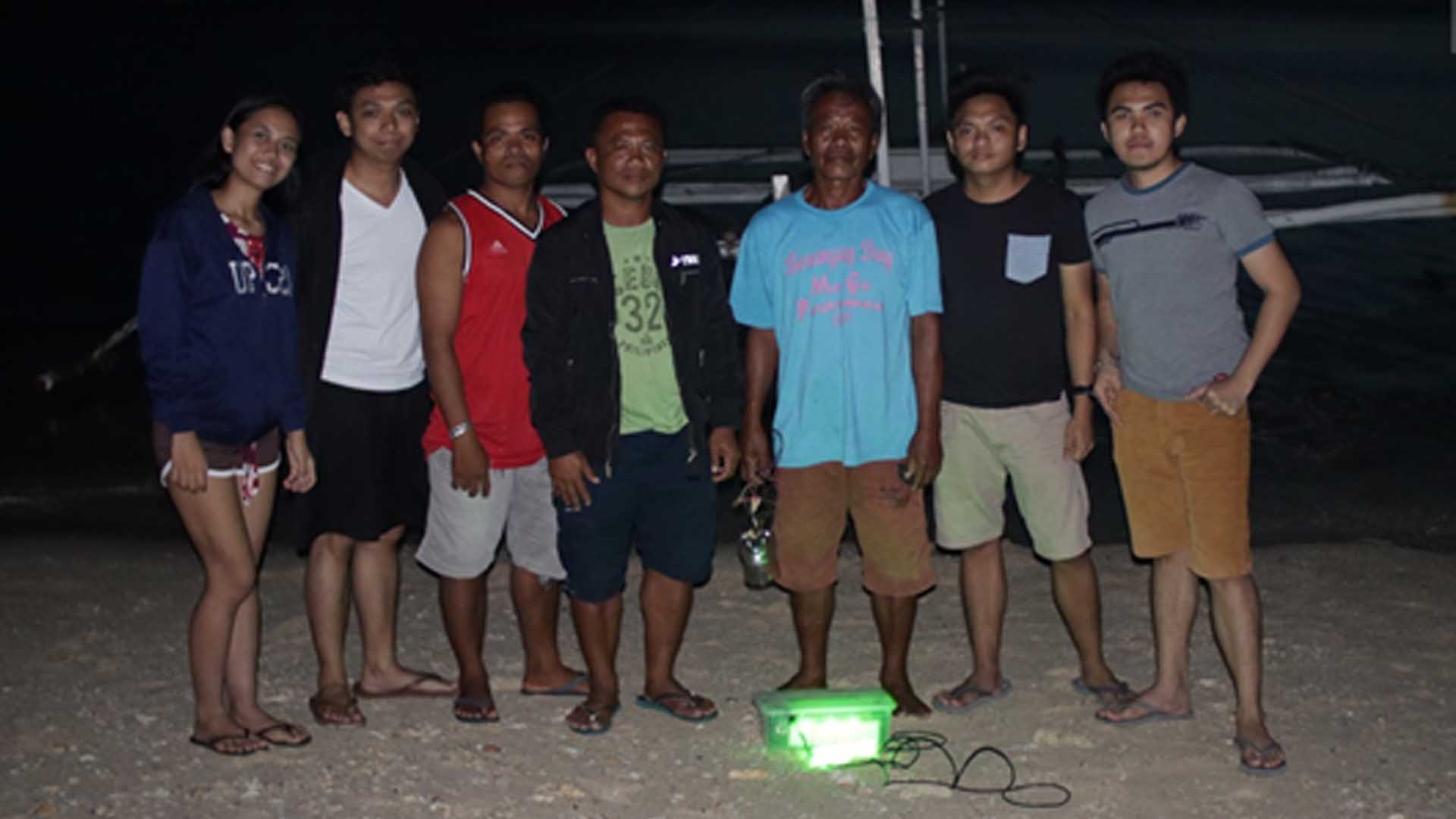






When we use light to signify hope, the fisherfolks in Laguna Lake knew this only too well since a novel source of light has fueled their aspirations for a better catch and a brighter future.
Researchers from the Technological Institute of the Philippines (TIP) developed a battery that literally lights up the path of fisherfolks and cleans the polluted water from where they get their livelihood, at the same time.
Dubbed iLAWA, derived from the Filipino phrase ilaw mula sa lawa (light from the lake), the researchers developed the battery technology from recycled aluminum, like cans, to help light the path of fisherfolks and clean the lake when submerged underwater.

The researchers explained that the battery gets its power from the electrolytes in the water due to the presence of electric charges.
The battery then cleans the water by removing its phosphate content. Phospates in lake waters come from agricultural and residential runoffs, dissipating as the cell operates in the water.
The T.I.P. team, composed of engineers Niel Jon Carl Aguel, Ana Luz Callao, Paul Vincent Nonat, and Rowel Facunla led by Dr. Drandreb Earl O. Juanico, first conceptualized iLawà in 2016 to address energy-related problems that the island of Talìm Island in the middle of Laguna Lake has been experiencing.
Their earliest prototype received recognition in 2017, bagging them an award from a non-government organization advocating sustainable energy.
Seeing the potential of this renewable energy (RE) innovation, the T.I.P. team pushed for its further enhancement and has successfully received funding support from the Department of Science and Technology’s (DOST’s) TECHNICOM Program for prototype development, field testing, and market validation. The project was monitored by the DOST-Philippine Council for Industry, Energy and Emerging Technoogy Research and Development (DOST-PCIEERD).
With the ample support for the project, the team was able to optimize the prototype with its cell volume and mass reduced by 90% and 73%, respectively, while increasing power output by 89%. These technical improvements led to greater potential uses that require higher electrical power levels.
To date, the team behind iLawà has forged several partnerships among material suppliers for the commercialization phase and technology adopters such as the Federation ng Mangingisda ng Bayan ng Binangonan, a fisher folk cooperative that operates in Barangay Ithan, municipality of Binangonan in the province of Rizal.

The T.I.P. team envisions that the widespread adoption of iLawà will consequently promote aluminum recycling and help remediate polluted lake waters. The release of phosphates through chemical reaction in the battery will then improve water quality. Furthermore, it will contribute in minimizing fish kills in lakes and enhance the fishing livelihood in the towns surrounding the lake.
DOST-PCIEERD Executive Director Enrico C. Paringit said, “The conscious efforts of T.I.P to boost the livelihood of Filipino fisherfolks by developing a durable, cost-effective innovation, not only will TIP’s technology produce clean energy but also improve lake environments. We look forward to seeing iLawà light up Philippines’ aquacultural areas, rivers, and even coastal waters.”


