


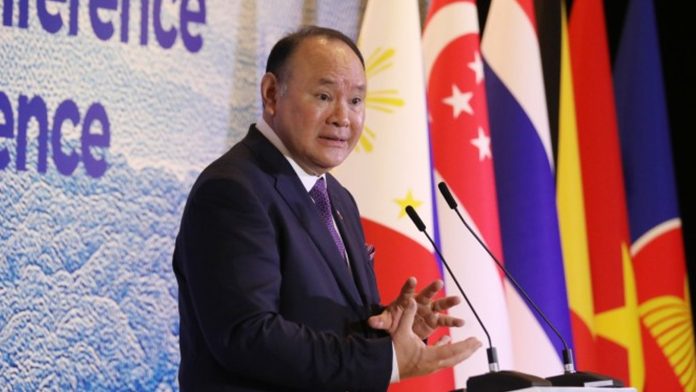






Defense Secretary Gilberto Teodoro Jr. has urged ASEAN countries to strengthen cooperation on disaster resilience amid increasingly complex and cross-border hazards, as member states adopted the Manila Declaration, committing them to accelerate regional disaster management efforts through 2030 and beyond.
In a news release Thursday, Teodoro, who also chairs the National Disaster Risk Reduction and Management Council (NDRRMC), noted the complex and dynamic risk landscapes threatening ASEAN member states.
As member states adopt the Manila Declaration, he said, ASEAN must move beyond agreements and strengthen practical cooperation on early warning, information sharing, risk financing, and science-based prediction.
“Actually, the adoption of the Manila Declaration is a realization and an admission of the urgency which we need to implement the Sendai Framework and the AADMER Framework,” Teodoro said during the press briefing at the closing of the ASEAN Ministerial Conference on Disaster Resilience (AMCDR) on Wednesday.
“And in such a spirit, we have encouraged all ASEAN member states to have functional exchanges and to exchange on a more person-to-person basis, on a more personal basis, ways that we can cooperate.”
The Manila Declaration calls for the accelerated implementation of the ASEAN Agreement on Disaster Management and Emergency Response (AADMER) Work Program 2026-2030, stronger accountability, monitoring and learning for disaster resilience, and the shaping of ASEAN’s disaster resilience agenda toward 2030 and beyond.
The declaration, adopted with the concurrence of all ASEAN member states, is slated for notation by ASEAN leaders at the 49th ASEAN Summit scheduled in November.
Faster, practical cooperation
Noting that disaster knows no national or institutional boundaries, Teodoro emphasized the need for faster and more practical cooperation.
“Disaster risk reduction and resilience knows no politics. It knows no institutional boundaries. It is about helping people. It is about building resilient communities,” he said.
He also cited the haze reaching the Philippines from Indonesia, earthquakes affecting areas around the Philippine-Indonesian boundaries, and typhoons experienced by both the Philippines and Vietnam as examples of hazards that require countries to work together.
“These kinds of realities need practical bilateral, multilateral, and sub-regional frameworks, which we have agreed to work more purposively towards having greater synergies,” he added.
Teodoro said the Philippines cannot prevent the source of the haze but must focus on adaptation and early response to limit its effects.
“Adaptation ang kailangan natin at early response para maiwasan ang sakit (What we need is adaptation and an early response to prevent diseases),” he said.
Teodoro said ASEAN’s “One ASEAN, One Response” framework should include anticipation and preparation, not only assistance after a disaster.
Without anticipation, he said, responses will be ineffective as it would need rebuilding, which, in the end, is more costly.
He said the meeting was also intended to encourage more direct exchanges and cooperation among ASEAN disaster officials “to meet a changing face of disasters that we see.”
Early warning
Teodoro identified science-based early warning and prediction as a key area where the Philippines can learn from other ASEAN countries.
“I think the first and foremost, really, is the science-based approach to early warnings, predictions, and anticipation. That is the most important endeavor. And it is multidisciplinary and multi-country. And I believe several countries are advancing the science-based approach in order to guide the authorities to anticipate responses,” he said.
“And that knows no boundaries, and we agreed that it is a best practice to have the most effective anticipatory regime that will suit your area. So, it is not only area-specific, but the discipline is cross-area so we can learn from others in this regard.”
He also called for more agile government structures to allow agencies to work across jurisdictional boundaries during disasters.
For the Philippines, Teodoro said, this also means investing in infrastructure and adaptation systems to deal with disasters that are becoming more unpredictable and severe, citing complex situations such as volcanic activity combined with the southwest monsoon that can produce lahar, as well as flooding in one area while another experiences drought.
He likewise called for cooperation among ASEAN countries in dealing with the expected effects of El Niño, including drought, food insecurity, and forest fires.
Meanwhile, he emphasized that the cooperation developed during the conference should continue beyond the meeting.
“I am hopeful that we will continue to work with one another faster, more often, on a more collaborative basis – not only within ASEAN, but with the international community within which we coexist – in the pursuit of a safer, more prosperous, and more resilient future for our people,” Teodoro said. (PNA)


