



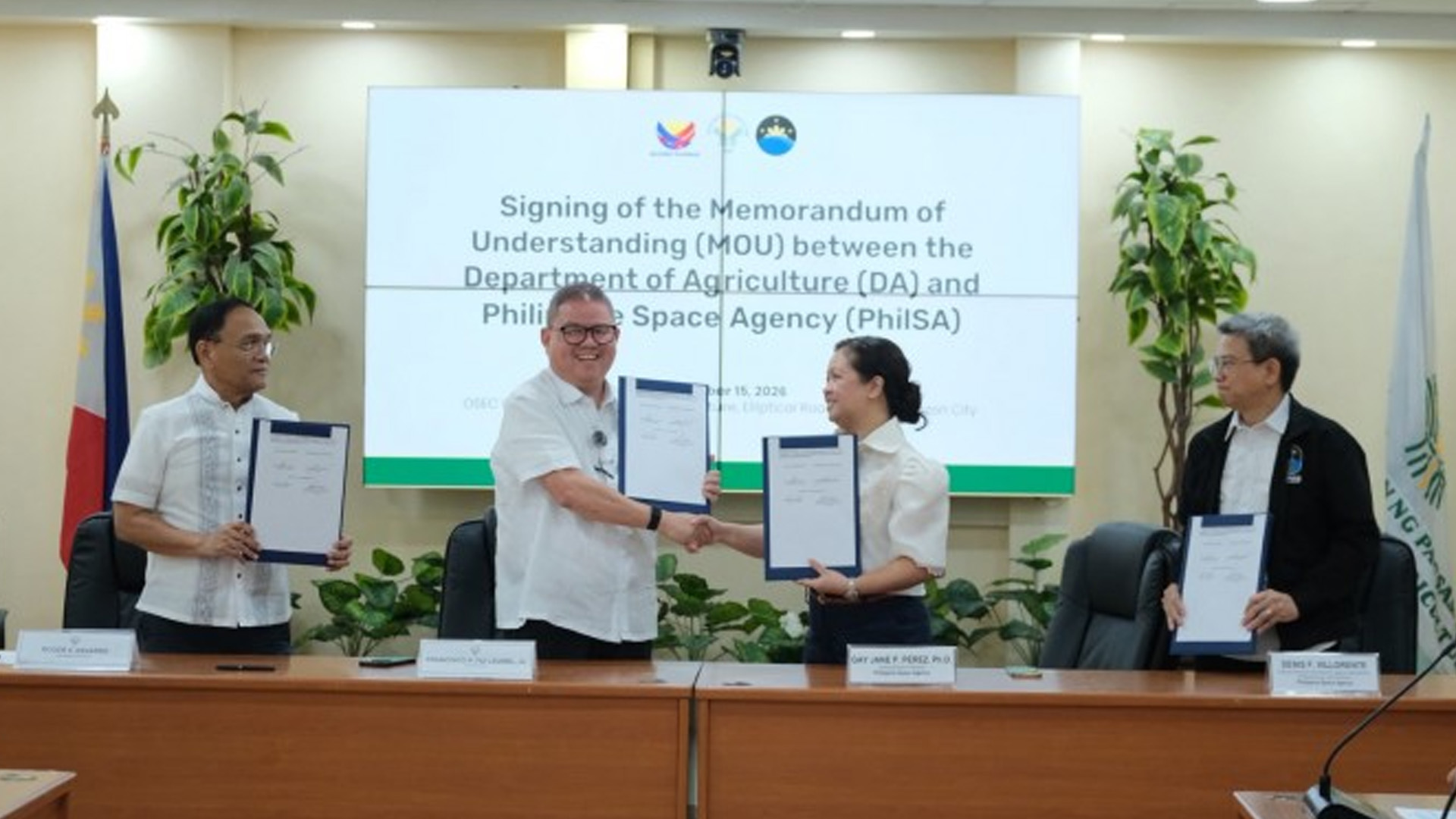







The Department of Agriculture (DA) said Tuesday it is looking to use satellite-based tools and artificial intelligence (AI) to help advance food security.
This is in partnership with the Philippine Space Agency (PhilSA) under a five-year framework.
In a statement, DA Secretary Francisco Tiu Laurel Jr. said the initiative will push for data-driven decision-making on the ground as space-based technologies are seen to strengthen agriculture, fisheries, disaster response, and climate-resilient planning.
“Definitely, we are not sending our farmers to space… What we are bringing down from space is information, technology, and better tools for decision-making,” he said.
“Ultimately, this is about using technology to strengthen food security and improve the lives of our farmers and fisherfolk.”
In particular, the framework seeks to utilize Earth observation and geospatial data to determine agricultural damage at a faster rate, enhance irrigation, and protect food production from the effects of floods, droughts, and other climate risks.
“From space, a satellite can see a flood. From the ground, a farmer sees a lost harvest. Our job is to connect those two views,” Tiu Laurel said.
Other functions include monitoring of crop conditions, hazard mapping for floods and drought, as well as areas susceptible to agricultural damage.
The satellite-based technologies can also help provide outlook through yield forecasts, track pests and diseases, and assess soil conditions.
For fisheries, the framework can also determine areas with potential productivity for fishing and aquaculture.
For its part, the PhilSA will be in charge of providing satellite data and technical assistance through the acquisition, processing, and analysis of Earth observation information.
The DA will gather on-the-ground data, validate satellite-based assessments, and integrate remote sensing, geographic information systems, and climate and hazard monitoring into agricultural programs.
“No matter how advanced our satellites become, we still need someone on the ground to confirm that what we see is, indeed, a farm,” Tiu Laurel said.
The framework, meanwhile, will not involve a transfer of funds, with each agency covering its own incidental expenses. (PNA)


