



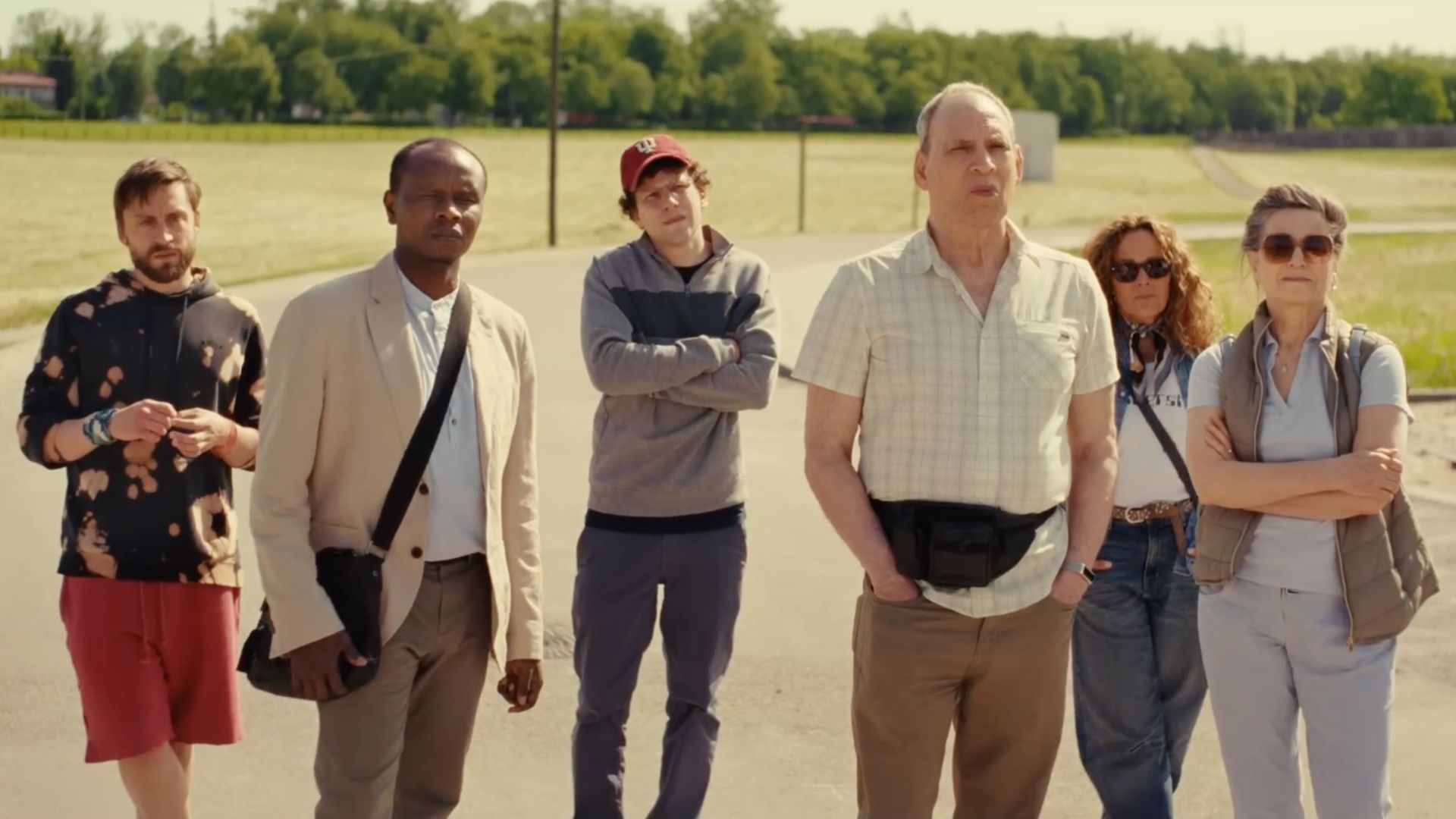






In “Letters to a Young Poet” (1929), poet Rainer Maria Rilke penned life-changing advice to a young poet named Franz Xaver Kappus. “Do not watch yourself too closely. Do not draw overrapid conclusions from what is happening to you. Simply let it happen,” his eighth letter read. Full of wisdom and introspection, it read like it was penned for the main character of “A Real Pain” himself, and pretty much everyone else in the cinemas.
As a growing fan of Rilke’s works, I could see his advice being a perfect soundbite over the ending shot of Jesse Eisenberg’s most outstanding film yet, which is a visual parallel to its beginning: a medium close-up shot of Benji Kaplan (Kieran Culkin) at the airport, sitting and glancing at everyone like a spectator without his cousin David Kaplan (Jesse Eisenberg) in his presence. Despite the parallelism, it looked like an entirely different sequence, as, based on Benji’s expressions, his life seemed to flash before his eyes. As I sat on the couch, jacket on, my thoughts drifting to Rilke’s letters at the bottom of my backpack, I, too, watched Benji process everything that had happened in their trip to Poland—life happening right before me, as if he were life itself. It spoke not only to my own but to everyone else’s.
With the film ending on that shot, some critics pointed out that the heritage tour didn’t change Benji at all, while others insisted that he was still analyzing what he would do once he returned home. Whatever they might say, I believe something has already happened to Benji. Something has already died in him. The author of my favorite book once said that a plant needs to be buried in order to grow; thus, when there is death, there is going to be life. Even if it takes us years to change, we will never not encounter a type of pain—personal, present, or historic—that will not transform us. As it is with Benji.
Culkin, who won the Golden Globe Award for Best Supporting Actor, was at his best in this film—his facial expressions, speech performance, and overall portrayal of a charming, miserable, and manic-depressed man. It hurt me to see his character because looking at him feels like looking at a mirror—I see my unlovable self, and I ache because I see how the world aches to be loved, just as I am.
Touching on subjects of grief, vulnerability, family, relationships, and world history, A Real Pain showed us the reality that all of us are in pain. It’s either we’re just good at hiding it or we’ve become numb enough not to notice. Eisenberg exposed the truth that we are all broken inside, and it’s this brokenness that causes us to wonder whether we truly belong in a cruel yet wonderful world like this or not. But the truth is we do, and in order to know and completely accept that, we have to feel all the emotions and experience both the highs and lows. We have to allow all the beauty and terror of life to transform us. We have to let life happen.
We will never know what will happen to Benji, but one thing’s for sure: he’s going to keep going—in his own amazing ways—and so we must, too, wherever we are in the world. We have to keep going, even if we don’t know where to go or there is nowhere at all, because, in Rilke’s words, “life is right, whatever happens”. No feeling is final.


