



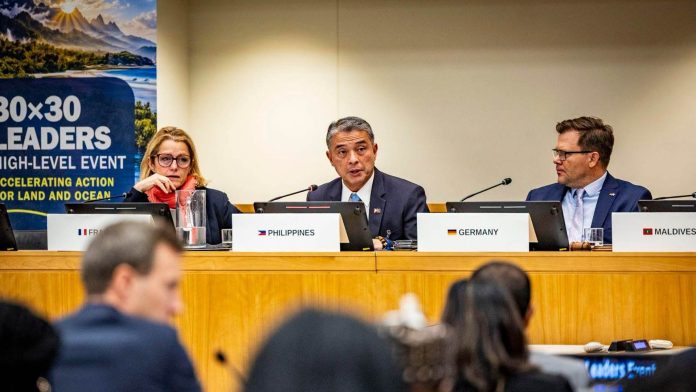






The Philippines is targeting the protection of 24 percent of its terrestrial areas and 16 percent of its coastal and marine areas by 2040 while seeking greater international financing to support biodiversity conservation.
According to a news release Wednesday, Department of Environment and Natural Resources (DENR) Secretary Juan Miguel “Mitch” Cuna presented the Philippines’ targets during his intervention at the 81st United Nations General Assembly (UNGA) Leaders Event for Nature and People held on Sept 25.
“The Philippines strongly reaffirms its commitment to the 30×30 target under the Kunming-Montreal Global Biodiversity Framework (KMGBF),” Cuna said.
The 30×30 target is a historic global commitment originally adopted at the 15th Conference of Parties of the Convention on Biological Diversity in 2022 under the KMGBF, which calls for the effective protection and management of at least 30 percent of the world’s land and oceans by 2030, with the goal of reversing habitat and species loss while addressing climate change.
Global coverage is only 17.16 percent for terrestrial areas and 9.8 percent for marine ecosystems.
The urgency is underscored by the World Economic Forum Global Risks Report 2026, which ranked biodiversity loss as the second top global risk over the next decade.
Cuna said the Philippines currently has 121 legislated protected areas covering more than 4.5 million hectares, noting that the country’s approach goes beyond expanding the number of protected areas.
“For us, 30×30 is not simply about increasing the number of hectares on paper. It is about ensuring that conserved areas are effectively managed, ecologically representative, and inclusive,” he said.
The Philippines is implementing its targets through the Philippine Biodiversity Strategy and Action Plan, while also advancing the Indigenous Peoples’ Biodiversity Strategy and Action Plan to integrate indigenous knowledge and rights into conservation policies through national dialogues.
Cuna said the country’s conservation work is being undertaken amid climate change, expanding settlements, food demand and the transition to renewable energy.
“Ambition must be matched by means of implementation, yet securing adequate biodiversity financing remains a critical hurdle,” he said.
The DENR said the Philippines is developing natural capital accounting and payment for ecosystem services to help address the funding gap and guide public and private investments.
Cuna said protecting biodiversity is particularly important for the Philippines because of its exposure to climate risks and its dependence on natural resources.
“As an archipelagic and megadiverse country, we recognize that protecting nature is not only a biodiversity imperative – it is fundamental to our climate resilience, food and water security, livelihoods, and the well-being of our people,” he said.
With the Convention on Biological Diversity’s COP17 approaching, Cuna urged stronger international cooperation and greater access to biodiversity financing for developing countries.
“As we move toward CBD COP17, we call for stronger international cooperation, technology and capacity support, and greater access to biodiversity finance, for developing countries,” he said.
“We believe that by working together, we can spur global ambition to protect and conserve nature upon which the health of our planet depends,” he added. (PNA)


