



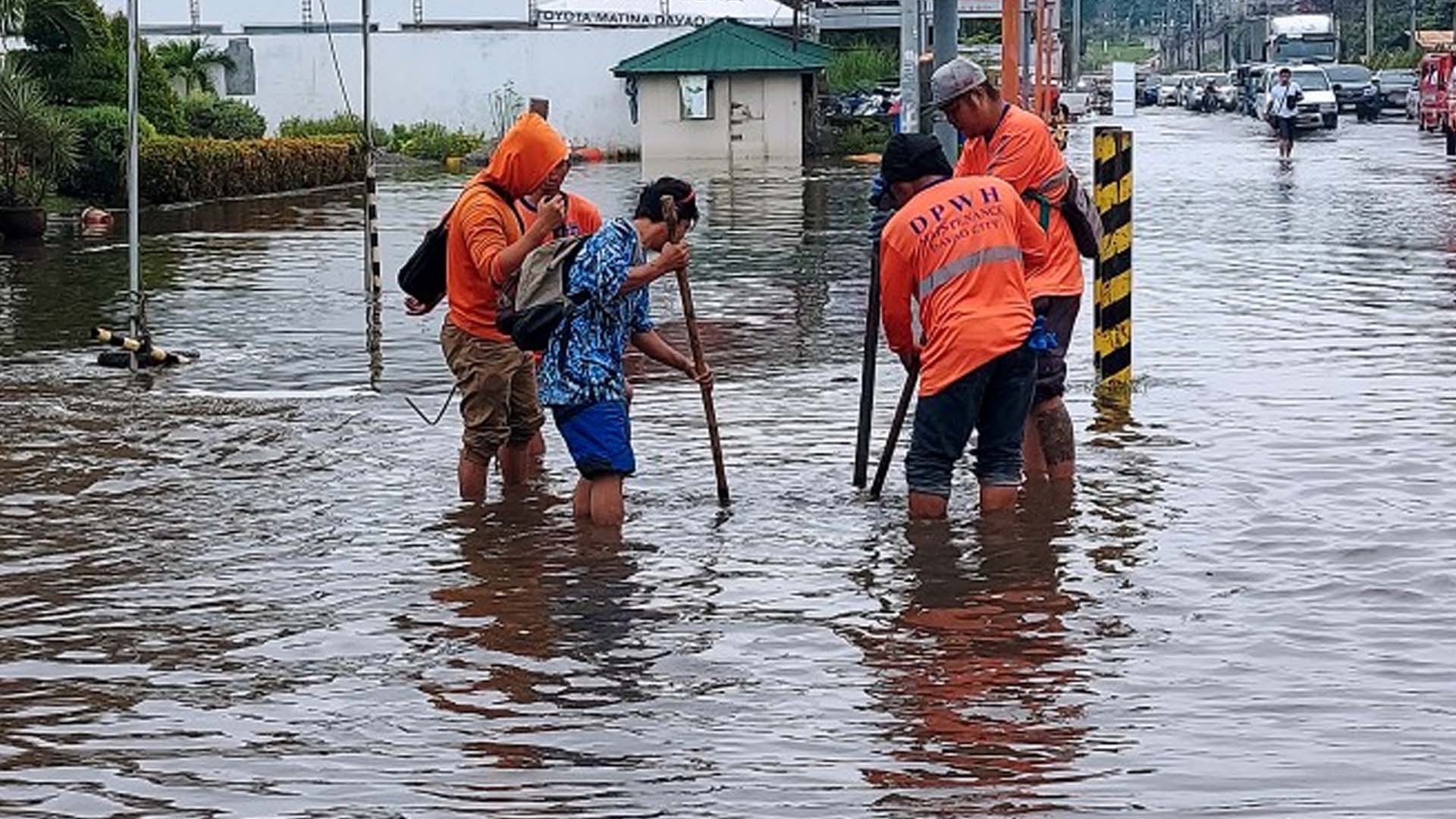






President Ferdinand R. Marcos Jr. is seeking the creation of higher flood walls and the implementation of aggressive reforestation program to control flooding, Malacañang said Wednesday.
Marcos’ plans were raised during his meeting with the Private Sector Advisory Council (PSAC)-Infrastructure and Digital Infrastructure Sector Groups at Malacañan Palace in Manila on Tuesday, the Presidential Communications Office (PCO) said in a news release.
During the meeting with the PSAC, Marcos said building higher flood walls “can do the trick.”
The PSAC said the construction of common towers in geographically isolated and disadvantaged areas could also help mitigate flooding.
Marcos said the implementation of an aggressive reforestation program is also key to address flooding, but acknowledged that it is not enough to manage flood risk.
He added the capacity of the government’s flood control system has decreased because of the country’s rising population.
Marcos said waste-to-energy initiatives could also be an effective flood prevention strategy, considering that garbage problem caused perennial flooding during the onslaught of typhoons.
“All garbage ends up in waterways, making pumping stations fail,” the President said, according to the PCO news release, adding that the watershed areas eventually suffer due to “irresponsible” garbage disposal.
In a Facebook post on Tuesday, Marcos said his administration, with the help of the private sector, is committed to pursuing flood-control projects that will benefit Filipinos, especially those living in remote areas.
The PSAC, during a meeting with Marcos on Aug. 29, cited the need to implement flood control basins as part of the government’s Infrastructure Flagship Projects, particularly on the 88 rivers identified by the Integrated Water Resources Management Office.
‘Long-term’ solutions
In a separate news release, the PSAC said one of its recommendations was to implement a river basin master plan that includes the widening of the Manggahan Floodway and launching a nationwide watershed restoration program, particularly in priority areas like Marikina.
The PSAC said the proposal is expected as a “long-term” solution to address the flooding problem.
“PSAC’s flood mitigation recommendations include the construction of retarding basins and dams along critical waterways, enacting ordinances that require property developers to install rainwater detention systems, and enforcing easement laws to clear floodways of obstructions, including informal settlements,” it said.
“The Napindan River will also be dredged to improve the outflow of Laguna de Bay. The Water Resources Management Office (WRMO), in collaboration with the Philippine Disaster Resilience Foundation (PDRF), will oversee these initiatives.”
The PSAC also sought the comprehensive planning for critical waterways and bridges affecting major roads like EDSA and Roxas Boulevard, adding that reforestation efforts are also essential for environmental recovery.
It also stressed the need to revisit the Parañaque Spillway project, construct a flood diversion tunnel from the Upper Marikina River to the Pacific Ocean, and make coconut-based garbage traps in villages to prevent drainage blockages.
The PSAC also expressed support for the consolidation of water and drainage management under the proposed Department of Water Resources.
It also encouraged local government units to collaborate on a unified approach and invest in waste-to-energy projects through public-private partnerships.
Digital infrastructure
Meanwhile, the PSAC also vowed to continue working with the Marcos administration to improve digital connectivity in the country.
The PSAC said around 100 new mobile towers will be built by July 2025, providing coverage to 100 villages and public schools, with 500,000 Filipinos gaining free internet access through the BBM Internet Promo.
This, as the council acknowledged that geographically isolated and disadvantaged areas in the country lack adequate digital infrastructure.
“To expedite the rollout, PSAC recommends simplifying the permitting process by adopting unified LGU forms. Legislative reforms such as institutionalizing the Center for AI Research (CAIR) and creating an open, secure API ecosystem are also pivotal for fostering digital innovation,” PSAC said.
“PSAC further emphasizes that digital connectivity should be recognized as a basic human right, ensuring that telco facilities are exempt from lease fees and that buildings are equipped with connectivity before occupancy. These recommendations are critical for strengthening the nation’s digital infrastructure and promoting inclusive growth, particularly in underserved communities.” (PNA)


