



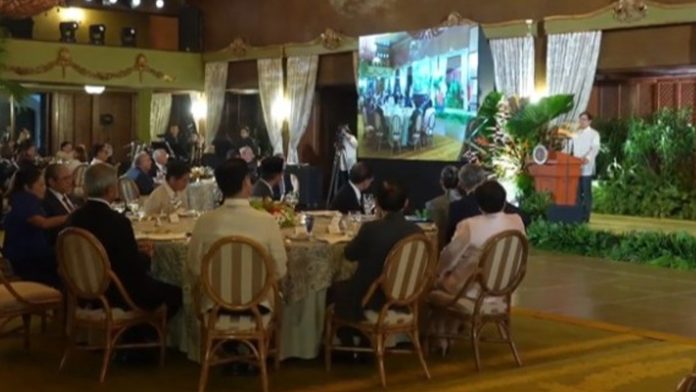






President Ferdinand R. Marcos Jr. on Friday emphasized the importance of collective effort in sustaining lasting peace and cooperation among Southeast Asian nations and their partners.
Marcos hosted gala dinner at Malacañan Palace for visiting foreign ministers who joined the commemoration of the 50th anniversary of the Treaty of Amity and Cooperation (TAC) in Southeast Asia.
The TAC was signed on Feb. 24, 1976 in Bali, Indonesia during the first ASEAN Summit by the five founding members – Indonesia, Malaysia, the Philippines, Singapore and Thailand.
“The document signed that day was far more than just a treaty. It was a statement of confidence in our region’s future, a conviction that despite our differences, Southeast Asia could build its security through mutual respect and cooperation,” Marcos said.
“Now, five decades later, that moment now carries a meaning we could barely have imagined,” he added, stressing that convening “a community of nations” together is “one of the most endearing legacies of the TAC.”
Earlier Friday, four European nations — Sweden, Poland, Romania, and Lithuania — acceded to the TAC as the new high contracting parties, reaffirming the pact’s growing relevance as a cornerstone of peace, stability and cooperation in the region.
The TAC aims to promote perpetual peace, amity and cooperation among Southeast Asian nations, guided by principles aligned with the United Nations charter.
Marcos expressed optimism that the gala dinner would serve as a reminder that every enduring partnership begins with a conversation, every lasting friendship with mutual trust, and every meaningful cooperation with a willingness to sit together, listen to one another and seek common ground.
“Throughout the day, you have worked together in the spirit of cooperation. You exchanged views with candor, listened to one another with respect, and explored practical ways to strengthen the TAC in response to the challenges of our time,” he said.
“These remain the very ideals upon which the Treaty was founded, and they remain as relevant today as they were in 1976,” Marcos added.
He stressed that enduring peace is “never achieved by chance” but is “built patiently, sustained collectively, and nurtured intently.”
Marcos expressed hope that the TAC’s principles would translate into “practical and mutually beneficial cooperation” in the region.
“Diplomacy, too, has always found its place around tables. Across generations, they have served as a marketplace of ideas for diplomats and policymakers. They have borne witness to exchanges of national statements, observed how consensus is reached, and have been among the first to witness landmark documents being signed,” he said.
“Upon these tables rests the agreements that shape economies, bolster relations amongst nations, deepen cultural understanding, and ultimately preserve peace.”
ASEAN member-states and their partners also convened for the 59th ASEAN Foreign Ministers’ Meeting; the Post-Ministerial Conferences; and Related Meetings, highlighting the regional bloc’s enduring role in fostering dialogue and strengthening partnerships amid evolving regional and global challenges. (PNA)


