



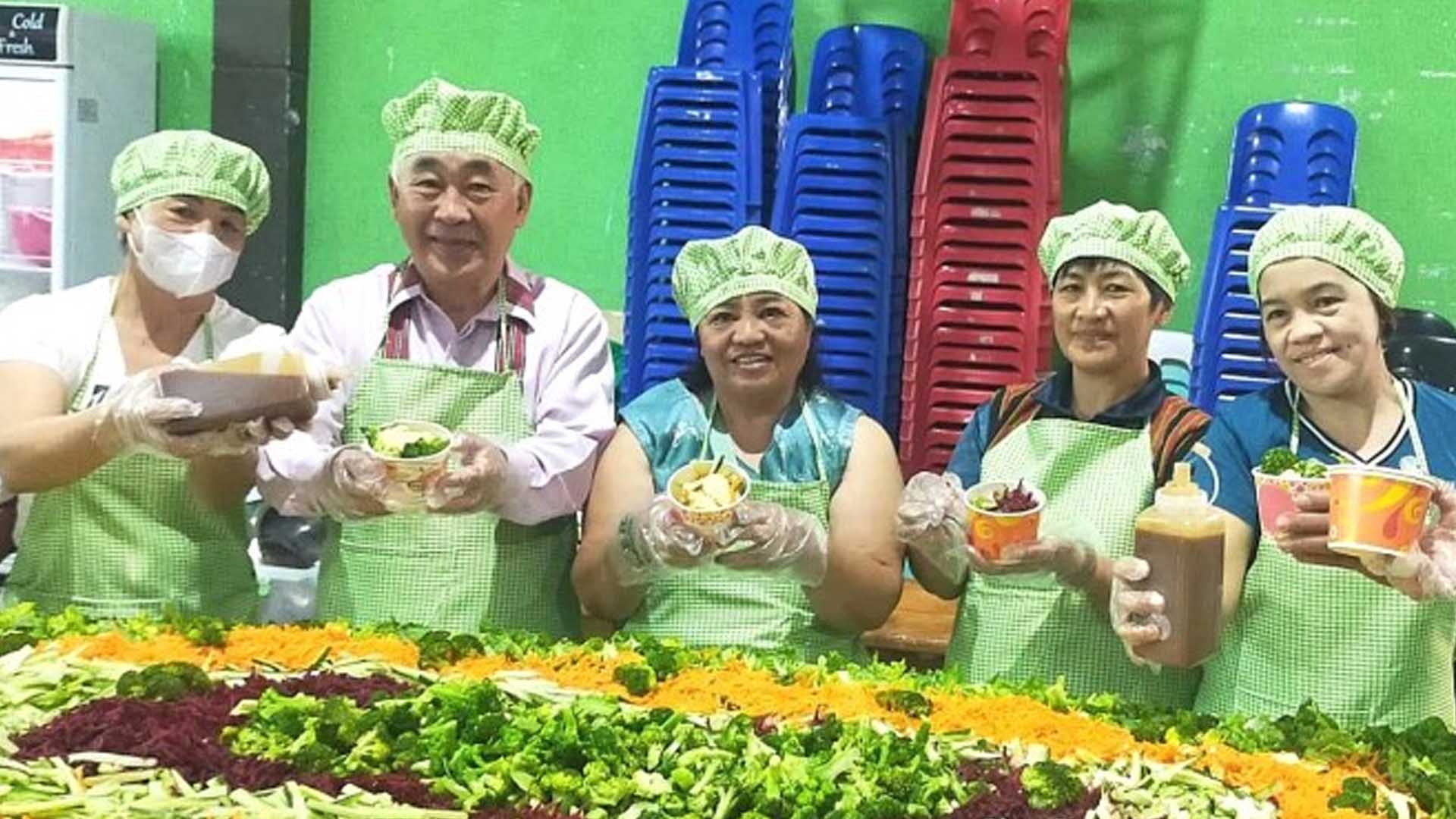







This capital town is gearing towards further increasing its organic vegetable and food production by five percent every year, with more health buffs preferring organically produced food.
“Our goal is to increase the organic farmer practitioners and GAP (good agricultural practices) practitioners by five percent every year so that we have more of the products,” La Trinidad municipal agriculture officer Nida Organo said in Ilocano on the sidelines of the serving of the Green Vegetable Salad event during the ongoing 6th Highland Vegetable Industry Week here on Thursday.
Out of the 180 organic practitioners in this capital town, at least 15 have been certified as organic practitioners by a third-party certifier.
A certification allows the farmers to package and sell their products with the certification seal.
Organic vegetable production uses compost materials as fertilizers and soil enhancers aside from naturally-made pesticides to kill insects that destroy the plants or damage the leaves. No chemical is introduced to the soil or to the plant making the produce safer to eat even if raw. A GAP-certified vegetable producer strictly comply with the appropriate use of chemically-grown products, including the interval of spraying them on the plants.
Aside from being the top producer of strawberries and being known as the rose (flower) capital, this town’s around 3,571 hectares of land is being used for agriculture, with 1,422 hectares used for vegetable production.
Of the number, only 11.6 hectares are used by organic and GAP practitioners producing broccoli, cauliflower, tomato, different varieties of lettuce, cucumber, among others.
“Their areas are small. The average area of an organic or a GAP practitioner is 500 square meters. Some have 100 or 250 square meters,” Organo said.
It was in this town where the first organic vegetable practitioners group was organized, which also led to the opening and operation of organic farms that later progressed to become learning sites aside from being agri-tourism farms promoting farm-to-table systems.
Gains of chemical-free
Stores selling organic vegetables have stable prices compared to the highly unpredictable and fluctuating prices of conventionally produced vegetables, making it more income-generating and viable to produce organic and GAP certified.
Organo said that to encourage continued organic production, the town provides greenhouses, irrigation, and farm inputs such as open-pollinated seeds.
Continuing training on GAP observance, organic production, bookkeeping and many more are also provided to those who desire to go organic and for those who are interested in starting farming and following the organic way.
She said further urbanization of their town is an additional reason to adopt urban gardening, with farmlands being converted to residential or commercial and economic activities.
Aida Pagtan, Department of Agriculture-Cordillera Regional Agriculture and Fisheries Information Service (RAFIS) chief, said organic production is among the programs of the department, where production of natural fertilizers, pesticides, soil enhancers and flowering or fruiting agents are focused.
She said that the shift to organic production from the conventional is a huge leap that is not easy in the Cordillera since it could affect the country’s food sustainability.
Thus, authorities are slowly pushing this by shifting to GAP certification where food is assured to be grown the proper and acceptable way following proper use of chemicals. (PNA)


