



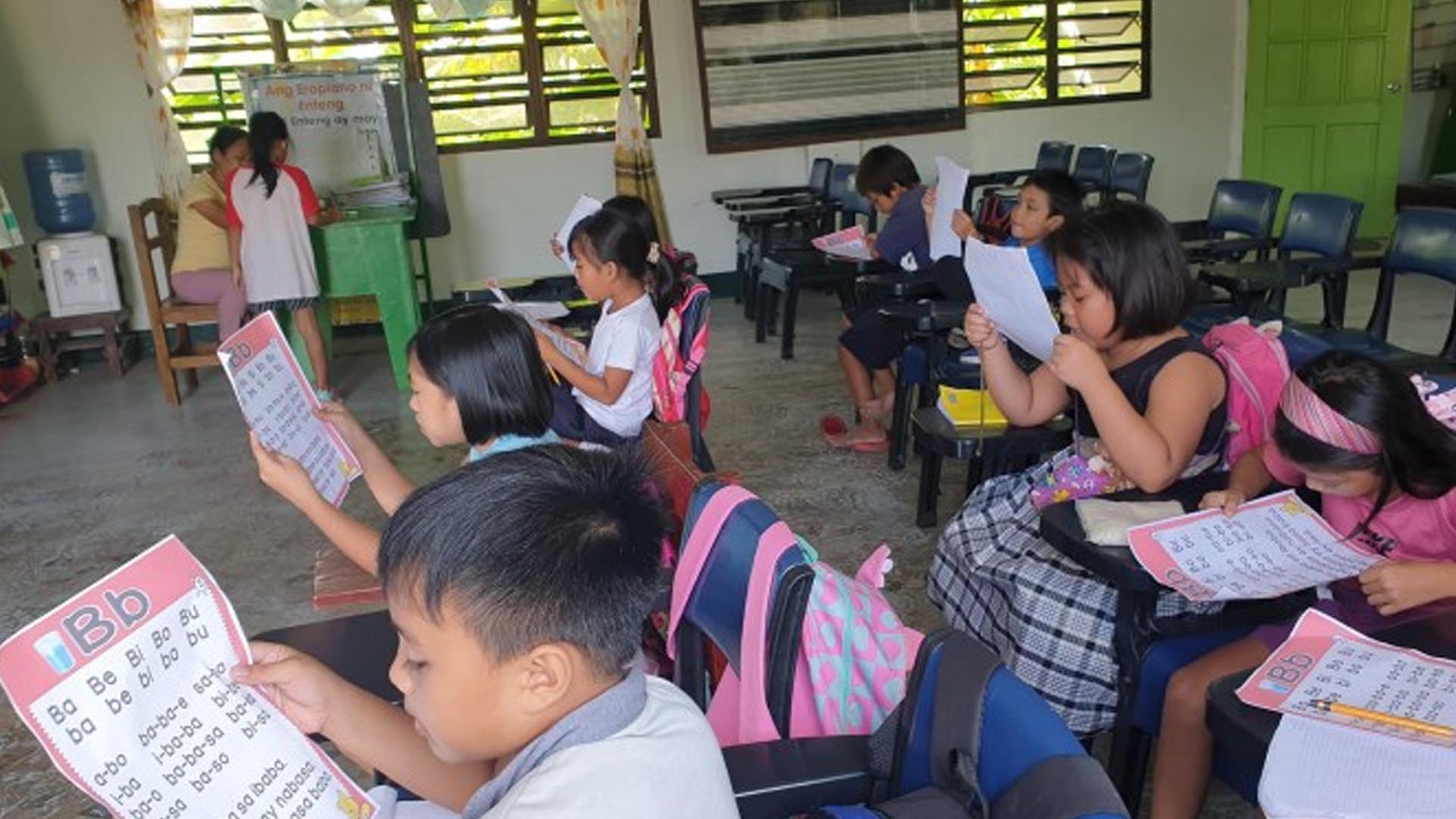






Some 343,920 learners from Grades 1 to 10 in Eastern Visayas will be covered by the Academic Recovery and Accessible Learning (ARAL) Program, to assist struggling readers this academic year.
The Department of Education (DepEd) regional office here reported on Tuesday that the figure represents 40.29 percent of 853,510 learners currently enrolled in Grades 1 to 10.
The majority of the target learners, or 157,230, are secondary students whose performance is three school years below their expected grade level based on the result of the Philippine Informal Reading Inventory (Phil-IRI).
Some 99,412 of them have been identified as struggling readers (both elementary and secondary) found through the Comprehensive Rapid Literacy Assessment done at the beginning and end of the school year.
The remaining 87,278 are elementary pupils who are performing three school years below their expected grade level based on the evaluation in the Phil-IRI.
In a statement on Tuesday, DepEd Eastern Visayas Regional Director Ronelo Al Firmo said the ARAL program will address low reading proficiency this school year.
“Despite the strong performance of learners in Leyte in recent assessments, the region remains committed to ensuring no learner is left behind. We have taken initiatives to address this alarming literacy concern, such as capacity building for teachers and distributed learning resources,” Firmo said.
For the school year 2025–2026, ARAL will prioritize reading to provide immediate assistance to low and high-emerging readers, as well as frustrated readers.
The ARAL Program, institutionalized under Republic Act 12028, aims to address learning gaps in reading, mathematics, and science for kindergarten to grade 10 learners.
Tutors under the program are teachers, para-teachers, pre-service teachers, and other trained individuals. They will receive appropriate training and compensation.
Nationwide, the DepEd has identified 6,713,352 students as beneficiaries of the ARAL program who will be assisted by 447,537 tutors and 45,084 school heads.
In the region, eight in every 10 persons are basically literate, the lowest in the Visayas and the second lowest in the country, next to the Bangsamoro Autonomous Region in Muslim Mindanao, according to the Philippine Statistics Authority.
The highest basic literacy rate in the region was registered in Leyte at 88.6 percent, followed by Eastern Samar, 88.4 percent; Tacloban City, 88.3 percent; Southern Leyte, 87.9 percent; Biliran, 87.4 percent; Samar, 80 percent; and Northern Samar province, 74.9 percent.
In terms of sex, the basic literacy rate was higher for females at 87.3 percent compared to males at 83.1 percent. (PNA)


