



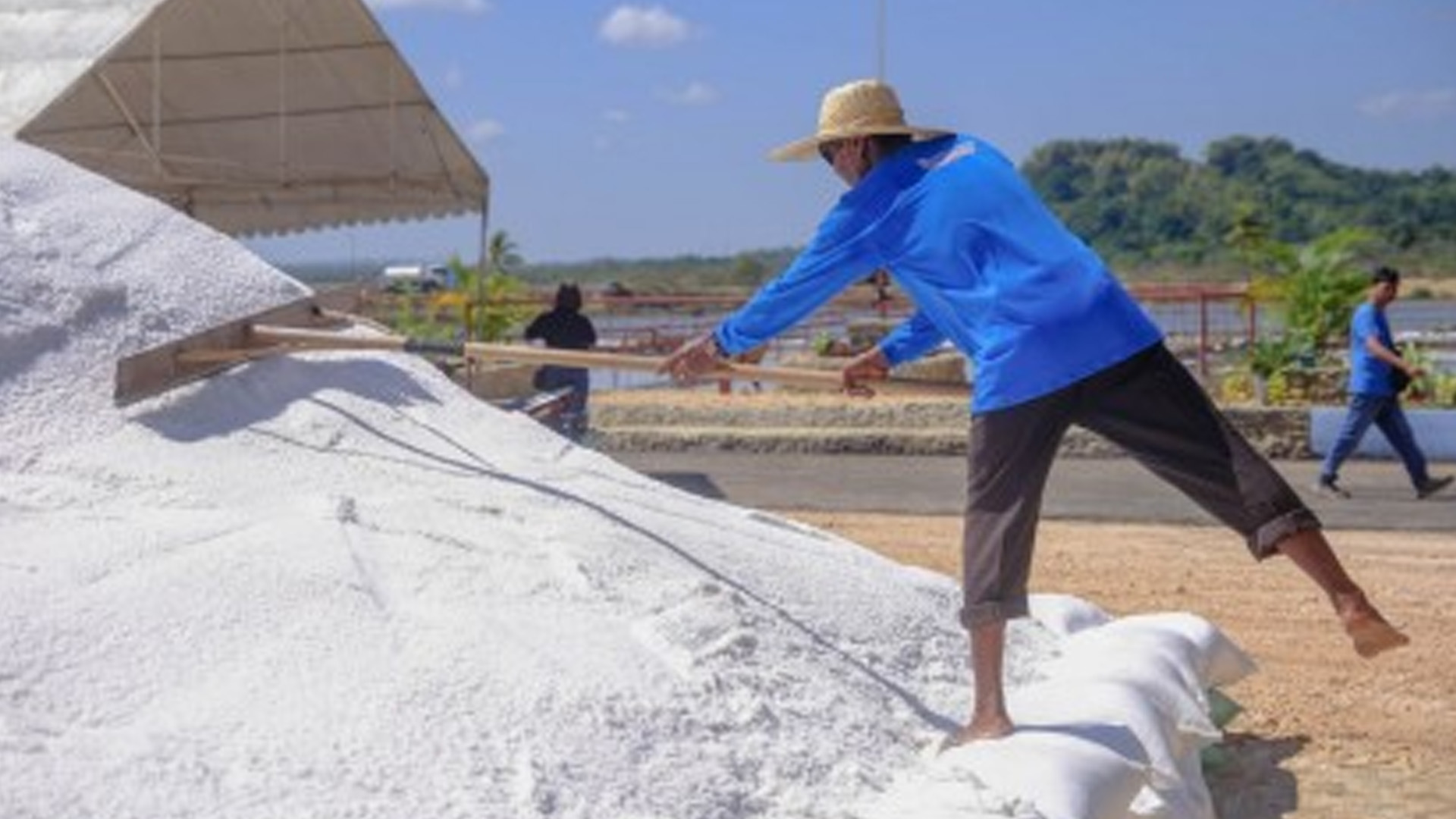






The Department of Environment and Natural Resources (DENR) will soon start identifying, mapping, and designating public lands and portions of municipal waters in the country that are suitable for salt production, in compliance with Republic Act No. 11985, or An Act Strengthening and Revitalizing the Salt Industry in the Philippines which took effect on April 1.
“Pursuant to Section 9 of the Act, the DENR, through its appropriate bureaus and its attached agencies, the National Mapping and Resource Information Authority (NAMRIA) and the Bureau of Fisheries and Aquatic Resources (BFAR) are mandated to map out, identify, and designate public lands, including portions of municipal waters, as salt production areas,” the DENR said in a news release.
Priority areas for salt production include Ilocos Norte, Ilocos Sur, La Union, Pangasinan, Zambales, Bataan, Occidental Mindoro, Oriental Mindoro, Palawan, Marinduque, Quezon Province, Misamis Oriental, and Antique.
Salt production areas identified in said provinces must be designated and declared within 60 days from the effectivity of the Act.
Under Section 10, the DENR is mandated to transfer the public lands mapped out, identified, and designated as suitable for salt production under its administrative jurisdiction to the BFAR within 90 days from the effectivity of the Act.
“Public lands located in other regions shall also be subsequently mapped out, identified, and designated as potential salt production areas within six months from the effectivity of the Act,” the DENR noted.
Meanwhile, the DENR is also mandated to inform the public of the result of the mandatory mapping, identification, and designation of said public lands, and inform interested salt industry investors.
A report on the completion of the mapping should then be provided to the Congressional Oversight Committee on Agriculture and Fisheries.
The DENR Secretary or her designated permanent representative shall also be a member of the Salt Industry Development Council or Salt Council which shall be created “to ensure the unified and integrated implementation of the Salt Roadmap and accelerate the modernization and industrialization of the Philippine salt industry.”
DENR Undersecretary Jonas Leones, meanwhile, said that they will also look at, and assess abandoned fish ponds for salt industry development, while fish sanctuaries and marine protected areas will be excluded.
Leones also assured that local fishermen fishing in municipal waters will not be affected, as they normally fish in deeper areas, while salt production is done on the dry part of the coastline. (PNA)


