



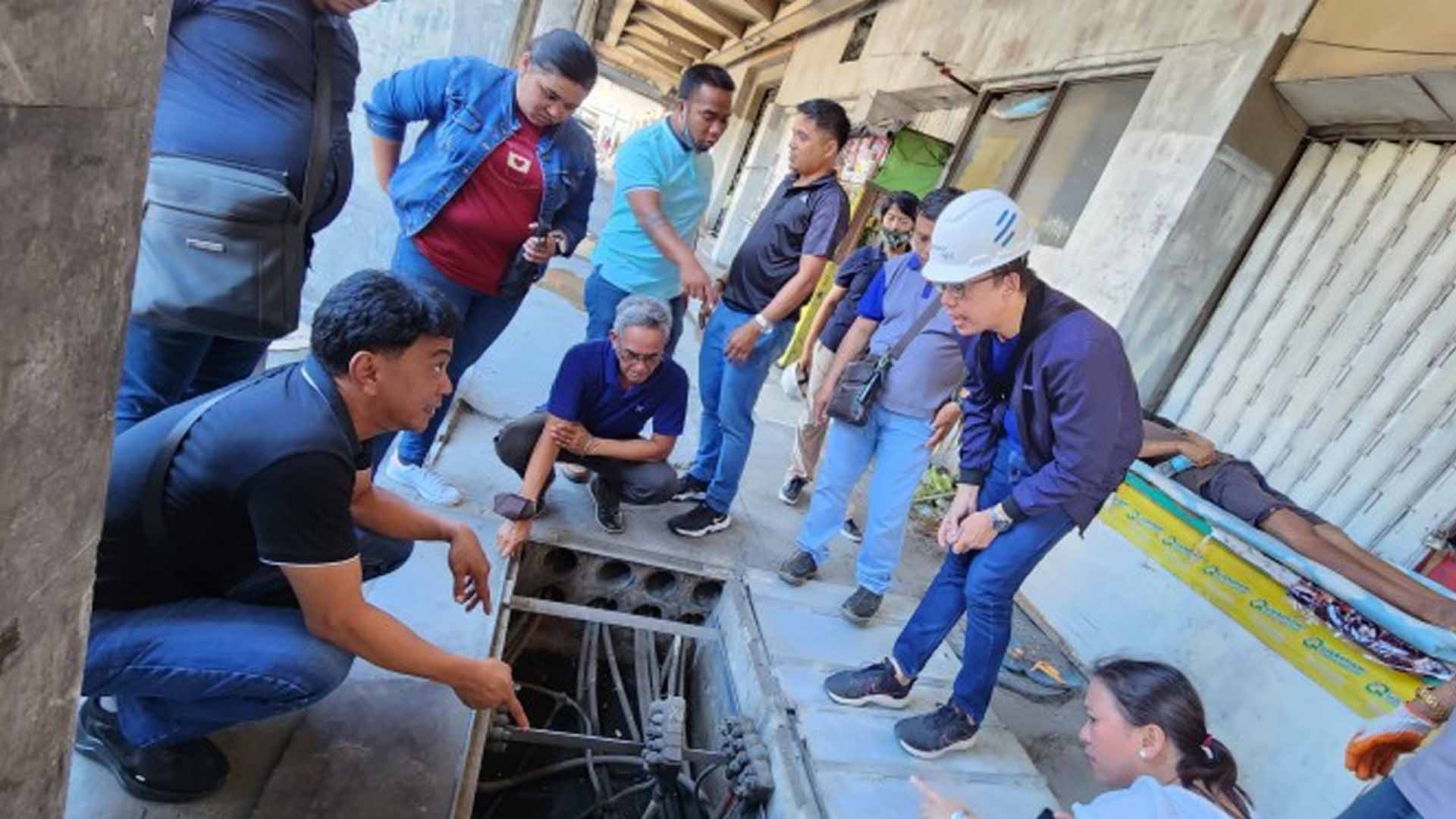






As this city aims to get rid of overhead wires by 2029, some local government units (LGUs) in the country have done benchmarking activities here to replicate the city’s underground cabling project.
Manila-based reporters recently visited the underground cabling project here of Davao Light and Power Company, Inc., wherein the firm said the LGUs of Butuan, Bataan, Mandaluyong, Naga, and Zamboanga Peninsula have learned how Davao Light is implementing the project.
“We didn’t expect the attention on the project. It was heartwarming and overwhelming when people started going to us on these benchmarking activities. It is (a) humble proof that Davao Light is already empowering our cities with the technology of undergrounding,” Davao Light project lead and design engineer Prince Rainier Yamyamin said.
Placing wires and cables of power and telecommunications companies underground was mandated by the Davao City LGU in 2014, with pilot areas including the vicinity of city hall and its Sangguniang Panlungsod.
Seeing that undergrounding cables and wires has improved the image of thoroughfares and enhanced the safety as well as reliability of power and telecommunication services, the Davao City LGU extended the project along the Kadayawan route and the central business district.
Through City Ordinance No. 0152-17 Series of 2017, the underground cabling project was extended to C.M. Recto St.; R. Magsaysay Ave.; C. Bangoy St., Bonifacio and Pelayo Streets; and San Pedro St.
But due to the pandemic, the completion of the project in 2020 was delayed. The LGU decided to extend the implementation of the projects until 2029.
“The implementation of underground cabling was not an easy journey. There came a time when our frustrations tried to eat us as the target date for the completion of the projects got nearer and nearer. As much as it was my first time handling this type of project, it was also a first time for our civil and electrical engineering contractors,” Yamyamin said.
Davao Light shared that the technology and method used during the pilot phase and the current projects were different.
Before, contractors broke and excavated the concrete in the streets then placed the conduits, or the pipes that protect the electric wiring.
Secondary 220-volt electric wires were inserted into the conduits while the primary lines carrying a voltage of 13.8 kV were directly buried along the road. They will cement the street again, and until then overhead wires will be removed.
Yamyamin said the company now uses the semi-direct method, wherein wires are no longer directly buried but are all inserted into the conduits, which is easier to maintain and offers more protection from physical damage.
Davao Light also uses different methods of installing transformers, an electromagnetic device that transforms voltage based on the service requirement of the customer.
For underground line facilities, installing transformers involved pad-mounting for a platform-type transformer.
Davao Light senior manager for lines section Leonardo Remulta III also cited challenges for underground cabling for other LGUs and contractors need to address.
These include getting the right of way; weather conditions; traffic control; obstruction of drainages, water lines, and existing telecommunication lines; soil conditions; and other unforeseen events such as the coronavirus disease 2019 (Covid-19) pandemic.
He added the political will of an LGU is also critical in implementing this kind of project.
Davao Light has committed to delivering all the underground cabling projects by 2029 as the city government aims for a wire-free city in six years. (PNA)


