







Over 2.6 million students have benefited from the government’s Free Higher Education Program in the first semester of Academic Year 2025-2026, as the Commission on Higher Education (CHED) reported significant gains in access, scholarships, workforce development, research and digital transformation during the first year of its ACHIEVE Agenda.
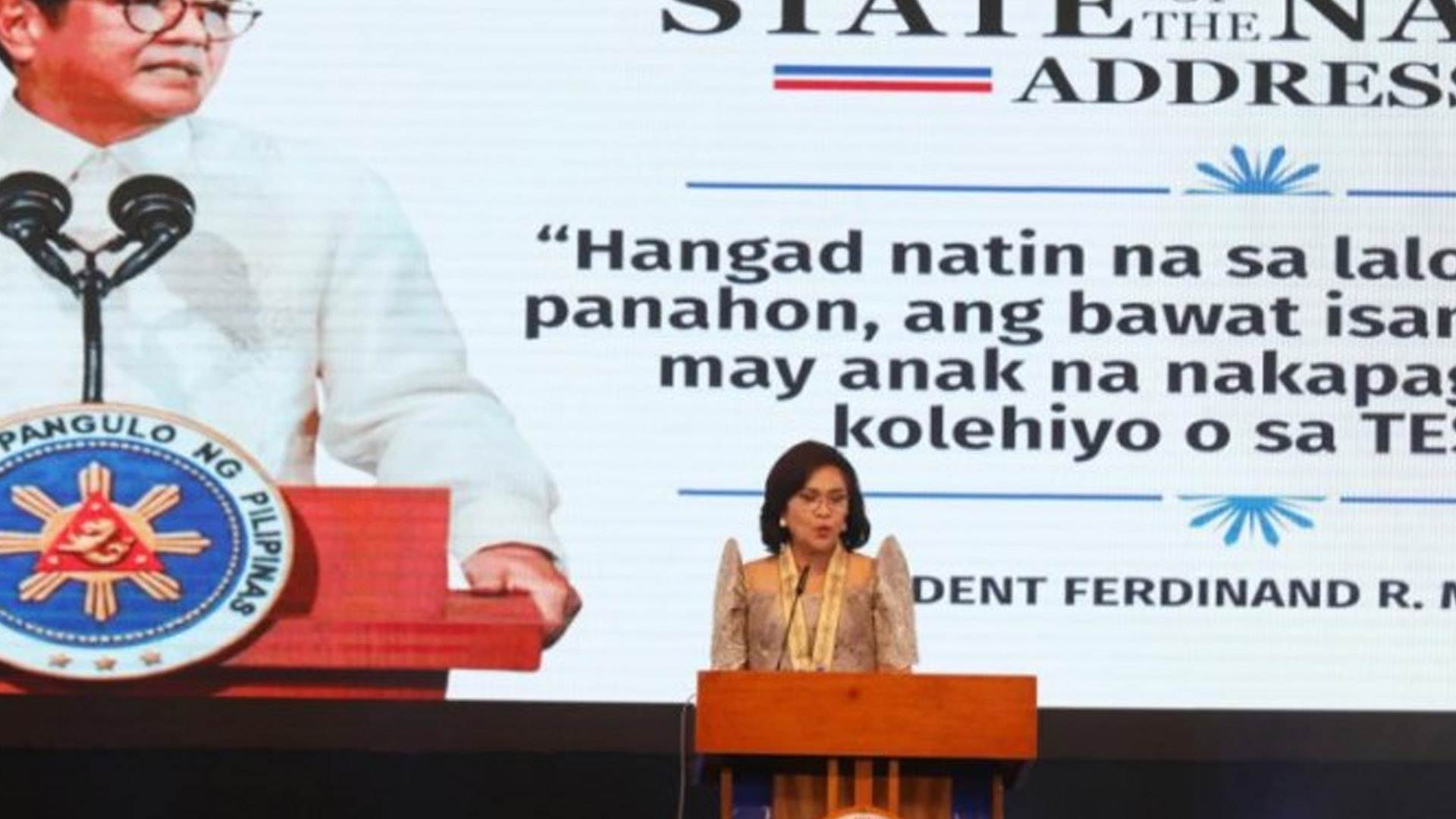
In her State of Higher Education Address during CHED’s 32nd founding anniversary celebration on Wednesday, Chairperson Shirley Agrupis cited the measurable outcomes achieved from the agency’s reform agenda, making higher education more accessible, responsive to industry needs and globally competitive.
Agrupis noted that the reforms were anchored on President Ferdinand R. Marcos Jr.’s vision of expanding educational opportunities for every Filipino family.
She quoted Marcos’ 2025 State of the Nation Address, in which the President expressed hope that every family will have a child who has graduated from college or from TESDA (Technical Education and Skills Development Authority).
“This vision reflects the aspirations of Filipino families — parents seeking better opportunities for their children, workers turning experience into recognized qualifications, and learners striving for a better future through education,” Agrupis said.
“Ito ay hindi lamang tungkol sa edukasyon. Ito ay pagkilala na ang dekalidad na mas mataas na edukasyon ay susi sa pag-angat ng buhay, pagpapalawak ng oportunidad, at pagsusulong ng pambansang kaunlaran (This is not just about education. This is the recognition that quality higher education is the key to improving lives, expanding opportunities and advancing national development). When more Filipinos access quality higher education, we build a stronger workforce and a more competitive nation,” she added.
Challenges
When she assumed office a year ago, CHED faced several long-standing challenges, including fragmented education systems, skills mismatches, limited research capacity, unequal access to international opportunities, outdated policies and weak stakeholder engagement.
After discussing these with the President, Agrupis said she was directed to “fix what hinders opportunity, and strengthen what drives excellence.
Under CHED’s “Advanced and Accessible Lifelong Learning” pillar, the agency expanded the reach of the Free Higher Education Program from 2.04 million students in 2022 to 2.61 million beneficiaries, up by almost 28 percent.
ACHIEVE, which stands for Advanced and Accessible Lifelong Learning; Centralized One-Nation Human Capital Development Plan; Harmonized SDG-based Higher Education Research and Innovation Agenda; Integrated Real-Time Data Collection and Analytics System; Expanded and Impact-Driven Internationalization Strategies; Vitalized Policies, Internal Systems, and Governance; and Effective and Efficient Public Service, is CHED’s seven-point strategic reform agenda for Philippine higher education (2025–2030) aimed at improving access, quality, employability, research alignment and global competitiveness.
Meanwhile, Agrupis noted that the Tertiary Education Subsidy recorded 727,451 beneficiaries during the first semester of Academic Year 2025-2026, the highest since its launch in 2018.
The program provides financial assistance to students as part of the government’s expanded access to higher education under Republic Act 10931 or the Universal Access to Quality Tertiary Education Act.
She also cited the Tulong Dunong Program, which provided financial assistance to 309,004 students.
CHED likewise strengthened support for disadvantaged learners through partnerships with the Department of Social Welfare and Development and by institutionalizing the Expanded Access to Scholarship for Special Equity Groups Program.
Expanded alternative learning
Agrupis said CHED continues to expand its alternative learning pathways through the Expanded Tertiary Education Equivalency and Accreditation Program (ETEEAP), which allows working Filipinos, including overseas Filipino workers, farmers, agricultural workers, community leaders, and social welfare practitioners, to earn college degrees by crediting their work experience and competencies.
She said 114 higher education institutions now offer ETEEAP nationwide, resulting in 3,343 individuals completing their degree programs.
To better align education with labor market demands, CHED also launched the Bagong Pilipinas Merit Scholarship Program and strengthened scholarship programs in priority sectors such as healthcare, agriculture, science, technology, engineering, and mathematics.
Collaboration between CHED and other government agencies and industry groups was also intensified to address skills mismatches and improve education-to-employment pathways.
Research and innovation likewise remained a key focus of the agency’s reform agenda.
She said CHED launched Sustainable Development Goals-focused research grants and expanded funding support for higher education institutions through programs designed to strengthen research capability, technology development, and innovation.
On the international front, Agrupis reported growth in transnational higher education (TNHE) programs and international partnerships under Republic Act No. 11448, or the Transnational Higher Education Act, which expands access to globally recognized academic programs and international learning opportunities.
“From only one approved TNHE program in 2022, we now have 16 approved programs, with 17 more applications under evaluation. We are now working to build a more robust and fully institutionalized TNHE ecosystem in Philippine higher education,” she said.
“To date, Philippine higher education institutions have established 4,847 university-to-university partnerships worldwide, while 82 government-to-government higher education agreements are now in place,” she added.
Agrupis also noted agreements forged with Cambodia, Bangladesh and Nova Scotia, Canada, and recently with the UK’s Quality Assurance Agency, which created new opportunities for academic mobility, research collaboration, and capacity-building.”
She said that CHED is also developing a national internationalization roadmap and pursuing the establishment of Philippine Education Global Services, envisioned as a one-stop platform for international students seeking to study in the country.
CHED has accelerated its digital transformation efforts through the rollout of new online systems for scholarships, academic credential verification, student records management, and higher education analytics.
She said that initiatives launched during the year include CHED TANAW, which provides real-time higher education data and analytics; the ETEEAP ENROLL System for online ETEEAP applications; the BPMSP, AHEAD, and enhanced SIKAP application portals for streamlined scholarship processing; and the eCAV System, which has already served more than 349,000 clients through fully online Certification, Authentication and Verification applications accessible through the eGovPH app. (PNA)


