



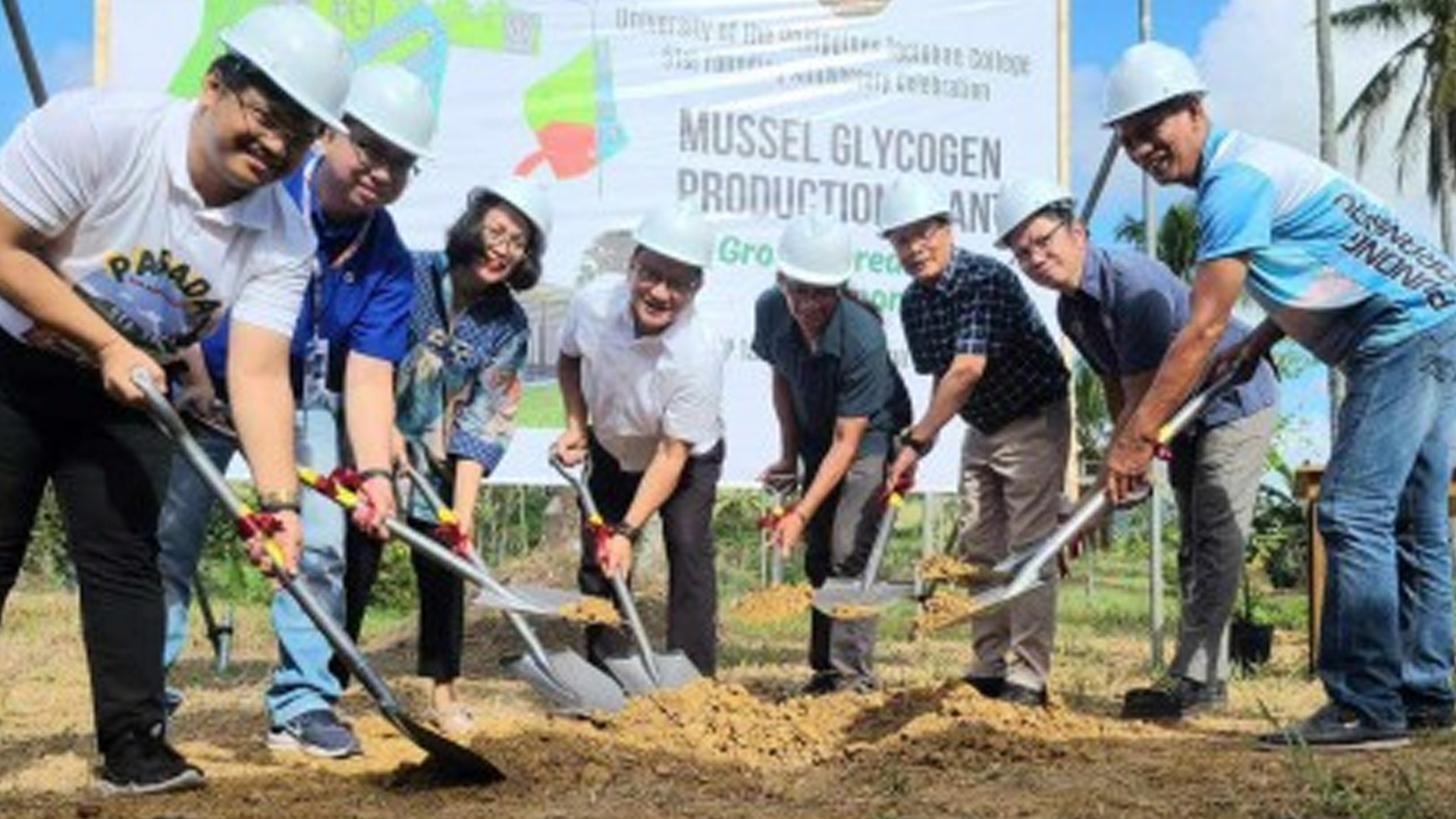






The country’s first mussel glycogen extraction plant will rise in this city, ensuring fishermen’s stable income amid the frequent occurrence of the red tide phenomenon.
Primarily funded by the Department of Science and Technology-Philippine Council for Agriculture, Aquatic, and Natural Resources Research and Development (DOST-PCAARRD), the PHP8 million facility will rise within a property of the University of the Philippines (UP) Tacloban in the city’s Sta. Elena village.
“We know that the economy of Eastern Visayas is largely affected by green mussel or tahong production. We know that the red tide affects the conditions of our fishermen and, therefore, the economy of the region. This plant finds solutions to the problem in the community,” UP President Angelo Jimenez said in a press briefing after the plant’s groundbreaking on Thursday.
Jimenez said that even with the occurrence of a red tide, which prohibits the consumption of green mussels, their meat can still be processed into glycogen for cosmetics and pharmaceuticals.
The DOST explained that mussel glycogen, with its unique properties and diverse applications, represents a breakthrough in sustainable production and innovation.
“The project will not only contribute to the economic growth of Eastern Visayas but will also pave the way for advancements in various industries, including pharmaceuticals, cosmetics, and food production,” the DOST said in a statement.
The production of mussel glycogen holds tremendous promise for both industry and its intended beneficiaries, not the industry alone but also the mussel farmers and other directly involved communities, according to DOST.
“The plant, which will be the first in the Philippines, will develop methods for producing glycogen on a scale that can be commercialized and used by large industries,” Jimenez added.
“This provides the tahong with a crucial added value as a non-food product. It will address the economic losses of mussel farmers whose harvest has been regularly devastated by the poisonous plankton species that cause red tide.”
Officials are eyeing the completion of the plant within a year.
Several bays in the region have been identified as vulnerable to red tide occurrences.
Red tide is a term used to describe a phenomenon where the water is discolored by high algal biomass or a high concentration of algae. (PNA)


