



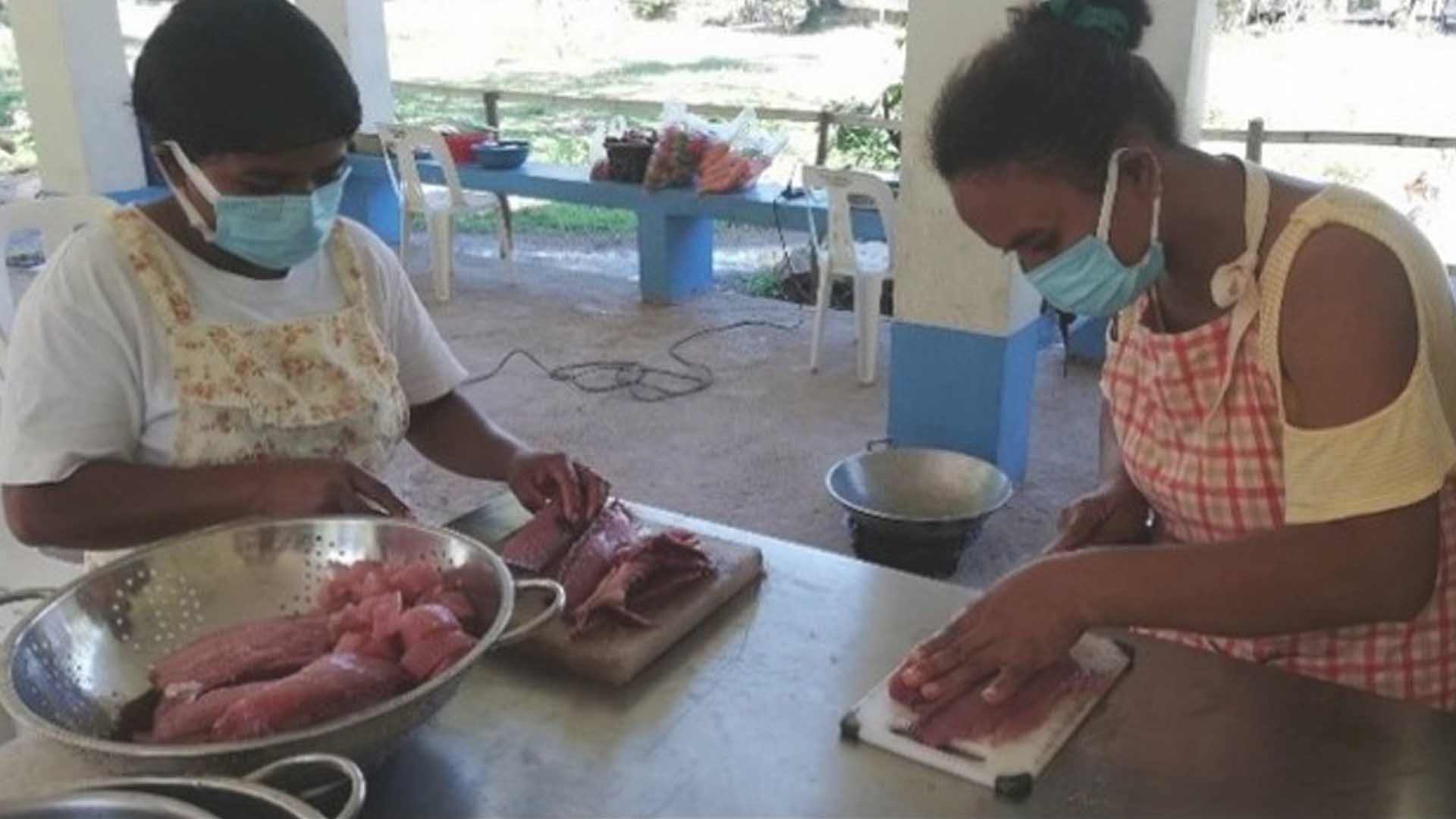






The Department of Science and Technology in Central Luzon (DOST-3) has provided technical assistance on fish processing and marketing to indigenous peoples (IPs) in Casiguran town, Aurora province to provide them with sustainable livelihood.
Maria Ana Espiritu, science research specialist II of the DOST-Provincial Science and Technology Office (DOST-PSTO), said on Wednesday the Samahan ng mga Katutubong Agta na Ikhan at Lhaman Phisad-Phisad (SAKAILAP) in Barangay Cozo, Casiguran received some PHP457,700 worth of assistance that includes fish processing equipment, packaging materials, laboratory analysis of products and label design execution.
“The Agta tribe’s main source of living is fishing. They ventured into fish processing. They use fish that have low market value such as small yellow fin tuna, locally known as “burubuto” and “matambaka” or bigeye scad to produce smoked fish,” Espiritu said in a statement.
To add value to the fish products, she said they conducted training on producing bottled fish in oil for 15 SAKAILAP members last March 2.
“The training was conducted to develop new product lines of the association. Basic product costing was also discussed with the participants,” Espiritu said.
With the provision of technical assistance, she said the SAKAILAP is expected to contribute to the economic development of their community.
Barangay Cozo is one of the villages along the San Ildefonso Peninsula in Casiguran that is being developed and promoted as a new tourist destination in Aurora due to its abundant natural resources and beautiful landscapes.
With this, the Agta tribe members are among those expected to benefit from the influx of tourists in the area.
Meanwhile, in Bataan, the DOST-3 has capacitated farmers’ groups to produce and sell brown rice.
Through the expanded implementation of the Community Empowerment through Science and Technology (CEST) program, the DOST provided each of the Greatest Manimas Farmers and Fisherfolk Association and Kapit Bisig ng Magsasaka ng Bilolo Inc. in Orion town a set of compact impeller brown rice mill (CIBRM) for commercial production of brown rice.
DOST-3 Director Julius Caesar Sicat said on Wednesday that the farmer-beneficiaries have already underwent training for the operation and maintenance of the CIBRM.
“The CIBRM allows the farmer-beneficiaries to mill their own harvest, saving them from costly transportation as they no longer need to bring their produce to commercial rice mills usually located in town centers. More importantly, this will give ready access to more nutritious brown rice in the rural communities where malnutrition is a problem,” Sicat said in a statement.
He cited the importance of making brown rice available to more people, especially those with nutritional deficiencies.
“Brown rice is produced by removing only the hull of the rice grain thus, leaving a higher content of nutritionally important fibers, minerals and natural oils, making it more nutritious than polished white rice,” the DOST official said.
He noted that the CIBRM has a milling recovery of around 70 percent which is higher compared to most common rice mills such as the stone disk or so-called “kiskisan” which has a lower milling recovery of 50-55 percent.
“The higher recovery and more efficient milling will substantially increase the production output and income of our local rice farmers,” Sicat said.
Last year, four farmer groups in Tarlac and six from Bulacan each received a CIBRM.
“By empowering the rice farmers, DOST is committed to bring science closer to the people and to push every rural area to continuously grow as progressive and resilient communities,” Sicat said. (PNA)


