



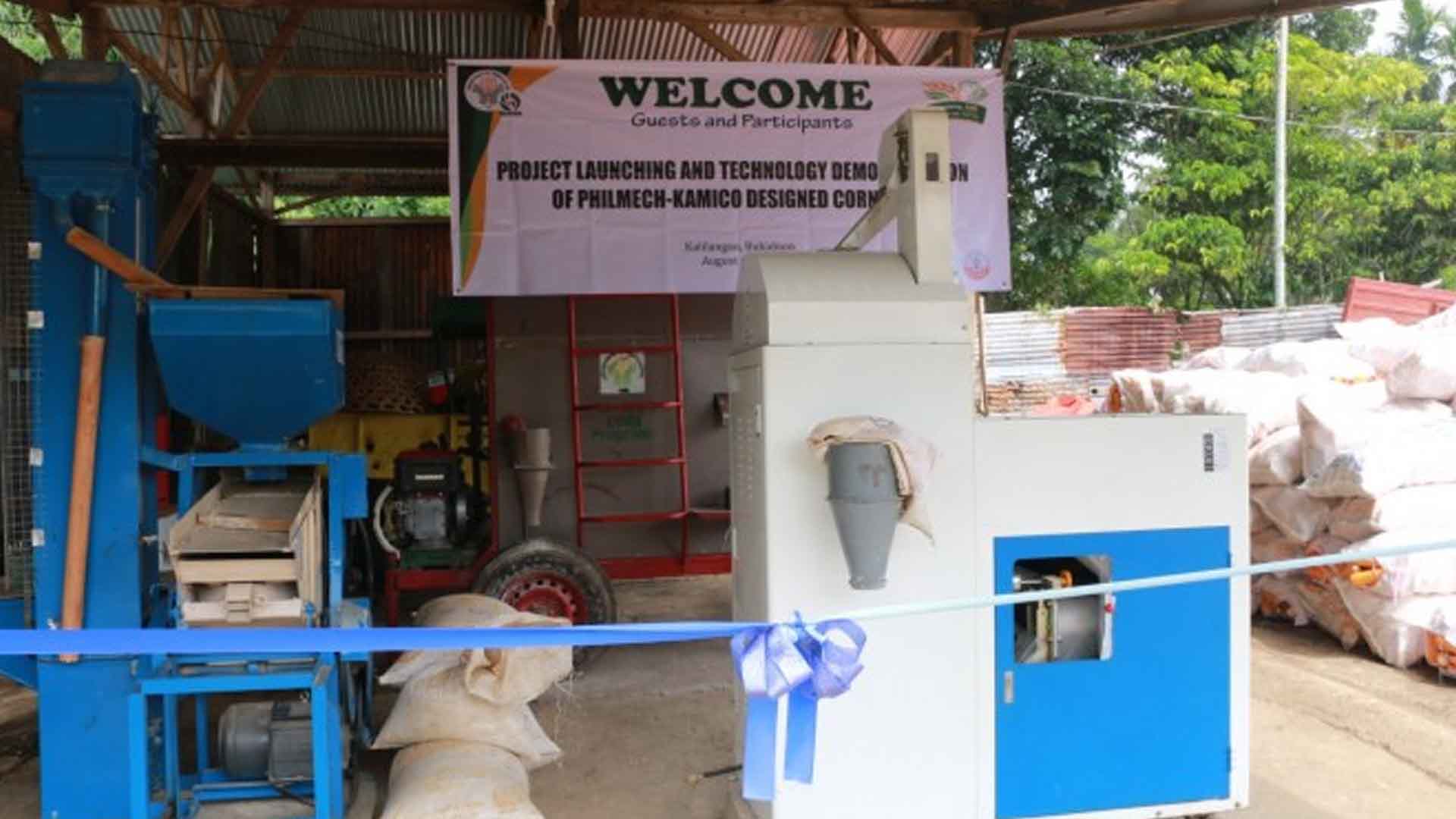






The Philippine Center for Postharvest Development and Mechanization (PhilMech) is eyeing the commercialization and wider adoption of the corn mill it developed in collaboration with the Korea Agriculture Machinery Industry Cooperative (KAMICO).
PhilMech Executive Director and Scientist IV, Dr. Dionisio Alvindia, on Monday said the project “Pilot Adaptation of the PHilMech-KAMICO Designed Corn Mill for Village Operation” was part of the agency’s coronavirus disease 2019 (Covid-19) response initiative that will also have a long-term impact on communities that depend on milled white corn or corn grits for their staple.
“This project supports the attainment of food security for communities that have lands and resources more suitable for growing white corn as their staple. Some parts in the Visayas and Mindanao also prefer milled white corn or white corn mixed with rice, called ‘bugas’ instead of rice, and this project will help ensure their food security,” Alvindia said.
He added that the agency is pilot testing the PhilMech-KAMICO Corn Mill in four sites — two in Bukidnon province; and one site each in Saranggani and Negros Occidental provinces.
“The pilot tests will be completed by June 2023, and after that, PhilMech will push for its wider adoption and study its commercialization. So far, the project is proceeding as scheduled,” Alvindia said.
Project Leader Engineer Donald Mateo said the corn mill, which can be easily transported, was developed by PHilMech and fabricated by KAMICO.
“It can mill 200 kilograms of corn with an output of 110 kilograms of corn grits per hour. It can separate the grits from the powder, and is powered by electricity,” Mateo said.
Uniform shape of grits are mostly produced by the PhilMech-KAMICO Corn Mill, which results in improved eating qualities of the milled corn.
Mateo added that the corn mill was also designed in such a way that women can also operate it. The corn mill needs only two people to operate.
“It can be easily operated like a washing machine, hence women can also operate the PhilMech-KAMICO Corn Mill,” he said.
It was in November 2016 when PhilMech and KAMICO entered into an agreement to level up the capabilities of the Filipino agency to design and produce farm machines.
Also, PHilMech in collaboration with KAMICO, Korea International Cooperation Agency (KOICA-Philippines), Korea Institute for Development Strategy (KDS) began last May establishing Agricultural Machinery Design and Prototyping Center (AMDPC) in the agency’s headquarters in Muñoz, Nueva Ecija. The AMDPC took in investment of USD3.6 million and will have state-of-the-art design and prototyping equipment and tools to develop farm machinery parts and components. (PNA)


