



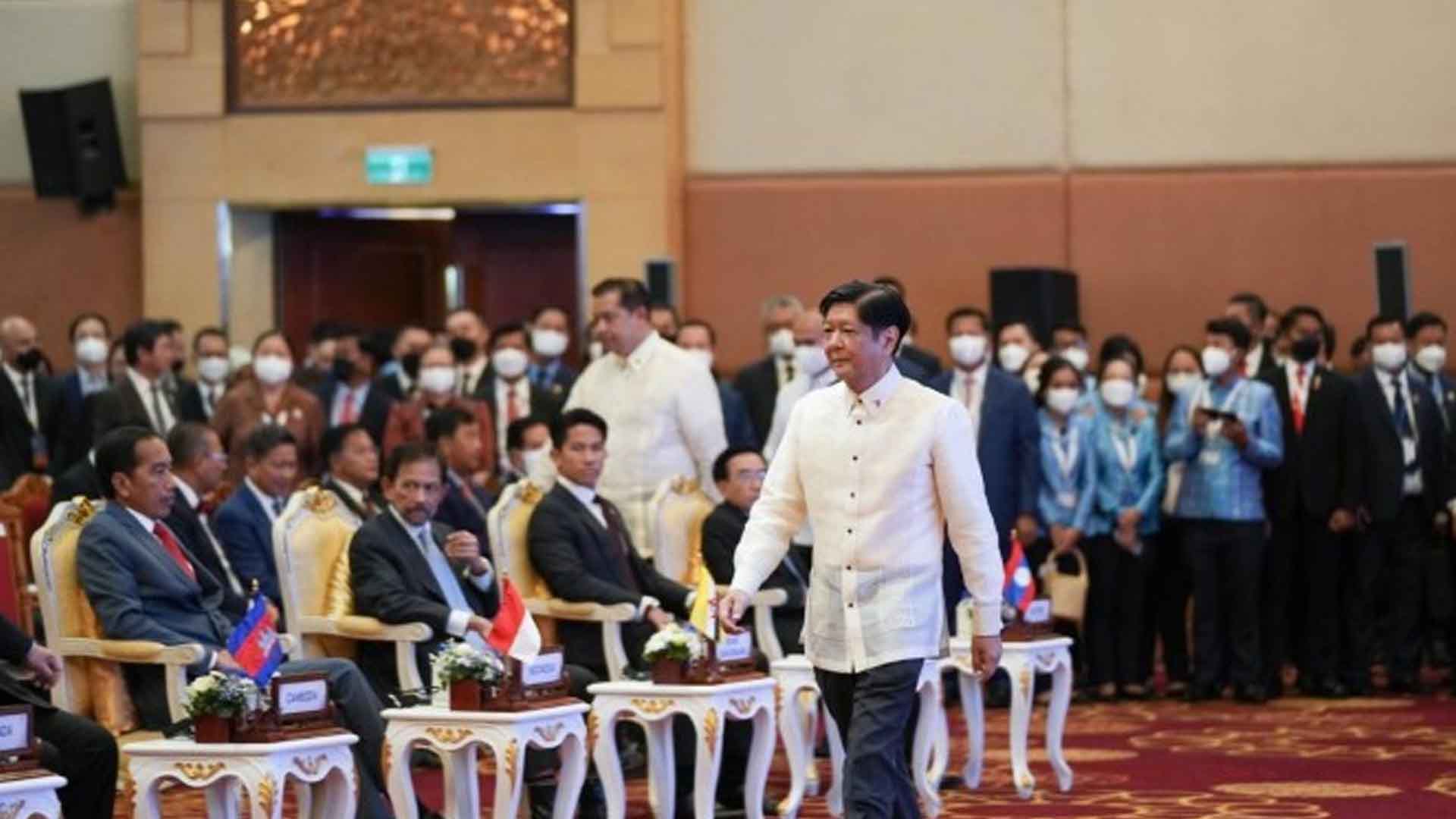






The long-awaited Code of Conduct (COC) in the South China Sea has made little progress, President Ferdinand R. Marcos Jr. said on Sunday, adding that the need for the code is becoming “more urgent.”
“Well, nothing new actually has happened in terms of the code of conduct. We all just restated over and over again. Kailangan na magkaroon ng code of conduct (We need to have a code of conduct),” he said in a media briefing on the sidelines of the 40th and 41st Association of Southeast Asian Nations (ASEAN) Summits and Related Summits in Phnom Penh, Cambodia.
Marcos was among the heads of state who brought up the need for a COC at various summits.
“To be very, very clear about what it is that we are agreeing upon, e kailangan may code of conduct na tayo. So ‘yun lang (we should have a code of conduct) That’s as far as you can go,” he said.
“It is urgent. It is becoming more and more urgent, and we really should — the negotiations and the finalization of the code of conduct. There’s been some progress in the past year, but we really need to have the actual code of conduct, already finalized and already in place as soon as possible,” he added.
Marcos said ASEAN leaders all agreed to apply the United Nations Convention on the Law of the Sea (UNCLOS) and uphold the international rule of law.
“Everybody, including the Chinese says we follow UNCLOS and the international law. So at least that position of ASEAN is clear,” he said.
He said they also reached a consensus to abide by the One-China Policy, a position held by the China that there is only a single sovereign state under the name China and that Taiwan is part of China.
He, however, said tensions between China and Taiwan must be resolved “peacefully.”
“We believe that Taiwan is part of China but you must resolve those issues peacefully. ‘Yun lang naman ang hinihingi ng ASEAN. Huwag magkagulo (That’s all ASEAN is asking for. Don’t cause trouble),” he said.
During his intervention at the 17th East Asia Summit (EAS) in Phnom Penh, Cambodia, Marcos renewed his pitch to maintain peace and stability in the highly contested sea.
“We must ensure that the South China Sea remains a sea of peace, a sea of security and stability, and of prosperity. With the UNCLOS and international law as our basis, the South China Sea will be a nexus of vibrant economic engagements and interactions, not an epicenter of armed conflict or geopolitical maneuverings,” Marcos said.
He said contracting parties of the Treaty of Amity and Cooperation in Southeast Asia must be guided by the universal principles of “peaceful coexistence” and “friendly cooperation.”
In October 2021, tensions between China and Taiwan escalated when the former stepped up military activities near the main island.
China, the Philippines, and several other littoral states have overlapping claims in the South China Sea.
In a 2016 arbitral ruling, the Hague-based Permanent Court of Arbitration ruled that Beijing’s nine-dash line, a demarcation that covers almost 80 percent of the South China Sea, is illegal. (PNA)