



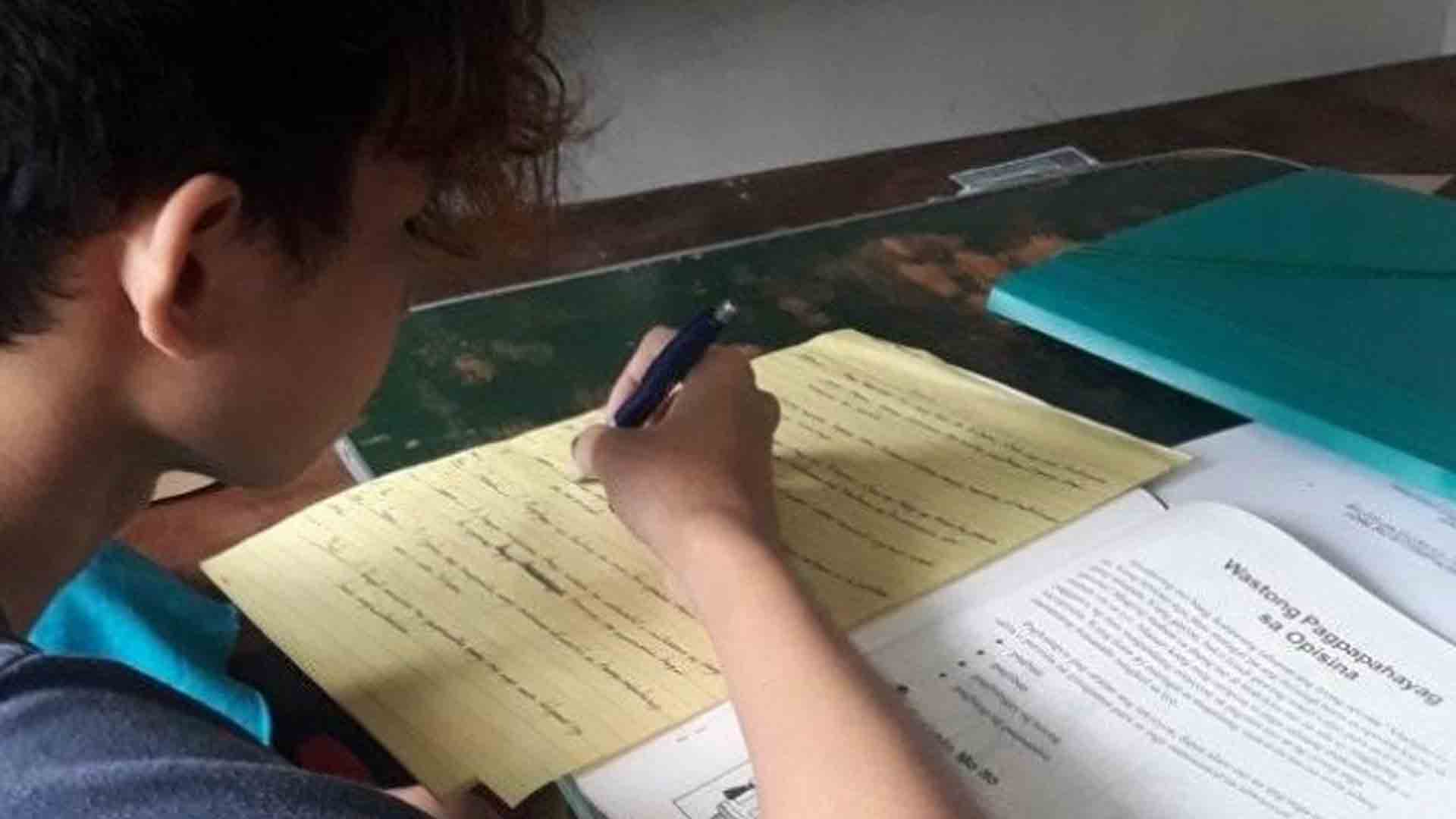






Being out-of-school for three years, Timothy, 15, has decided to continue his elementary education this year amid the coronavirus disease 2019 (Covid-19) pandemic.
In an interview with the Philippine News Agency (PNA), Timothy admitted that addiction to mobile gaming made him neglect his studies and lose his love for physical activities including basketball and taekwondo.
“My mom would always tell me to go back to school because I’m growing old already, and, in my mind, I want to study again, but I’m also hesitant because my future classmates will be a lot younger than me and I’m ashamed if that is the situation,” he said in a mix of Filipino and English.
When the Department of Education (DepEd) implemented blended learning program including the Alternative Learning System (ALS) to prevent the spread of the Covid-19, Timothy found new motivation to study again.
He is hoping to earn appropriate educational level for his age and eventually enroll for senior high school when face-to-face classes resume in the future.
“I don’t need to go to school and I just need to get my self-learning modules (SLMs) from my ALS adviser every Monday and return them to him, complete with answers on the next Monday. Then, I’ll have my new batch of SLMs, and also, we have an online class once a week,” he said.
He said ALS provides opportunity for out-of-school youth like him to earn quality education despite uncertainties posed by the pandemic worldwide.
Timothy is one of the 25 million learners who enrolled in public and private schools nationwide for the academic year 2020 to 2021.
Latest DepEd data showed that 405,902 learners are currently enrolled under DepEd’s ALS program.
The ALS is a parallel learning system which encompasses informal, non-formal, and indigenous teaching strategies as an alternative to the existing formal education.
During the opening of classes on October 5, DepEd Assistant Secretary for ALS G.H. Ambat said the department continues to deliver quality education to the vulnerable, marginalized, and out-of-school youth and adults (OSYA) who want to finish their elementary and high school education.
Ambat said different distance learning modalities – modular, online, television and radio-based instruction learning – set up by the department to ensure the safety of learners and teachers amid the pandemic are nothing new to ALS students because they are used to learning from modules at their own phase.
During the launch of the “Duterte Legacy” on Jan. 18, 2020, Education Secretary Leonor Briones reported that OSYA enrollees has substantially increased under President Rodrigo Duterte’s administration.
Briones said current ALS enrollees are 57 percent higher compared to the past administrations due to Duterte’s full support to the program.
She added that policy reforms led to higher number of learners passing the ALS Accreditation and Equivalency Test yearly, equating to 56 percent compared to the average number of passers per year from 2005 to 2015. (PNA)


