



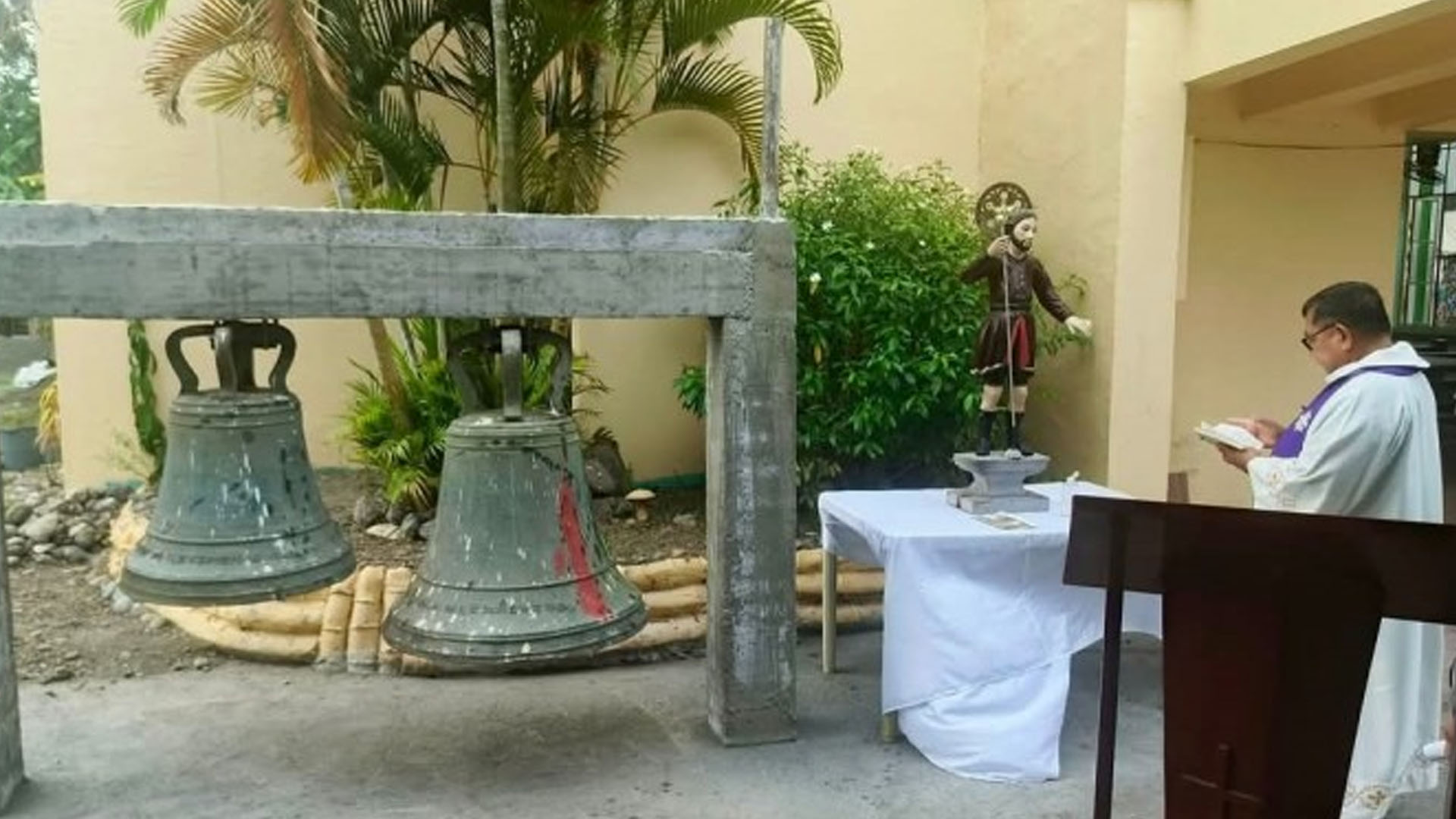







The 184-year-old Spanish-era twin bells at the Parish of the Sacred Heart of Jesus in Sibalom, Antique, long hidden from public view, will soon become tourist attractions.
After the blessing on Feb. 5, the bells are now on display in front of the parish in Barangay Egaña.
Jonathan de Gracia, a member of the Sibalom Municipal Council on Tourism and History, said in an interview on Monday that there are people interested in cultural heritage who would like to study the bells.
The National Commission for Culture and the Arts, provincial government, Department of Education, University of the Philippines-Visayas, and the Office of Senator Loren Legarda listed the bells as among the important cultural properties of Antique because of their age and historical significance during the 2021-2022 cultural mapping inventory.
As important cultural properties, the bells can’t be moved outside of Antique and cannot be sold.
“The bells were made on Feb. 5, 1842, based on the inscription,” De Gracia said, adding that they were commissioned by Spanish priest Fr. Julian Nuñez, assigned in Sibalom from 1839 to 1851.
Sibalom Gobernadorcillo (Little Governor during the Spanish era) Agustin Baladjay, who served from 1839 to 1841, and his successor Tomasito Veñegas, oversaw the making of the bells which are made of copper.
“There used to be a copper mine in Barangay Carawisan and Bongbongan in Sibalom in the 1840s that could be the reason why the bells were made of copper,” De Gracia said.
The bigger bell is estimated to be 91.44 centimeters tall, while the other one is slightly smaller.
Historical accounts said that in 1843, after the bells were completed, Baladjay led a revolt against the Spanish colonizers because they could no longer bear the forced labor and other abuses committed against local folks. (PNA)


