



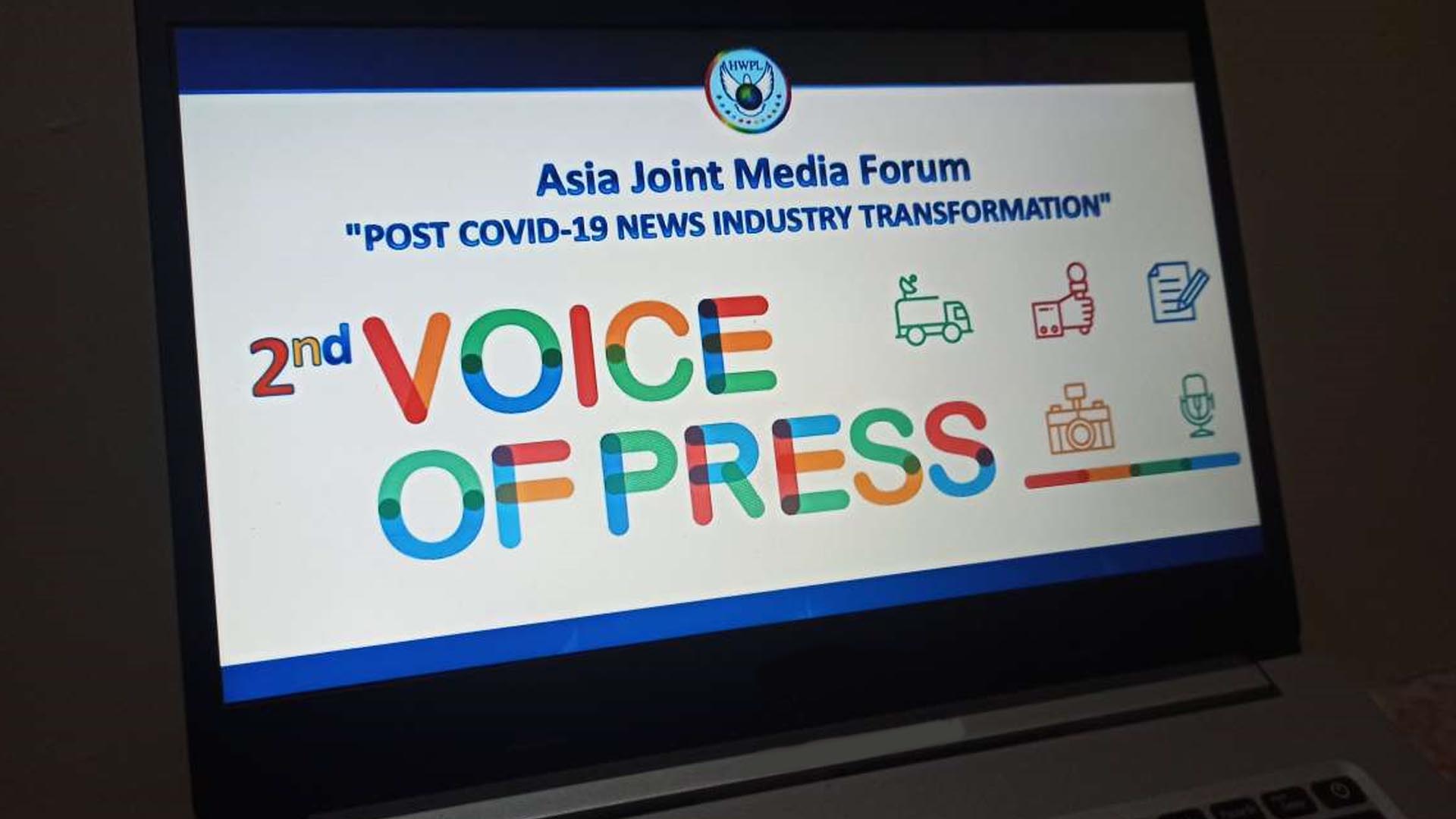






On the 27th of February, the 2nd Voice of Press (V.O.P.) Asia Media Forum was held online with the topic, “Post COVID-19: News Industry Transformation”. 20 journalists from Indonesia, Nepal, Hong Kong, and the Philippines discussed the challenges facing the news industry as well as opportunities and suggested good practices to adopt amid the changing media landscape in a post COVID-19 world.
In the first session of the forum, the speakers spoke about the current challenges and opportunities faced by the news industry in their respective countries.

Terry Yeung, a media consultant in Hong Kong, talked about how citizens hardly pay attention to the actual media production but are more concerned about the political sides of media institutions. He explained how political polarization in Hong Kong worsened during the pandemic, which made communication between media and the people very challenging.

Hendry Nursal, Chief Editor of Jambi Daily from Indonesia, empathized with the fact that small media outlets had to stop their business or service because they cannot support operational costs, while big media companies had to displace employees and cut costs to survive.
Meanwhile, Theofel Santos of Radyo Veritas from the Philippines found opportunities in the online media where news is released faster than in radio or newspapers. Social media platforms such as Facebook and YouTube allowed journalists to broadcast their news and generate income through ads.

Piya Ratna Maharjan, President of Track Nepal was also grateful to social media and technology as a medium “to connect with the whole world” helping journalists during the post COVID era.
In the second session, an open discussion was held within each country’s breakout rooms where the journalists suggested good practices to adopt amid the challenges presented.
Michael Balaguer from Diaryong Tagalog (Philippines) highlighted how the science community has been well-appreciated during the pandemic. Science journalists like him and MJ Balaguer of DZMJ Online have a very crucial role in delivering factual and useful information to the citizens as a form of public service.
Indonesian journalists agreed that media needs to be flexible and it must evolve to address the changing needs of the people in the present. The responsibilities of media were also reiterated by Ridwan Mubarak of Journal News which includes observing the Journalists’ Code of Ethics, informing people based on facts, and using media to influence the public in a positive way.
Health and safety has been the utmost priority of Nepali journalists, maximizing online collaboration tools like Zoom to minimize face-to-face meetings. For on-site media operations, office infrastructure was changed to maintain social distancing.

After presenting the summary report of each country’s discussion, Levi Leung, HWPL Coordinator in Hong Kong branch, announced the 2021 plans of HWPL Public Relations Department. The organization will continue to support journalists through holding a series of webinars about the news industry situation in the post-COVID-19 era and explore possible solutions through academic journals, media outlets, and social media. HWPL will also promote joint statements by Asian journalists on best practices to develop public awareness.
Voice of Press (VOP) is a place of communication where journalists from all over the world can voluntarily participate and speak out for freedom of media and peace journalism by establishing a global media network. This platform is organized by Southern Seoul and Gyeoggi Branch’s International Public Relations Department of Heavenly Culture, World Peace, Restoration of Light (HWPL), an international peace non-governmental organization in consultative status with UN ECOSOC and associated with UN DGC


