



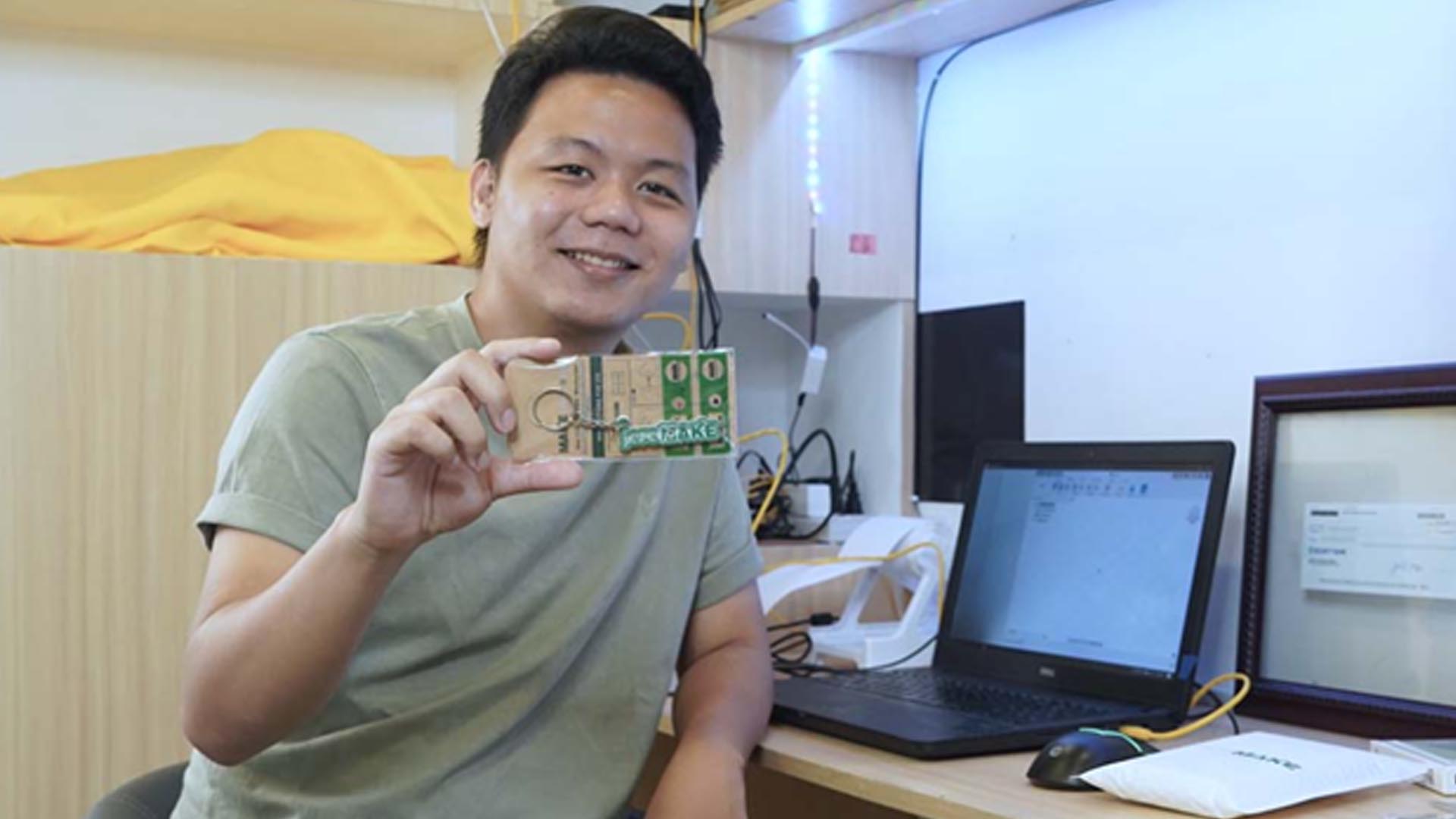






As the whole world shifted to online learning during the COVID-19 pandemic, tools such as microscopy are limited to videos, pictures and online simulations yet this young Pinoy inventor took this opportunity to innovate a Make-roscope Keychains, a low-cost alternative to a light compound microscope.
Jeremy de Leon, founder of JereMake, which is the home of the Make-roscope Keychains, is a graduate of Manufacturing Engineering from Mapua Institute of Technology.
His innovation, Make-roscope Keychains, can magnify samples from 265 to 400 times and is meant to be placed on top of the front-facing camera of a smartphone or tablet, which will make use of the gadget’s screen to project the magnified samples.
With the vision of JereMake to provide Make-roscope to every Filipino student, it also anchors on the enterprise’s advocacy to provide an affordable tool for quality education, especially in public schools without a fee. De Leon believes that students need to experience things to be able to fully appreciate learning, particularly in the microscopic world, as they might need to see a cell, for example, to understand how it actually works.
Under the Invention-Based Enterprise Development (IBED) Program, the Institute has made the provision of Make-roscopes to target schools, organizations, and institutions in Luzon, Visayas, and Mindanao possible. Currently, more than 1,000 units of the keychain microscopes have been successfully deployed and distributed all over the country, with the pilot production funded by the Department of Science and Technology-Technology Application and Promotion Institute (DoST-TAPI)’s Invention-Based Enterprise Development program. Jeremake, the company founded by de Leon, received PHP 123,150 in funding from DoST-TAPI.
DOST-TAPI Director, Atty. Marion Ivy D. Decena said that Make-roscope is not just a technical solution to a problem but a market-driven innovation, which they advocate in the Institute. She also emphasized that being technically and commercially viable alone may not be enough for a sure-hit commercialization but finding the right market for the innovation is just as important.
De Leon also urged education partners to adopt the product to improve the knowledge of children without shelling out a lot of money because Make-roscope works.
Photo Credit: http://www.tapi.dost.gov.ph
Source: http://www.tapi.dost.gov.ph/news/187-small-but-terrible-the-power-of-make-roscope-keychains

