



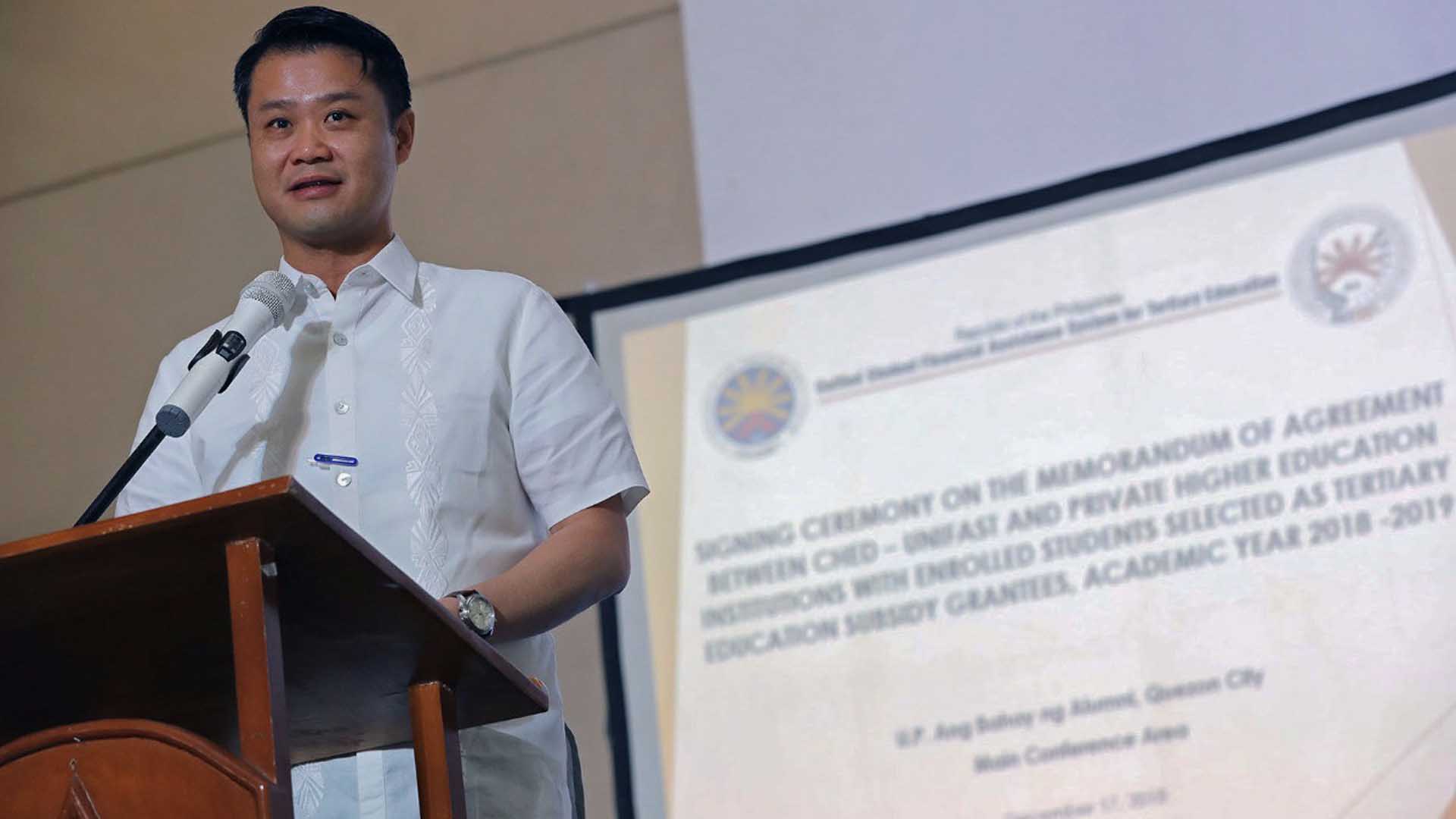






Senator Win Gatchalian urged the Commission on Higher Education (CHED) to fast-track the automation of reimbursing tuition and miscellaneous fees under the Universal Access to Quality Tertiary Education Act (Republic Act 10931), better known as the Free College Education Law.
Although CHED reported that 80 percent of the 215 public higher education institutions (HEIs) for the second semester of this year are fully paid, Gatchalian took note of the 2019 discussion paper by the Philippine Institute for Development Studies (PIDS) emphasizing that failure to reimburse these fees would result in the schools’ absorption of deficiencies and the passing of costs to students in the years ahead. Fees form part of schools’ incomes and are used for operations.
There are 1.3 million beneficiaries of the Free College Education Law and 500,000 beneficiaries of the Tertiary Education Subsidy (TES). The TES provides additional funding for education-related costs such as books, transportation, board and lodging, and allowances for disability-related expenses among others.
The senator explained that State Colleges and Universities (SUCs) and Local Universities and Colleges (LUCs) have to submit their billing and other documentary requirements to CHED before they are reimbursed for tuition and miscellaneous fees. To date, there are 12 SUCs and LUCs that still have compliance issues. According to CHED, these SUCs and LUCs cannot reimburse even if the funds are downloaded by the Department of Budget and Management (DBM).
Gatchalian pointed out that lawmakers already raised this concern during the deliberations on the 2020 budget. He also emphasized that without addressing this issue, the proposal to give the funds directly to SUCs and LUCs becomes an attractive idea. Gatchalian, however, pointed out that this proposal needs to be studied more carefully to protect public funds.
“We really need to finalize and fix this because it cannot be a recurring problem every year. The funds are badly needed by the SUCs and LUCs as we all know,” said Gatchalian.
“It can be done, I believe that technology can solve this problem but we have to act fast,” he added.
CHED Chairman J. Prospero de Vera III explained that while the Unified Student Financial Assistance System for Tertiary Education (UniFAST) already has an existing database of students, the Commission is seeking the help of Iloilo Science and Technology University (ISAT-U) to improve the current system and allow direct communication with beneficiaries.
Gatchalian is co-author and co-sponsor of the free higher education law and has called for its improved implementation. He also filed Senate Bill No. 1793 or the ‘Full Digital Transformation Act of 2020,’ which seeks to provide full, integrated E-Government (eGov) services to the public by the end of 2022.


