



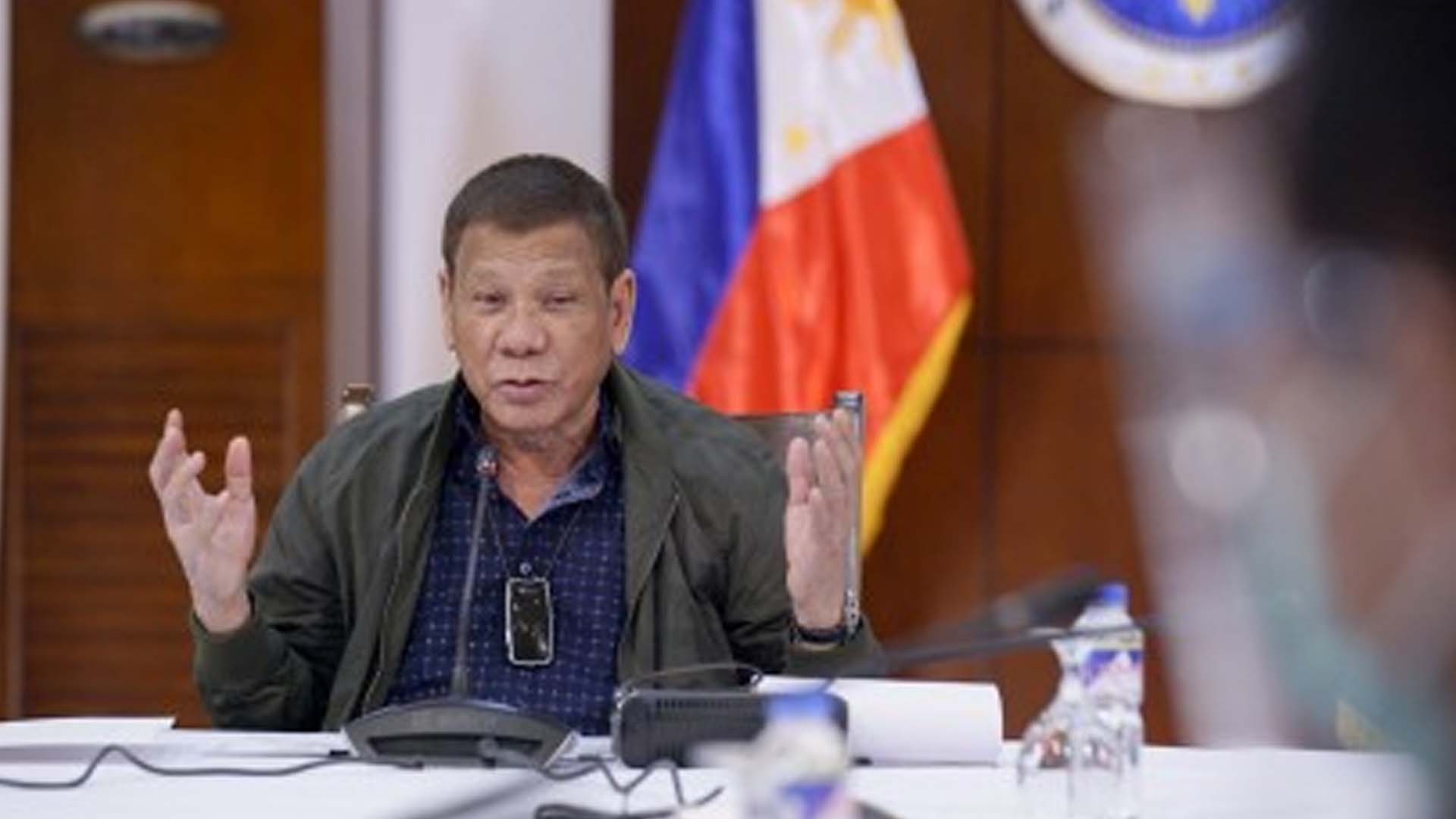






President Rodrigo Duterte’s regular public appearances in connection with the government’s response to the coronavirus disease 2019 (Covid-19) showed that he is actively performing his official duties, the Supreme Court (SC) said.
In its five-page resolution dated May 8 released on Wednesday, the high court junked the petition filed by lawyer Dino de Leon seeking to compel Malacañang to disclose all the medical results and health bulletins of the President and to compel him to undergo “confirmatory medical examinations” for lack of merit.
“The Court also deems it proper to emphasize that in the recent months, the President has been visibly holding regular Cabinet meetings, belying petitioner’s insinuation that the President is suffering from serious illnesses,” the court said.
In denying the petition for a writ of mandamus, the court explained that a writ of mandamus “will not issue to compel an official to do anything which is not his/her duty to do or which it is his/her duty not to do, or to give to the applicant anything to which the latter is not entitled by law.”
“Apparently, petitioner’s allegation that the President is seriously ill is unsubstantiated and is based merely on petitioner’s surmises and conjectures regarding his perception of the declining health of the President,” the tribunal added in dismissing the petition.
Article 7, Section 12 of the 1987 Constitution mandates the President to declare the real status of his health “in case of serious illness.”
Duterte is suffering from muscle spasms, chronic back pains and migraines. He also has myasthenia gravis, a chronic autoimmune neuromuscular disease that weakens skeletal muscles responsible for breathing and moving parts of the body.
The President has also admitted that he has Barrett’s esophagus, a potentially serious complication of gastroesophageal reflux disease, and Buerger’s disease, a rare disease of the arteries and veins in the arms and legs.
Despite his age and health problems, Duterte has repeatedly assured the public that he remains fit to work and can fulfill his mandate as the country’s highest elected official.
Thirteen justices concurred with the decision while Associate Justices Benjamin Caguioa and Marvic Leonen filed separate dissenting opinions. (PNA)


