



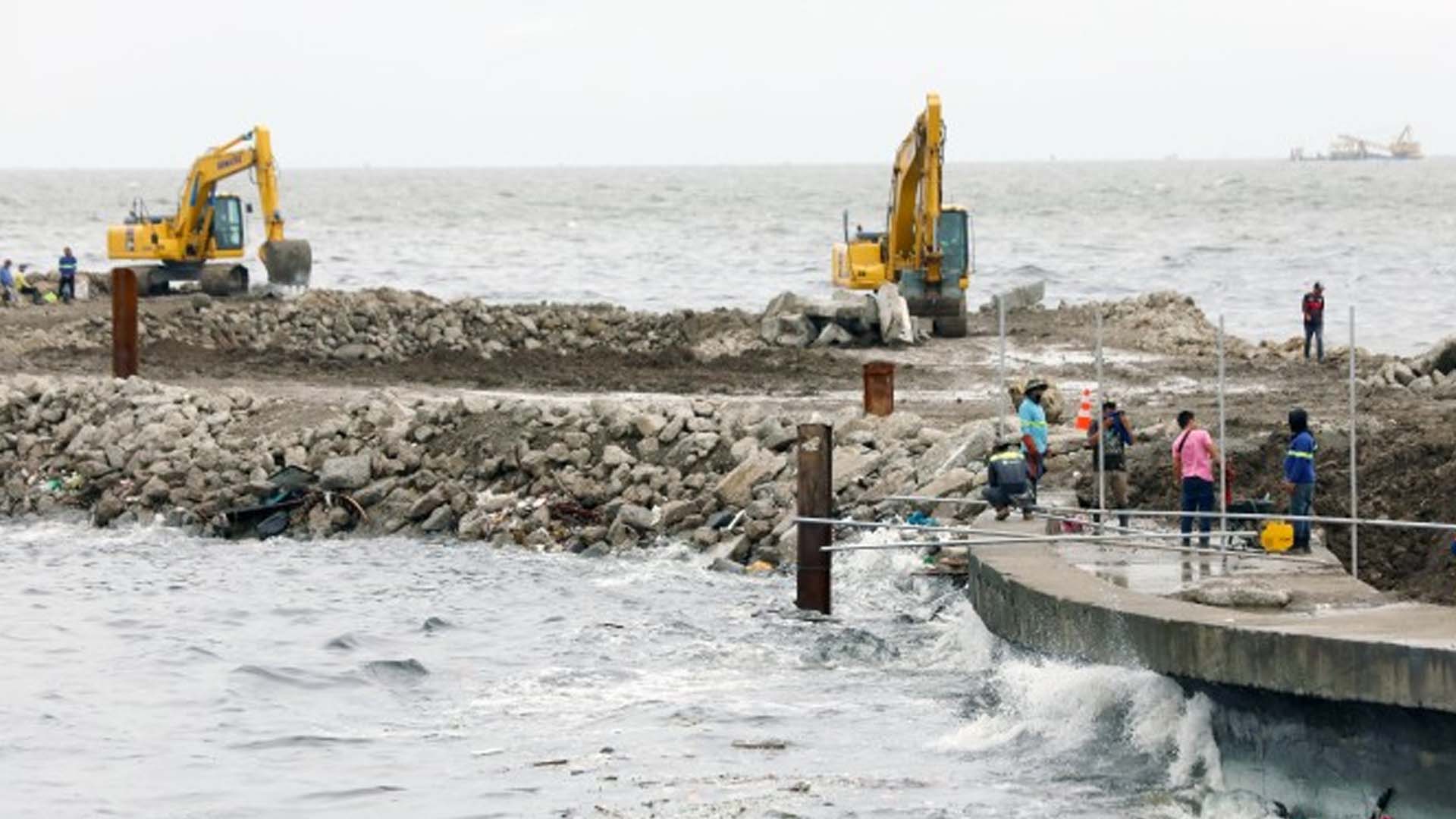







While the country spends billions of pesos on flood control and other infrastructure projects, these may worsen the country’s climate risks, instead of easing them, if not guided by science and coupled with strict environmental safeguards, a scientist from the University of the Philippines (UP) Marine Science Institute said.
In an ambush interview on Wednesday at the Department of Environment and Natural Resources’ (DENR) Project Transform Colloquium in Pasay City, Fernando Siringan warned that many projects continue to bypass or water down the Environmental Impact Assessment (EIA) process, undermining climate resilience and exposing communities to greater risks.
Unfortunately, he said that despite having a budget of millions of pesos, most of these projects proceed without a proper impact study.
“Hindi lahat ng proyekto ay may EIA study, at marami sa mga proyekto ng pamahalaan mismo ang walang EIA (Not all projects have undergone EIA study, and many government projects do not have EIA),” Siringan said.
He noted that there are a number of data and methods to guide development, and that the government and the private sector just need to utilize them, emphasizing that the stricter enforcement of EIAs is crucial in preventing flawed projects from being built in the first place.
Siringa warned that the simple dredging of rivers and laying down of concrete floodwalls are but temporary fixes.
He cited the “Room for the River” program in Europe as a global best practice.
“Floods will be less frequent, lower in height, less widespread, and shorter in duration if we give rivers more room to flow instead of just repeatedly dredging them,” he said, noting that widening is better than just dredging.
He also urged policymakers to shift toward nature-based solutions that fit ecosystems.
In his presentation, Siringan noted that tree covers can reduce surface heat by as much as 12°C, intercept rainfall, and allow water to seep into the ground.
“Sponge city” innovations, such as permeable pavements that help floodwater seep through the ground, green roofs, and water-absorbing parks, can ease flash floods in urban centers.
Meanwhile, he said that mangrove belts, with just 100 meters of healthy cover, can slash storm wave energy by half, while shielding coastal communities.
“These measures are not only more sustainable but also provide multiple benefits for ecosystems and communities,” he said.
Siringan’s call comes as President Ferdinand R. Marcos Jr. widens his probe into alleged anomalous flood control projects, as he ordered a lifestyle check on government executives.
Siringan emphasized that flooding is not just an engineering problem, but also an environmental and governance problem.
DENR Secretary Raphael Lotilla, meanwhile, said the way forward lies in integrated river basin and water management programs, which identify the areas where infrastructure is needed and where it must be avoided altogether.
Citing Marikina as an example, he said that clearing riverbanks of settlements reduced risks.
He said that housing projects built in hazard-prone areas expose communities to danger.
“But in areas where one has to refrain from, in fact, filling up the waterways, then it’s not a case of building, but to protect the waterways and floodplains,” he said.
Lotilla admitted that while the country has had many river basin plans, implementation has been weak.
“What has been lacking is faithful implementation. And we want to be able as well to have better coordination with infrastructure agencies. If one looks back at the river basin plants we have had, what has been lacking is faithful implementation of these,” he said.
Lotilla also underscored the significance of better coordination between government agencies and the local government.
“We have received actual complaints where there are infrastructures that have encroached on natural waterways, which they’re not supposed to and they’re asking for cease-and-desist orders. And in a number of cases, these have been issued, but the enforcement, as I’ve said, would have to be done in coordination with the infrastructure agencies at the outset and not after the structures have already been built,” he said. (PNA)


