



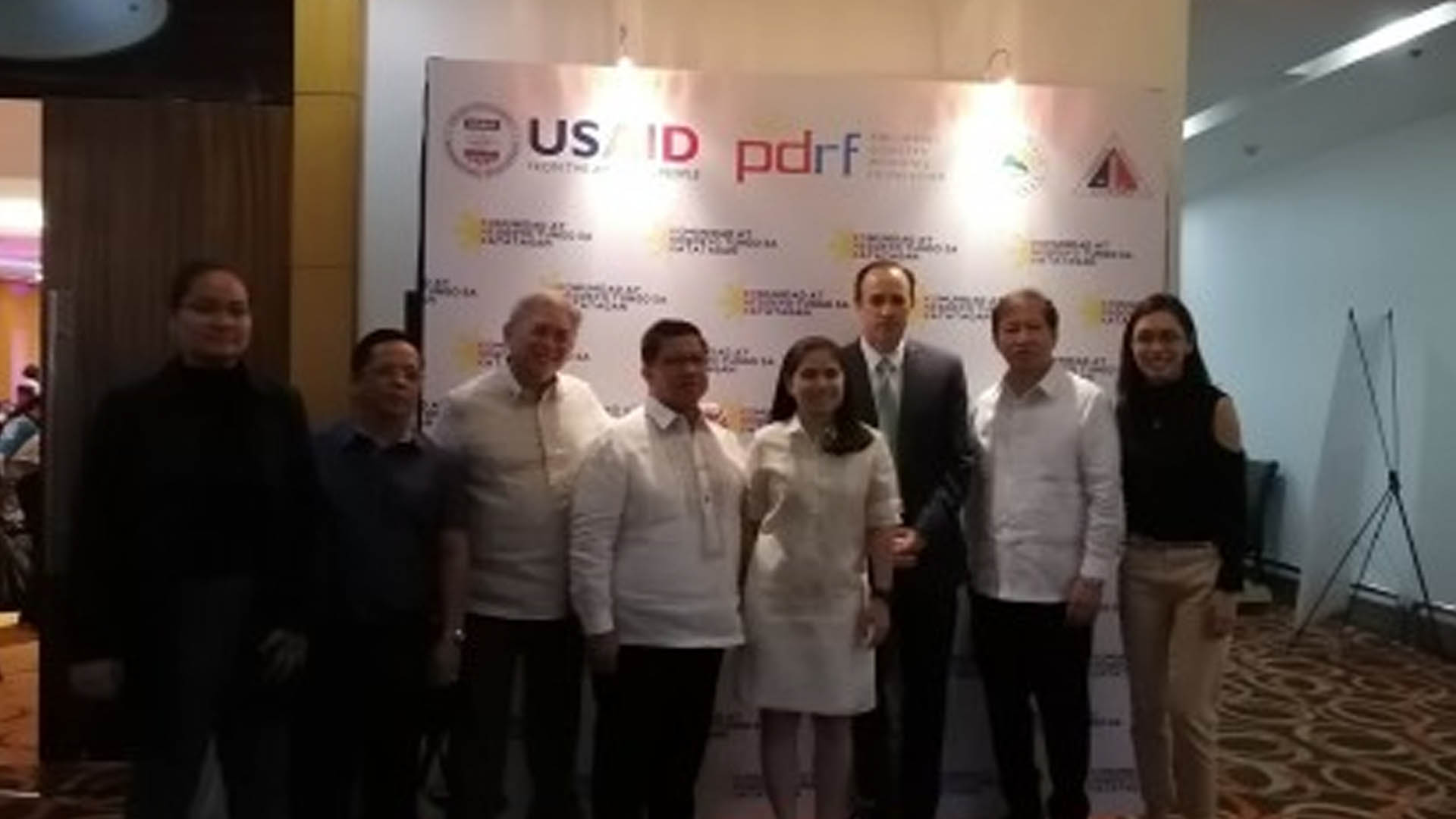






The Philippine Disaster Resilience Foundation (PDRF) is expanding its support for the country’s disaster risk reduction plan, partnering with the local government units (LGUs) via a disaster resilience project launched on.
PDRF president Rene ‘Butch’ Meiley said the foundation values the importance of preparedness against calamities or disasters.
The foundation introduced a program dubbed “Komunidad at Negosyo Tungo sa Katatagan or Project KoNeK” to improve the disaster capacities of selected barangays in Quezon City and Makati City.
“The goal is to help local government units improve (their) disaster resilience based on their disaster inputs and strengthening public service continuity within the communities,” Meiley said.
He said there is a need to prepare local governments for fast recovery after disasters.
He added the Project KoNek aims to help barangays in Quezon City and Makati to come up with its own Barangay Disaster Risk Reduction and Management Plan (BDRRMP) which includes advocating for the whole-of-society approach dealing with catastrophes.
The project will provide disaster awareness-promotion sessions, risk assessment, participatory three-dimensional mapping to family preparedness, business continuity for MSMEs (Micro- Small and Medium Enterprises) including drills and simulation to the DRRMO officers of the cities.
PDRF community resilience program manager Cardice Bismonte said the scope of the project not only limited to natural calamities but also covers man-made hazards such as terrorism or human-induced hazards, among others.
“In public service continuity, it is not just the disaster that we are preparing for, but also any disruptions or emergencies and we must ensure the availability of public service is always delivered,” she said.
She added that choosing the two cities to pilot the project is strategic for the National Capital Region (NCR) since the major economic ventures are located in these areas. Metro Manila is also vulnerable to various natural hazards, including earthquakes, fire, and floods.
“It’s a pilot to the LGU to push public service continuity, although we’ve done this to other national government agencies, but this is the first time we did it at the local level. Of course, we would like to see LGUs within NCR unites for fast recovery when a disaster occurs,” she said.
She added the project KoNek’s reduction and management plans are needed for fast quick disaster response, recovery, and rehabilitation.
The PDRF is mulling to expand the project to the other cities in the country.
Meanwhile, Karl Marasigan, QC-DRRMO head, said the project can contribute to the goal of achieving a safe, adaptive and disaster-resilient Quezon City.
Quezon City comprises 23 percent or 2.936 million of Metro Manila’s total population, and it is a city prone to various natural hazards, including earthquakes, fire, and flood.
The PDRF launched the second phase of Project KoNeK in partnership with the Makati City and Quezon City governments, Center for Disaster Preparedness (CDP), and the Philippine Geographical Society (PGS) and with support from the USAID Office of U.S. Foreign Disaster Assistance (OFDA). (PNA)


