



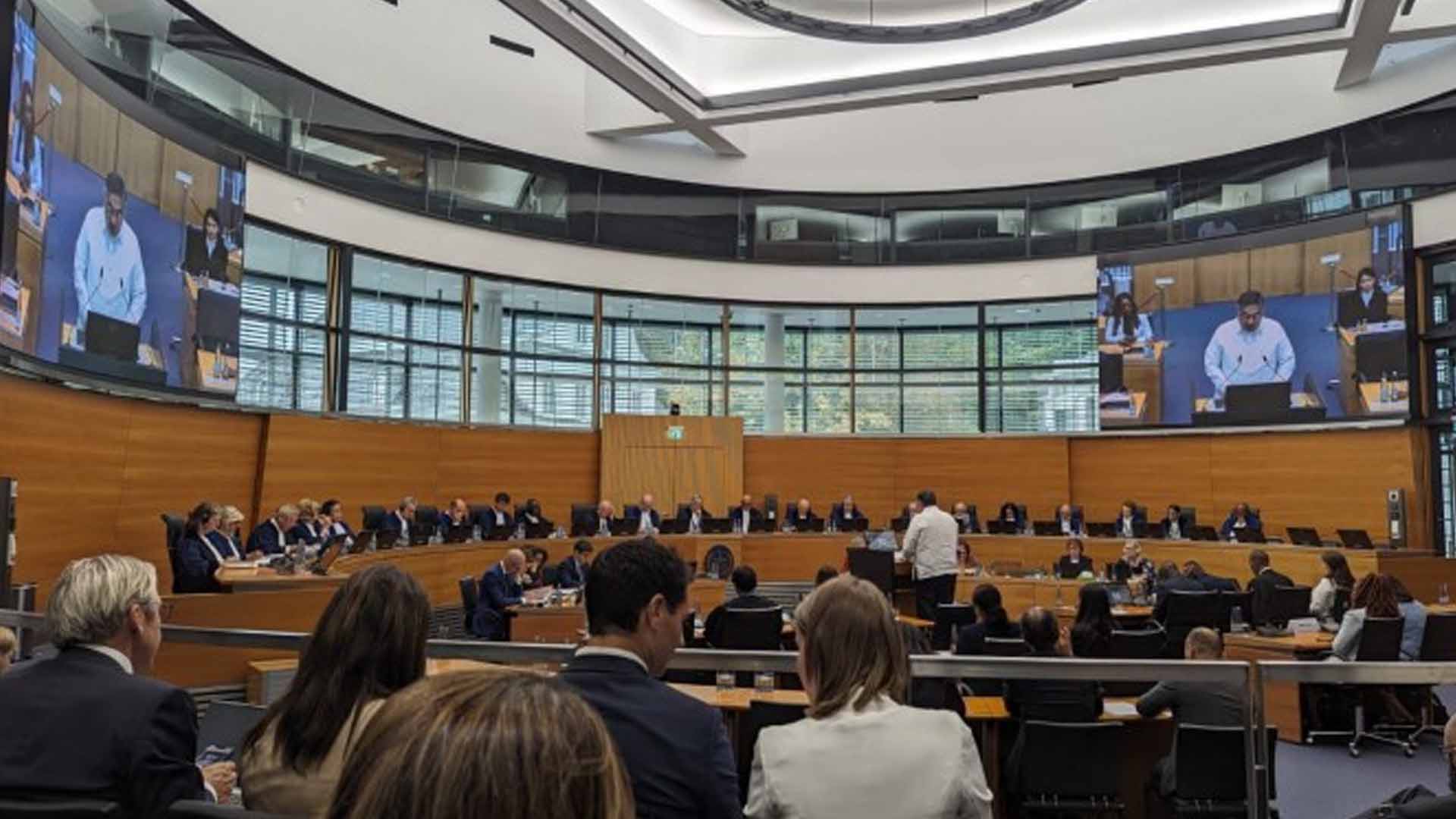







The Philippine government backed on Tuesday a move urging a United Nations court to provide an advisory opinion to interpret the world’s oceans treaty in the context of curbing climate change.
The statement of support was delivered before the Hamburg-based International Tribunal for the Law of the Sea (ITLOS) which has recently begun legal proceedings for a closely watched oceans climate justice case.
The case, brought by the Commission of Small Island States on Climate Change and International Law (COSIS) last December 2022, asks the UN court to determine the specific duties of states parties to the UN on the Law of the Sea (UNCLOS) in preventing the pollution of the marine environment caused by climate change through the accumulation of anthropogenic greenhouse gas emissions.
“As an archipelagic state comprised mostly of small islands, and one of the most vulnerable to and most affected by climate change, the Philippines stands in solidarity with COSIS and all the small island states that comprise it and outside of its membership, and support their initiative to request the tribunal’s advisory opinion,” said Philippine Permanent Representative to the UN in Geneva Carlos Sorreta in co-delivering Manila’s statement.
“Fundamental to our position is that while UNCLOS was not designed as a mechanism for regulating climate change, its mandate is broad enough to consider the connection between climate and the oceans,” he added.
Sorreta argued that the 40-year-old treaty must be interpreted “in light of changing global circumstances and changing laws”.
“It is, among others a strong, innovative and comprehensive global environmental treaty governing over two-thirds of the planet. It must be interpreted and applied with subsequent developments in international law and policy in mind,” he said.
In the Philippines alone, Sorreta pointed out that coastal erosion, the bleaching of coral reefs, loss of seagrass have severely affected the resources and livelihoods of Filipino coastal communities.
Foreign Affairs Assistant Secretary for Maritime and Ocean Affairs Maria Angela Ponce added that by its nature, greenhouse gas emissions qualify as “pollution of the marine environment”.
“The science behind climate change and the effects of greenhouse gas emissions on the marine environment is unassailable,” she said, reiterating ocean warming, ocean acidification, and sea-level rise as examples.
In a July 2023 piece published in The Conversation, Ellyscia Harrould-Kolieb and Margaret Young of the University of Melbourne explained that advisory opinions are not legally binding but they provide guidance to states and international organizations about the interpretation of international law.
In their oral and written statements, the European Union and New Zealand cited the 2016 Arbitral Ruling on the South China Sea and suggested adopting its general interpretation of a state’s obligation under UNCLOS.
China, meanwhile, argued that ITLOS lacks jurisdiction to issue the requested opinion and pointed out that there are other international laws — the UN Framework Convention on Climate Change, Kyoto Protocol, and Paris Agreement — that are appropriate in dealing with climate change and its adverse effects.
Manila, on the other hand, believes ITLOS has “advisory jurisdiction” given that COSIS is empowered to request the UN court advisory opinions “on any legal question within the scope” of UNCLOS.
“The Philippines does not see any compelling reason for the Tribunal to refuse its advisory jurisdiction. Rather, what exists are compelling reasons for the Tribunal to exercise its jurisdiction and carry on with its advisory competence,” Assistant Solicitor General Gilbert Medrano said. (PNA)


