



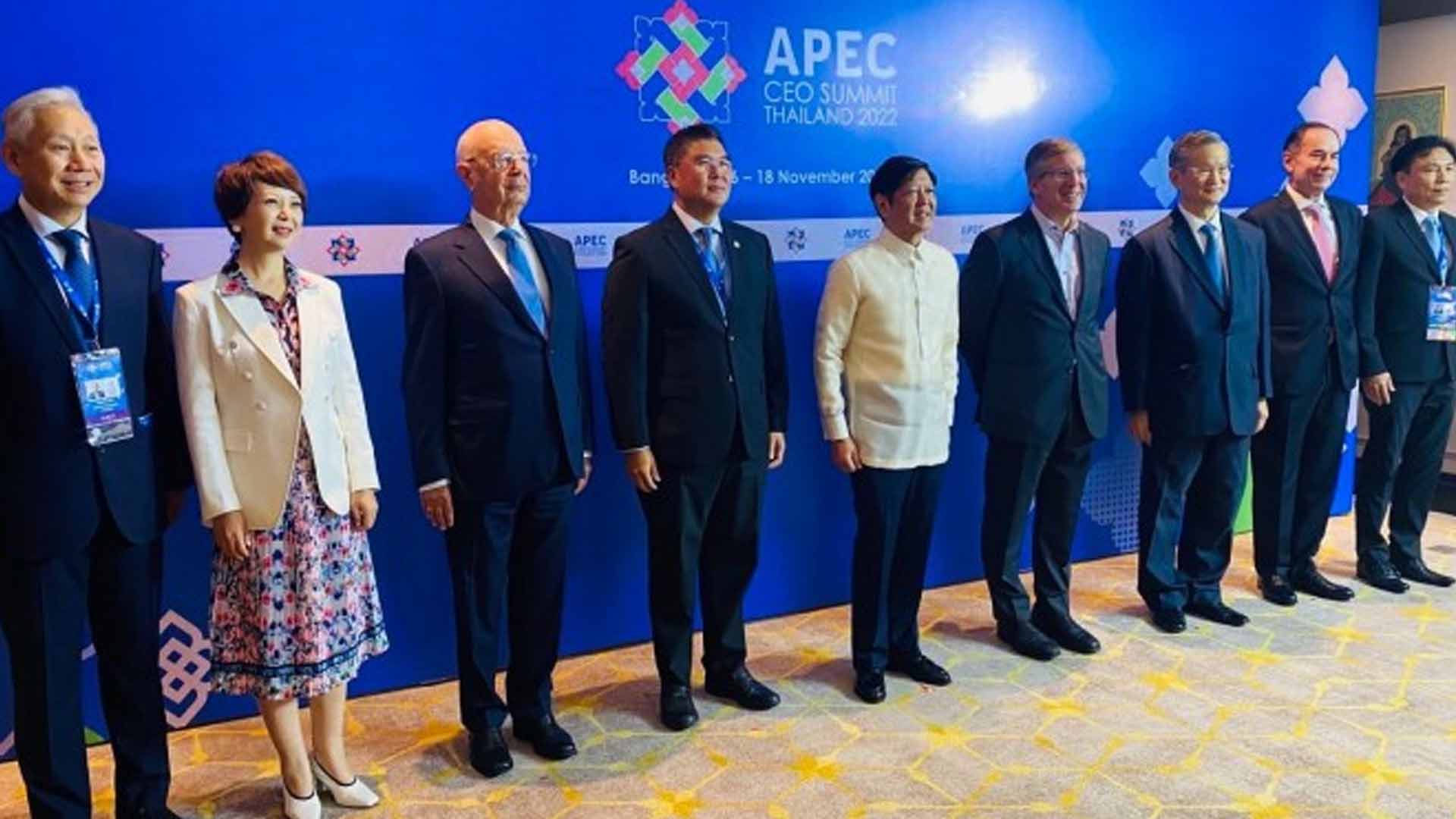






President Ferdinand R. Marcos Jr. on Thursday emphasized the importance of diversifying energy sources to sustain global economic growth and avoid the worst impacts of climate change.
In his opening remarks during the Asia-Pacific Economic Cooperation (APEC) CEO Summit in Bangkok, Thailand, Marcos lamented that the progress made to address climate crisis is “not enough,” despite the implementation of global climate pacts such as the United Nations Framework Convention on Climate Change (UNFCCC) and the Paris Agreement.
Marcos said a “stronger” action is needed, considering that climate change is “the most pressing existential challenge of our time” that may cause adverse impact on the global economy.
“The Conference of the Parties to the UNFCCC (COP 27) is in full swing, but stronger climate action is required. As the energy demands of the modern global economy continue to expand rapidly, diversification into renewables and other sources is imperative,” he said during the forum.
APEC member economies, Marcos said, should step up efforts to address “structural and policy” issues to counter the effects of several global challenges, including the climate crisis.
Marcos made the call, as he noted that climate change is “interconnected” with high inflation and geopolitical crises, as part of a “delicate” global food ecosystem that affects the entire world.
Marcos said the Philippine government is now focused on using renewable energy sources such as hydropower, geothermal power, solar and other low-emission energy sources.
He said his administration is particularly setting a target of a 35 percent share of renewable energy in the power generation mix by 2030 and 50 percent by 2040.
He issued the statement, as he cited the findings of the Asian Development Bank’s study which showed that the Philippines is one of the countries that are at “great risk” from the climate crisis, as it stands to lose over six percent of gross domestic product (GDP) annually by 2100.
Marcos earlier approved the Department of Energy’s plan to explore and develop the country’s offshore wind (OSW) potential as a source of clean and sustainable energy.
Marcos is currently in Thailand for his first participation in the APEC Economic Leaders’ Meeting.
The APEC is a regional economic forum established in 1989 to leverage the growing interdependence of the Asia-Pacific.
APEC’s 21 member economies seek greater prosperity in the region by promoting balanced, inclusive, sustainable, innovative, and secure growth and by accelerating regional economic integration. (PNA)


