



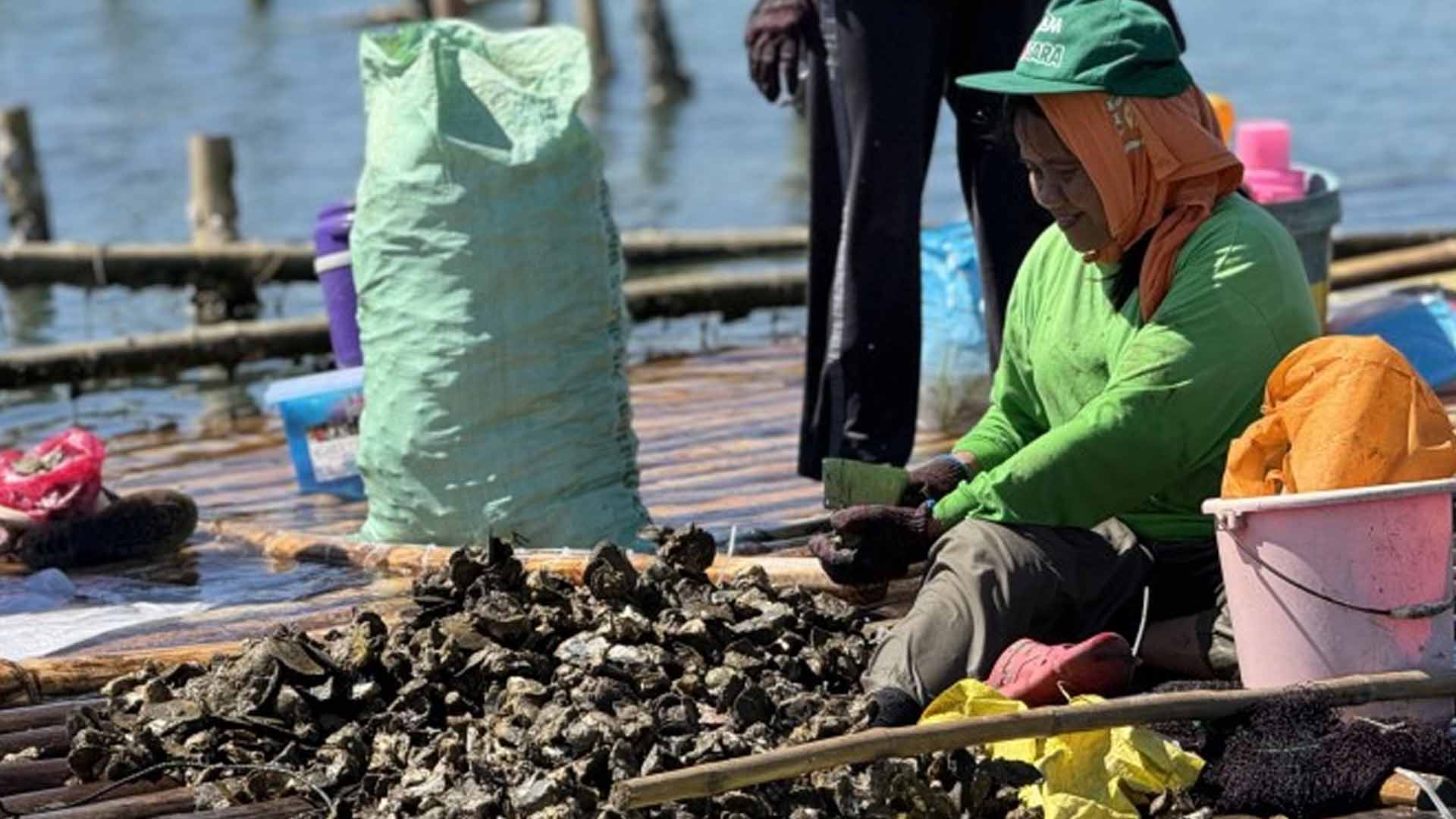






Some 40 oyster farmers in Alaminos City, Pangasinan have successfully adopted the modified bamboo raft technology introduced by the Department of Agriculture-National Fisheries Research and Development Institute (DA-NFRDI) last year.
In a phone interview on Wednesday, Alaminos City aquaculturist Michaela Tamayo said the farmers harvested around 3,219 kilos of oyster from the 25 bamboo raft structures during the pilot testing from June to December last year.
Tamayo said the bigger sizes were sold at PHP1,200 per kilo while the smaller sizes were sold at PHP400 per kilo.
“Environmental wise, it is safer and harvesting was also made easy with the bamboo raft according to the farmers,” she said in Filipino.
Funded by the DA-Bureau of Agricultural Research (BAR), the project was implemented by NFRDI in collaboration with Bureau of Fisheries and Aquatic Resources (BFAR)-1 and BFAR-National Fisheries Development Center (NFDC).
Oysters are being cultured and harvested in the city traditionally by using either discarded rubber tires or the bamboo stake method.
On the other hand, the bamboo raft technology utilizes floaters, bamboo and straps to cultivate oysters, benefiting oyster growers by reducing mortality rates, enabling faster growth and producing better-quality meat, Tamayo said.
Tamayo said the Department of Labor of Employment (DOLE) has added eight bamboo rafts following the program’s successful pilot testing.
“Developed and verified by Japan and the Bureau of Fisheries and Aquatic Resources-National Fisheries Development Center (BFAR-NFDC), NFRDI implemented modifications in the original design of the culture raft module to make the raft more durable and resilient against typhoons and strong waves, and increase target production,” Joseph Christopher Rayos, project leader and chief of NFRDI- Aquaculture Research and Development Division, said in a statement.
Aside from Alaminos City, the towns of Anda, Bani, Bolinao and Sual have adopted the technology showcasing its potential to improve oyster farming methods in the province.
In a separate phone interview, Bani municipal agriculturist Jeffrey Pamo said they were not able to successfully produce the ideal size of the oyster demanded by the market, at around three inches, since their harvests only ranged between 1 to 1.5 inches.
“We were not able to meet the ideal size because the plankton requirement of the oyster variety they have given us is insufficient in our area, resulting in smaller size than the required size in the market,” he said in Filipino.
“We will try mussel production using the bamboo raft technology given to us as we are also eyeing it to be part of research and agro-tourism in our town,” he added. (PNA)


