



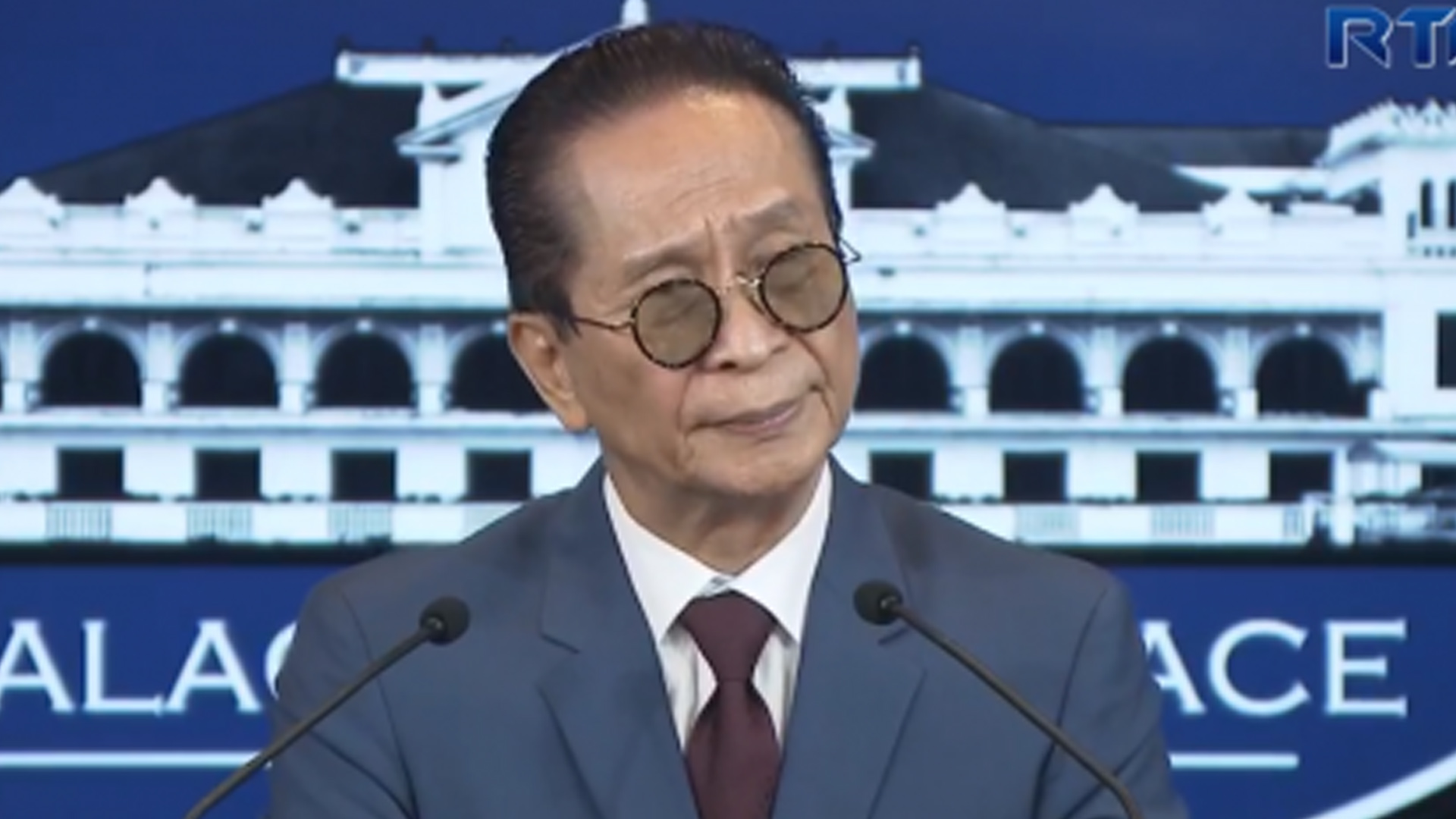






Chief Presidential Legal Counsel Salvador Panelo rejected claims that the government is behind the proliferation of dummy Facebook accounts, saying he himself is a victim.
In a virtual presser, Panelo told opposition lawmakers that because he was also found to have bogus accounts, there is no truth to their allegation that only critics of the anti-terror bill are being targeted.
“I’ll give you one concrete example why the government will not do it. Alam niyo ba na ang inyong lingkod ay biktima rito (Do you know that yours truly is also a victim)?” he said.
Panelo showed printouts of his “real” Facebook account, which was created by his former students, saying it has been “inactive” for about four years.
He then showed printouts of about eight accounts, some of them missing profile pictures.
Even before the Congress passed the anti-terror bill, Panelo said fake social media accounts are already rampant on social media.
The Palace official recalled how a scammer who posed as him tried to swindle some of his friends but was eventually arrested by police.
Echoing Senator Panfilo “Ping” Lacson, author of the anti-terrorism bill, Panelo floated the possibility that groups or individuals who called for the junking of the bill may be behind the proliferation of the dummy profiles.
Panelo said it would appear “staged” if the government was behind the sudden surge of duplicate accounts.
He also urged the public to be vigilant on social media because whoever is behind these bogus accounts could strike again.
On Monday, Malacañang urged House Deputy Minority Leader and Bayan Muna Rep. Carlos Zarate to file corresponding charges before the court if they could prove that the national government had anything to do with the dummy accounts.
Currently, the National Privacy Commission (NPC) and the Department of Justice (DOJ)-Office of Cybercrime, in coordination with the Philippine National Police (PNP) and the National Bureau of Investigation (NBI) are already investigating the matter.
Anti-terror bill
Justifying the anti-terrorism bill anew, Panelo said critics are either those who refused to acknowledge the Duterte administration’s accomplishments or those who simply refused to read the measure.
“Tingnan mo naman kung gaano kakapal ‘to, 63 pages. Paano mo nga naman pagtiyatiyagaan basahin ‘yan (Just look at how think this is, 63 pages. How will anyone have time to read that)?” he said, brandishing a copy of the proposed law.
Amid fears the measure would allow warrantless arrests, Panelo assured that law enforcement officers who make the arrests should inform the court within 24 hours or risk imprisonment of up to 10 years and disqualification from public service.
He rejected accusations that the bill is intended against the dissenters, saying the legislation specifically states that terrorism does not include dissent or protest.
Law enforcement authorities cannot “surveil, record or collect” any private communication or conversation without filling out an application before the Court of Appeals, he added.
He said the detained terrorist suspect can also avail of the extra-legal remedies of the writ of habeas corpus, and writ of amparo and question the legal basis of arrest and detention.
The writ of habeas corpus is a remedy that can be used to secure the release of a person who is being unlawfully detained while a writ of amparo is a remedy available to any person whose right to life, liberty and security has been violated or under threat.
The suspected terrorist can also file a petition for bail which the Constitution grants to all persons charged, he said. (PNA)


