



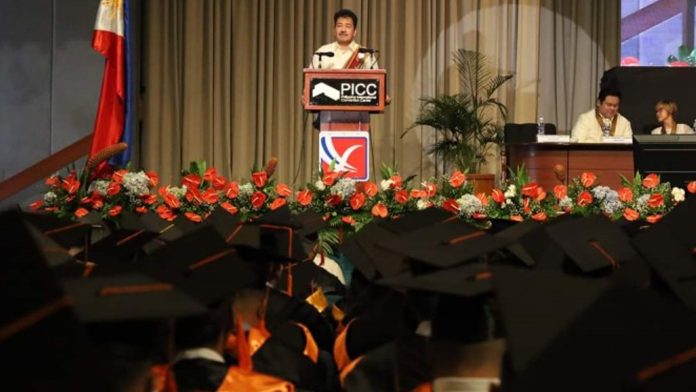






More than a year after the enactment of the Expanded Tertiary Education Equivalency and Accreditation Program (ETEEAP) Act, Solid North Party-list Rep. Ching Bernos urged the Commission on Higher Education (CHED) to intensify its information campaign so that more working Filipinos can take advantage of the law.
“Republic Act No. 12124 or the Expanded Tertiary Education Equivalency and Accreditation Program Act is one of the most empowering education reforms we have passed because it recognizes that learning does not happen only inside the classroom,” Bernos said in a news release.
“Sa tingin ko po, marami pa ring Pilipino ang hindi nakaaalam na maaari na silang makakuha ng college degree batay sa kanilang work experience, training, at skills. Sayang ang oportunidad kung hindi ito naipapaabot sa mga manggagawa at iba pa nating mga kababayan na higit na makikinabang dito (In my opinion, many Filipinos are still not aware that they can get a college degree based on their work experience, training and skills. It will be a wasted opportunity if this is not being relayed to the workers and other people who will benefit from it most),” she added.
RA 12124, signed into law on March 5, 2025, institutionalized the ETEEAP, which had been operating since 1996 under a CHED memorandum order.
The program allows working Filipinos – Including overseas Filipino workers – to earn a college degree by converting relevant work experience, prior learning, and non-formal or informal training into equivalent academic credits.
Bernos said CHED should launch a sustained nationwide information campaign in partnership with local government units, employers, labor organizations, overseas Filipino groups, and deputized higher education institutions to ensure the program reaches its intended beneficiaries.
“Ang pinakamagandang batas ay walang saysay kung hindi alam ng mga tao na mayroon pala silang ganitong pagkakataon (The best law is useless if the people are not informed that they have this opportunity). We have to bring the program to our workers instead of expecting them to discover it on their own,” the lawmaker stressed.
She also urged CHED to continue deputizing more higher education institutions to offer the program.
“The closer the program is to our workers, the more lives we can change,” Bernos said.
The lawmaker also encouraged CHED to regularly publish data on the program’s implementation, including the number of applicants, graduates, participating institutions, and other key indicators, to help policymakers determine whether the law is achieving its intended impact and identify areas for improvement.
The ETEEAP is open to Filipino citizens residing in the Philippines or abroad. Applicants must be at least 23 years old, have completed high school, and have at least five years of work experience related to the degree they intend to pursue.
Applicants are required to submit supporting documents, including a Philippine Statistics Authority (PSA) birth certificate, secondary education credentials or official transcript of records, a work portfolio, certificates from relevant training programs or Technical Education and Skills Development Authority (TESDA) national certificates, employer or industry recommendations, and other requirements prescribed by the deputized higher education institution. (PNA)


