



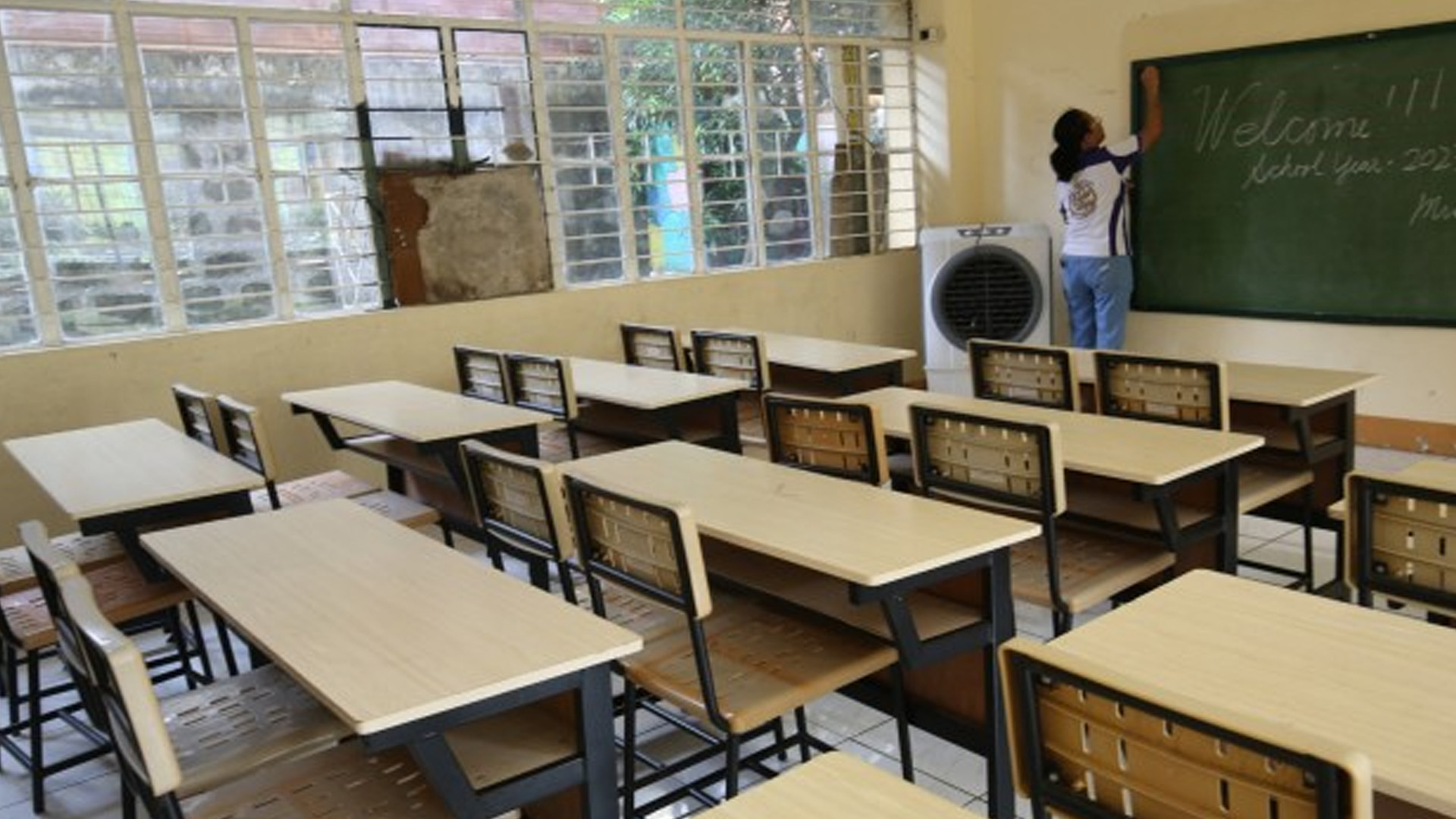






A party-list lawmaker on Friday sought the passage of a measure that aims to digitalize the country’s public school system.
House Bill 276, also known as the Institutionalization of Digital Technology in Public Education Act, seeks an initial PHP500 million to modernize public schools and empower both teachers and students to leverage technology as an essential educational tool.
In a news release, Bicol Saro Party-list Rep. Brian Raymund Yamsuan said digitalizing the Philippine public school system is crucial for improving education access, especially for marginalized communities.
“Institutionalizing the use of digital technology in our public school system will help promote inclusive learning as this will increase the access of marginalized communities to quality education via the Internet. Digitalization will also ensure that our students are future-ready and globally competitive,” Yamsuan said.
He cited a statement from the private think tank Stratbase Institute, which described the digital transformation of public schools as an “urgent necessity” to elevate student learning competencies.
“In the last pandemic, digital technology was used as a crisis management tool to ensure that most students were able to continue learning even when lockdowns and other health protocols were in place. But today, even without a crisis, digital technology has proven to be a must in facilitating learning inside and outside the classroom,” Yamsuan said.
He pointed out that during strong typhoons, floods, and other emergencies, private school students can easily shift to online classes, while public school students often rely on makeup sessions or printed modules.
Yamsuan also referred to the Department of Education’s (DepEd) revised guidelines on class suspensions, which allow only Kindergarten classes to be automatically suspended under Tropical Cyclone Wind Signal (TCWS) No. 1.
Classes from Kindergarten to Grade 10 are suspended only under TCWS No. 2, with students required to shift to online or modular distance learning, performance tasks, or makeup classes to ensure learning continuity.
Classes and work in all levels under TCWS No. 3 and above are automatically suspended.
However, most public schools still lack the digital infrastructure and resources needed to support online and modular learning during disruptions.
“These options should have covered the use of digital technology for all public schools to provide students with better learning outcomes. But unfortunately, not all our public schools have the necessary tools to shift to online learning,” Yamsuan said.
“The government needs to invest now in institutionalizing the digitalization of our public schools so that we can be prepared for whatever challenges our education system may face now, and in the future,” he added.
HB 276 mandates the DepEd to formulate a Digital Technology Road Map for Public Schools, in collaboration with the Department of Information and Communications Technology, Department of Science and Technology, and the Commission on Higher Education.
Yamsuan added that the proposed road map would ensure the continuous upgrading of outdated technology in public schools and provide training programs for both teachers and students to enhance their digital skills.
The bill also mandates a review of the road map every five years or as needed to keep up with technological advancements. (PNA)


